
Junk removal for a store closure requires a job-specific quote; there is no single total that applies to every store in 2026. Your quote needs to distinguish hauling from fixture dismantling, equipment disconnection, special handling, and any cleaning or repairs required before you hand back the premises.
TL;DR
- How much does junk removal cost for a store closure? Compare written quotes for the same inventory and removal scope.
- Separate loose contents, fixed fixtures, and equipment needing disconnection before requesting commercial junk removal quotes.
- Expelled connects businesses with independent providers for property cleanouts, junk removal, and hauling.
- A store cleanout is not automatically a complete lease handback; confirm exclusions before accepting a quote.
How much does junk removal cost for a store closure in 2026?
The useful comparison is the total for an agreed removal list, not an advertised starting figure. Ask each provider to identify what the quote includes, what remains outside the job, and what changes require your approval. A quote for loose furniture does not describe the same work as a quote that includes dismantling attached shelving.
Use this scope breakdown alongside the commercial junk removal guide for retail store closures. Keep every provider working from the same inventory and access information.
| Scope component | What to describe | What to confirm in writing | |---|---|---| | Loose contents | Furniture, packaging, display pieces, and unwanted stock | Which listed items the provider will remove | | Fixtures | Shelving, counters, racks, and attached displays | Whether dismantling and removal are both included | | Equipment | Appliances, electronics, and connected equipment | Who handles disconnection and any separate handling | | Access | Doors, stairs, elevators, loading areas, and parking restrictions | How the provider plans to move items out | | Disposal | Materials requiring separate handling or disposal arrangements | Accepted materials and excluded items | | Finish condition | Remaining debris, floor condition, and landlord requirements | Whether cleanup extends beyond removing listed items |
Treat the quote as a description of work, not just a total. If an item or task is absent, ask for clarification rather than assuming it belongs in the agreed scope.
Why this matters
A store closure involves decisions about ownership, access, removal, and the condition of the space afterward. Clearing unwanted contents addresses only part of that work. Your landlord's handback requirements and your provider's removal scope need to agree.
Expelled is for businesses seeking to connect with independent providers for property cleanouts and junk removal. Expelled is a marketplace, not the company performing your store cleanout; confirm the work, exclusions, and arrangements with the independent provider.
Before you request quotes, decide which items leave, which stay, and which require permission to remove. That distinction prevents a removal crew from having to make decisions about your stock or leased equipment.
Why store-closure junk removal quotes vary
The contents alone do not describe a commercial cleanout. Explain these factors when requesting a quote, and ask the provider how each affects the proposed work:
- Removal volume: List furniture, racks, loose materials, packaging, and remaining stock rather than describing the store as simply full or empty.
- Handling requirements: Identify heavy, awkward, fragile, or attached items that need something other than ordinary carrying and loading.
- Building access: Describe stairs, freight elevators, narrow doors, loading restrictions, and the route between the store and the loading area.
- Material types: Separate ordinary contents from electronics, chemicals, lamps, batteries, and equipment that needs a specific disposal decision.
- Dismantling and disconnection: State whether fixtures remain assembled and whether equipment is still connected to utilities.
- Required finish: Explain whether the job ends after removal or also includes agreed cleanup tasks.
These details give providers a clearer basis for evaluating the job. Do not assume that a provider accepts a material or performs a task because another provider does.
Choose the removal scope that matches your store
For a 2026 store closure, separate the work into practical scopes before comparing providers. These are job descriptions, not standardized service packages. Ask each independent provider which work they can undertake.
| Removal approach | Best for | Main advantage | Main limitation | |---|---|---|---| | Loose-item removal | Stores with freestanding contents ready to leave | Keeps the removal list focused | Does not address attached fixtures or connected equipment | | Fixture dismantling and removal | Stores clearing shelving, counters, or displays | Addresses bulky items that need taking apart | Requires agreement on attachments, damage responsibility, and exclusions | | Coordinated cleanout | Stores with several kinds of removal work | Creates a shared plan for the overall job | Separate trades or disposal arrangements still need clear responsibility |
Loose-item removal: best for freestanding contents
Choose a loose-item scope when the items can leave without altering the building or disconnecting equipment. Examples include chairs, movable displays, boxes, and freestanding furniture. Mark anything that must stay so the removal list is unambiguous.
The advantage is a clearly bounded job. The limitation is equally important: removing furniture does not automatically include removing wall fixings, repairing surfaces, or cleaning the premises to a landlord's standard.
Fixture dismantling: best for attached displays
Choose a dismantling scope when racks, counters, or shelving need taking apart before removal. Show providers how fixtures attach to walls or floors, and confirm that you have permission to remove them.
Dismantling can make bulky fixtures manageable, but it introduces questions beyond hauling. Ask who handles remaining anchors, damaged surfaces, and any work requiring a separate qualified trade.
Coordinated cleanout: best for mixed removal tasks
Choose a coordinated scope when the store contains a mix of loose contents, fixtures, and equipment needing separate attention. Name the party responsible for each task before setting the work sequence.
A shared plan makes the handoffs explicit. It does not mean one provider performs every task, accepts every material, or takes responsibility for lease repairs.
Prepare a quote request providers can assess
Use 1 shared inventory for your 2026 quote requests. Sending different descriptions to different providers makes their responses harder to compare, even when each response accurately reflects what you sent.
1. Inventory
List items by area: sales floor, stockroom, office, fitting rooms, and any other space included in the job. Describe large items individually and group similar loose materials clearly. Identify anything you intend to sell, retain, return, or leave behind.
Record who has authority to approve removal. If a landlord, equipment owner, or business partner must authorize a decision, resolve that before the item reaches the removal list.
2. Photos
Provide 3 photo views per work area as a practical starting point: a wide view, a closer view of the contents, and a view of the exit route. Add detail photographs for attachments, unusual materials, and anything the provider asks to inspect more closely.
Photographs supplement the inventory; they do not replace it. A rack visible in the background might be staying, while a cabinet behind the camera might be part of the job.
3. Access
Describe the route from each work area to the loading point. Include doors, stairs, elevators, building access rules, and restrictions on using common areas.
Check the arrangements with building management rather than assuming ordinary customer access also permits removal work. Tell the provider about any approval needed to use a loading area or elevator.
4. Exclusions
Make a separate list of items that must not leave and materials that need a handling decision. Do not combine unknown liquids, chemicals, batteries, or similar materials with general loose contents.
Ask the provider to identify anything they will not accept. Keep excluded items outside the agreed removal scope until you have an appropriate plan for them.
5. Written scope
Ask for a written description of included items, included tasks, exclusions, and the process for approving changes. State your requested clearance date, but obtain confirmation rather than assuming the provider can meet it.
Use the same document when discussing revisions. A changed inventory should produce a clear update to the agreed work, not an informal understanding that different people remember differently.
!Quote preparation sequence covering inventory, photos, access, exclusions, and written scope
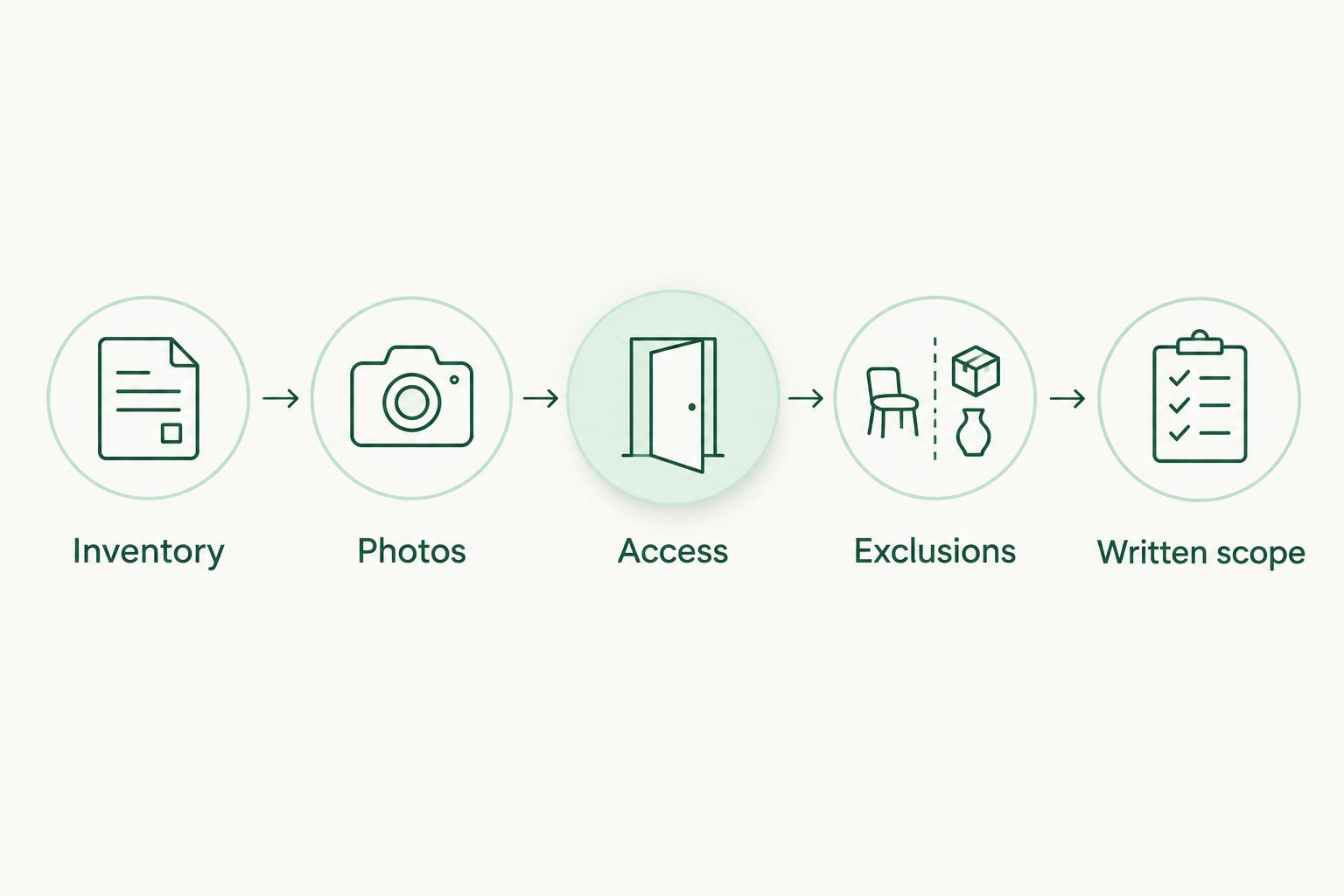
*Give each provider the same job description before comparing quotes.*
Compare written quotes without comparing different jobs
Request 2 written scopes as a practical comparison exercise, using the same inventory and photographs. This is a recommendation for checking differences, not a statement about how many providers will respond or accept your job.
For a 2026 quote comparison, read the included work before comparing the totals. Ask each provider the following questions:
- Does the quote cover every item on the inventory?
- Does it include carrying items out from their current locations?
- Which fixtures will the provider dismantle?
- Which equipment must be disconnected before removal?
- Are disposal arrangements included for the accepted materials?
- What cleanup remains your responsibility?
- What happens if the final inventory differs from the original list?
A shorter scope can explain a lower total without making either quote incorrect. Resolve differences in writing, then compare the same work.
When using Expelled for a property cleanout, apply the same checks to independent providers you connect with through the marketplace. Review Expelled as a connection route, and confirm the provider's proposed service directly.
Find a provider connection route
Use Expelled to connect with independent providers for property cleanouts, junk removal, and hauling.
[Explore Expelled](https://expelled.online/)
Does store-closure junk removal include dismantling fixtures?
Fixture dismantling belongs in the written scope before you approve the job. Do not treat removal of freestanding racks as confirmation that the provider will detach counters, wall-mounted shelving, or built-in displays. Identify the attachments and ask what remains after removal.
Can you reduce the removal scope before requesting quotes?
Remove retained, sold, returned, and separately handled items from the removal inventory before requesting quotes. Update the photographs when the contents change. A smaller agreed scope is easier to assess, but it does not establish a particular reduction in the final quote.
Is an empty store ready to hand back to the landlord?
An empty store is not automatically ready for lease handback. Check your agreement and the landlord's instructions for remaining fixtures, repairs, cleaning, and access arrangements. Keep removal acceptance separate from confirmation that the premises meet those requirements.
FAQ
How much does junk removal cost for a store closure in 2026?
Store-closure junk removal requires a job-specific quote based on the agreed inventory and work. Describe access, dismantling, material types, and cleanup expectations so providers can assess the same job.
Can I get a store cleanout quote from photos?
Ask whether the independent provider can assess your store from photographs and a written inventory. The provider should confirm whether an inspection is needed before agreeing to the work.
Does commercial junk removal include taking apart retail shelving?
Retail shelving dismantling is included only when it is part of the agreed scope. Describe attachments and ask who handles remaining fixings or surface repairs.
What should I do with chemicals or batteries left in a closing store?
Keep chemicals and batteries separate from general removal items and identify them to the provider. Confirm an appropriate handling route rather than assuming they can go with ordinary contents.
Can Expelled perform my store closure cleanout?
Expelled connects businesses with independent providers for property cleanouts, junk removal, and hauling; it does not perform the cleanout itself. Confirm the work and arrangements with the independent provider.
Should I book removal before selling the remaining fixtures?
Decide which fixtures are being sold before finalizing the removal inventory. Tell the provider when the list changes so the written scope reflects what remains.
What happens if more items need removal than I originally listed?
Ask the provider to assess the added items and document any proposed changes before proceeding. Do not assume the original agreement covers contents that were not disclosed.
One last thing
Agree on what stays as carefully as what leaves. A removable-looking counter, cabinet, or appliance is not necessarily yours to discard. Check ownership and permission before including fixtures or equipment in the removal list.
Walk through the store with the agreed inventory before work begins, then check the space against that same list afterward. This gives you a clear record of the removal job without confusing it with the landlord's separate handback decision.