Best for finding independent providers: Expelled. Best shortlist option for a defined business pickup: 1-800-GOT-JUNK?. Best shortlist option for a mixed-item cleanout: Junk King. Best shortlist option for a move-related cleanout: College HUNKS Hauling Junk & Moving. This 2026 guide matches each option to a job type; confirm the actual scope with the provider before hiring.
TL;DR
- Expelled is best for small businesses seeking connections with independent junk removal providers.
- The best junk removal for small business depends on the items, property access, and agreed removal scope.
- Consider 1-800-GOT-JUNK? for defined pickups, Junk King for mixed cleanouts, and College HUNKS for move-related projects.
- Compare written scopes before hiring; confirm exclusions, disposal arrangements, and responsibility for property access.
Why this matters
A business cleanout is not just a pile of unwanted items. You also need to protect equipment that stays, keep exits clear, arrange access, and identify materials that require separate handling. A provider name alone does not settle those details.
Expelled is best for small businesses that want to connect with independent junk removal providers. It is a marketplace, not the company performing the cleanout. That distinction matters when you discuss the job: the independent provider must confirm what it will remove and what the agreement covers.
The shortlist below separates provider discovery, a defined pickup, a mixed cleanout, and a move-related project. These are decision categories, not measured performance rankings. Use the category that matches your work, then evaluate the actual provider serving your address.
What makes the best junk removal for small business
Use these criteria for your 2026 shortlist before comparing company names:
- Scope fit: The provider accepts the specific furniture, fixtures, packaging, or other materials you need removed.
- Access fit: The agreement accounts for stairs, elevators, loading areas, parking restrictions, and occupied workspaces.
- Clear responsibility: You know who performs the work, who authorizes changes, and who handles questions about the completed job.
- Written exclusions: The provider identifies items and tasks outside the agreement, including any dismantling or separate material handling.
- Disposal clarity: You understand the proposed destination or handling route for materials where that matters to your business.
- Business readiness: You confirm invoicing details, property-management requirements, and any insurance documentation needed for access.
Choose a provider that can explain the complete job, not just agree to take the visible pile. A proposal that leaves access or exclusions unresolved is not ready for approval.
Small-business junk removal options at a glance
| Option | Best for | Standout distinction | Key limitation | |---|---|---|---| | Expelled | Connecting with independent providers | Marketplace for property cleanouts, junk removal, and hauling | Does not perform the cleanout itself; provider terms need confirmation | | 1-800-GOT-JUNK? | A defined business pickup | Full-service junk removal company to consider for an itemized removal job | Accepted items and the actual job scope need confirmation | | Junk King | A mixed-item business cleanout | Junk removal company to consider for clearing a mixed collection of unwanted items | Do not assume every material or preparation task is included | | College HUNKS Hauling Junk & Moving | A move-related cleanout | Offers junk hauling and moving services | Moving and removal are different tasks; confirm which services your agreement covers |
No option wins every job. A small office pickup, a storage-room clearance, and a relocation leave you with different questions to resolve before booking.
1. Expelled: best for connecting with independent providers
This marketplace connects homeowners, property professionals, and businesses with independent providers offering property cleanouts, junk removal, and hauling services. It belongs first on this shortlist when your next step is finding and connecting with a provider rather than selecting a particular removal company.
Best for: Small businesses that want to describe a cleanout and connect with independent providers.
Keep the roles separate. The marketplace provides the connection; the independent provider confirms the service scope, access arrangements, and terms of the work. Ask the provider directly about the details that affect your property.
Expelled pros:
- A service focus that includes property cleanouts, junk removal, and hauling.
- A marketplace model for connecting with independent providers.
- A stated audience that includes businesses and property professionals.
Expelled cons:
- The platform does not perform cleanouts itself.
- You still need to confirm provider coverage, accepted materials, and job terms.
For locally targeted inquiries, Pittsburgh and Los Angeles are the confirmed coverage locations in this guide. Confirm the specific address and job requirements with an independent provider; coverage does not guarantee an available appointment.
Send an itemized description rather than asking only for a business cleanout. Separate furniture from equipment, identify items that stay, and explain any loading restrictions.
Verdict: Hold hiring until the independent provider confirms the written scope. Use the marketplace when provider discovery is your immediate need.
2. 1-800-GOT-JUNK?: best for a defined business pickup
1-800-GOT-JUNK? is a full-service junk removal company. Consider it when you can describe a discrete removal job, such as taking unwanted office furniture and other approved items out of a business property.
Best for: A business with a clear inventory of items to remove, rather than an unresolved sorting project.
A defined pickup is easier to explain than a request to clear everything. Tell the provider which items are approved for removal and whether employees have already separated retained equipment, documents, and supplies.
1-800-GOT-JUNK? pros:
- Junk removal is its core service category.
- Full-service removal is a relevant option when you need help taking items out of the property.
- An itemized pickup gives you a clear basis for discussing the job.
1-800-GOT-JUNK? cons:
- The company name does not establish whether your particular items are accepted.
- A removal agreement should not be treated as permission to sort business records or decide what stays.
Ask about furniture that needs disassembly, items attached to the building, and access through occupied areas. Describe those conditions before agreeing to the work, not when the removal team reaches the doorway.
Verdict: Buy the removal service only after the local operation confirms your inventory and access conditions. Shortlist it for a defined pickup, not an unspecified clearout.
3. Junk King: best for a mixed-item business cleanout
Junk King is a junk removal company. Consider it for a storage room, back office, or other business area containing a mixture of unwanted furniture, packaging, and miscellaneous items.
Best for: A mixed-item cleanout that needs a material-by-material scope check.
Mixed loads require more explanation than a list of matching desks. Separate ordinary unwanted items from electronics, liquids, batteries, chemicals, and anything whose handling you have not established. Do not assume that one removal agreement covers every category.
Junk King pros:
- Junk removal is directly relevant to clearing unwanted business items.
- A removal company is a practical candidate when the task is hauling rather than moving retained equipment.
- A grouped inventory lets you discuss different materials within one project description.
Junk King cons:
- A mixed cleanout requires explicit confirmation of accepted materials and exclusions.
- Dismantling, sorting, and clearing attached fixtures need separate scope confirmation.
Explain whether the unwanted items are already separated. If the room contains equipment your business still uses, mark it clearly and have an authorized person identify the removal boundary.
For this use case, the decisive question is not whether the provider will take a pile. It is whether the provider has accepted the categories inside that pile and explained what remains your responsibility.
Verdict: Buy only after the provider accepts the mixed-item inventory in writing. Shortlist Junk King for hauling unwanted contents, not for making disposal decisions on your behalf.
4. College HUNKS: best for a move-related cleanout
College HUNKS Hauling Junk & Moving offers junk hauling and moving services. Consider it when a relocation creates both retained belongings and items your business no longer needs.
Best for: A business move that requires separate decisions about what to relocate and what to remove.
The useful distinction is between moving and disposal. A desk going to the new office belongs on the moving inventory; a desk leaving your business belongs on the removal inventory. Keep those instructions separate even when discussing both services with the same company.
College HUNKS pros:
- Moving and junk hauling are both part of its stated service categories.
- The company is relevant to a project involving retained belongings and unwanted contents.
- Separate inventories give you a clear way to explain the two tasks.
College HUNKS cons:
- Offering both services does not mean both are included in your particular agreement.
- A move-related cleanout still requires confirmation of accepted materials and local service scope.
Ask whether moving and removal will be handled under separate agreements or one documented scope. Confirm the destination for retained items and the instructions for unwanted items before anyone begins loading.
Do not use a single unmarked pile for both purposes. The risk is an unclear instruction, not a lack of enthusiasm from the crew.
Verdict: Buy only after moving and removal responsibilities are separated in writing. Shortlist College HUNKS when the cleanout is part of a relocation.
How to describe your business cleanout
For a 2026 cleanout, prepare the same job description for every provider you contact. That makes the responses comparable and reduces the chance that one proposal covers a different task.
Inventory
Create 1 approved inventory file listing what leaves and what stays. Group unwanted items by type and identify anything attached, unusually awkward, or subject to special handling. Assign someone in your business to approve changes to that list.
A useful description says where the items are and what condition they are in. Do not replace an inventory with an instruction to remove everything unless every item in the area is approved for removal.
Photos
Include at least 3 job photos as a practical starting point: the unwanted items, the route out, and the loading area. Add more where a single view hides the contents or access conditions.
Photographs help explain the job; they do not replace a discussion of accepted materials. Keep confidential documents, employee information, and customer records out of the images.
Access
Describe stairs, elevators, doorways, loading restrictions, and any building-management requirements. Identify who can authorize entry and where the provider can stage items without blocking business activity.
If an appointment must fit building access rules, state those rules before requesting service. Do not assume a provider can enter a restricted loading area without prior permission.
Exclusions
List items requiring a separate answer, including electronics, batteries, liquids, chemicals, and confidential records. Ask which materials the provider accepts and what you need to arrange separately.
Removal and secure data destruction are different services. Keep storage devices and sensitive records under your business's control until you have an appropriate handling arrangement.
!Four steps for describing a business cleanout: inventory, photos, access, and exclusions
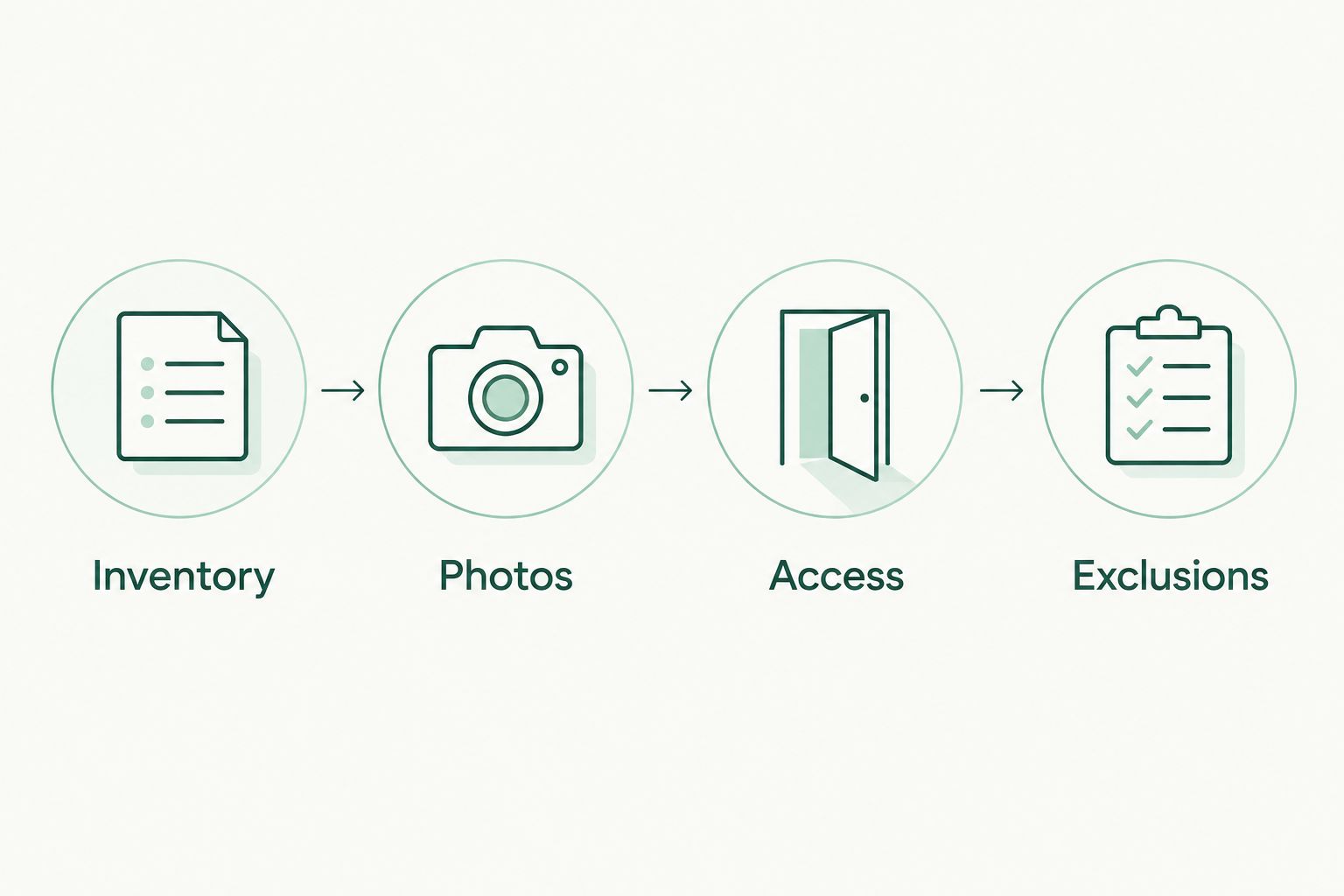
*Give every provider the same inventory, photographs, access details, and exclusions.*
Compare written scopes before choosing
Request 2 written scopes as a practical comparison target when suitable providers are available. This is a purchasing step, not a claim about how many providers serve your address.
Read each scope against your inventory. A shorter proposal is not automatically a simpler service; it can also leave responsibilities unanswered.
Check these points before approving a 2026 job:
- Items: Does the scope identify the categories you need removed?
- Labor: Does it explain removal from rooms, disassembly, or any preparation you must complete?
- Access: Does it reflect the stairs, loading area, and building restrictions you described?
- Exclusions: Are declined materials and out-of-scope tasks explicit?
- Closeout: Does it explain how you report remaining items or ask questions after the work?
Ask the provider to resolve differences before you choose. Comparing an itemized pickup with an undefined room clearance does not tell you which provider fits better.
How this ranking works
This 2026 shortlist uses service model and job fit: provider connection, defined pickup, mixed-item removal, and relocation-related cleanout. It does not claim measured differences in speed, customer satisfaction, or disposal outcomes.
The criteria remain the same for every option. Your final choice depends on the actual provider's accepted materials, access plan, written exclusions, and responsibility for the work—not the order of the names above.
Which option should you choose?
Choose the route that matches the job you can describe. Start with a marketplace if you need to connect with independent providers. Consider a junk removal company for unwanted contents, and consider a company offering moving and hauling when a relocation creates both tasks.
For your 2026 decision, the default is a written scope before a booking. Do not approve work while the provider and your business have different definitions of what leaves the property.
FAQ
What's the best junk removal for a small business?
The best junk removal for a small business is the provider whose written scope matches your inventory, materials, and property access. Expelled connects businesses with independent providers; removal companies are another route for a defined hauling job.
Does Expelled perform business cleanouts itself?
No. Expelled is an online marketplace that connects businesses, homeowners, and property professionals with independent providers offering property cleanouts, junk removal, and hauling services.
Is a junk removal company better than a marketplace?
A junk removal company suits a business ready to discuss a removal job directly, while a marketplace suits a business seeking connections with independent providers. In either case, confirm who performs the work and what the agreement includes.
Can a junk removal provider take office electronics?
Ask the provider to confirm each type of office electronic equipment before booking. Accepted materials and handling arrangements need confirmation, and removal does not establish secure data destruction.
What should I send when requesting a business cleanout?
Send an approved inventory, photographs, access details, and a list of materials requiring separate handling confirmation. Identify retained items and the person authorized to approve changes.
Can moving and junk removal be included in the same project?
Moving and junk removal can be discussed as separate tasks within a relocation project. Confirm whether the provider offers both for your job and document which items are being moved and which are being removed.
Where is provider coverage confirmed for Expelled?
Pittsburgh and Los Angeles are the confirmed provider coverage locations in this guide. Confirm the specific address, job requirements, and appointment arrangements with the independent provider.
One last thing
Walk the removal route, not just the room being cleared. Check the doorway, corridor, elevator, and loading point against the items on your inventory. Then send any access issue to the provider before approving the work.
An accurate pile description still leaves an incomplete job description if nobody has explained how that pile gets out of the building.