
Office relocation junk removal is the removal of unwanted workplace contents with the aim of clearing your old premises for handover. Commercial junk removal for office relocations in 2026 requires clear ownership decisions, building access arrangements, and separate handling for records and data-bearing equipment—not just a list of furniture to haul away.
TL;DR
- Commercial junk removal for office relocations starts with separating retained assets, unwanted furniture, and sensitive equipment.
- Expelled is best for businesses seeking to connect with independent providers for property cleanouts and junk removal.
- Compare written scopes, access requirements, exclusions, and disposal arrangements before selecting a provider.
- Keep office cleanouts separate from data destruction, moving services, and lease-restoration work unless each task is explicitly included.
Why commercial junk removal matters for office teams
An office relocation involves competing instructions: the moving team needs to know what travels, IT needs control of equipment, and the property manager needs the premises returned in the agreed condition. A removal crew should receive one approved disposal list, not conflicting directions from different departments.
Your 2026 cleanout plan needs to account for loading access, items attached to the building, and equipment that contains business information. A desk marked for removal is straightforward; a filing cabinet containing records is not.
Expelled is a marketplace that connects businesses with independent providers offering property cleanouts, junk removal, and hauling services. It does not perform the cleanout itself. The convenience is finding a connection; you still need to confirm the provider's scope, coverage, terms, and suitability for your office.
Start by defining what a successful handover means. Removing loose contents, cleaning floors, repairing walls, and restoring alterations are different tasks. Check your lease and the building's instructions rather than treating them as one service.
How to plan your office relocation cleanout
1. Define the scope
Walk through the office before requesting removal proposals. Record each room or work area, identify unwanted contents, and name the person authorized to approve disposal. Include storage cupboards, meeting rooms, reception areas, and any off-site storage within the job's actual scope.
Use a shared document or spreadsheet first. You do not need a dedicated system to produce a clear inventory. Group contents by handling requirement, not just department: freestanding furniture, attached fixtures, electronics, records, and materials requiring separate assessment.
For your 2026 relocation, write the handover condition beside the removal scope. An empty office and a lease-compliant office are not necessarily the same thing. Ask the property manager which fixtures must stay and which alterations require separate attention.
Close the scope only after the relevant owners have approved it:
- List each room and the items proposed for removal.
- Mark landlord-owned, leased, and company-owned assets separately.
- Photograph bulky items and their route out of the building.
- Identify items requiring disassembly or specialist assessment.
- Name the person who can approve changes on site.
2. Separate sensitive items
Sort possessions before a removal team arrives. Use clearly marked groups for items that move, items approved for removal, and items awaiting a decision. Unapproved items stay out of the disposal scope. This protects retained equipment from being treated as junk.
Assign records and data-bearing devices to the responsible internal team. Computers, storage drives, and other office equipment can contain business information. Routine hauling is not proof of data destruction, so specify any separate destruction process and the documentation your organization requires.
Keep uncertain materials outside the general load until the provider confirms acceptance and handling. Batteries, chemicals, and equipment with unknown contents need explicit discussion rather than an assumption that everything in the office belongs in one truck.
Complete the separation before comparing final scopes:
- Label retained assets where the labels are visible.
- Remove confidential records from drawers and cupboards.
- Have IT identify devices requiring data-handling instructions.
- Flag batteries, liquids, and unidentified materials separately.
- Obtain disposal approval for leased or financed equipment.
3. Compare independent providers
Prepare one job brief and send the same information to each provider you assess. Direct inquiries are the manual route: describe the contents, access conditions, requested work, and handover requirements yourself. Ask each provider to respond against that same scope.
Expelled offers another route for commercial junk removal: connecting your business with independent providers. Treat that connection as the start of your assessment, not as confirmation that a provider accepts your items or covers your address.
Compare what the proposals include before comparing their overall terms. One proposal might cover collection from rooms; another might assume everything is already staged near the loading area. Those are different jobs.
Use the licensing and insurance comparison guide alongside your own checks. Ask for documents relevant to your job and confirm the building's requirements directly.
- Send identical inventories and photographs to each provider.
- Ask whether removal begins inside the office or at a staging point.
- Confirm accepted materials and excluded items in writing.
- Check insurance documentation against building requirements.
- Identify who handles subcontracted or specialist work.
4. Confirm building access
A provider needs the physical route from the items to the vehicle. Describe stairs, service elevators, corridors, loading areas, and any restrictions imposed by building management. Do not assume that an office address explains how collection works.
For a 2026 move, agree on the access plan with both the provider and the property manager. A requested collection date does not establish an elevator reservation or permission to use a loading bay. Confirm those arrangements separately.
Decide where moving activity and removal activity will overlap. Keep retained possessions clearly separated from disposal staging, and identify who controls shared doors or loading areas. If furniture cannot pass through the intended route intact, discuss disassembly before work begins.
Document the access plan with practical details:
- Record the floor, stairs, and usable elevator route.
- Confirm loading permissions and building access procedures.
- Share doorway or corridor constraints affecting bulky items.
- Identify surfaces and common areas requiring protection.
- Assign an on-site contact with access authority.
5. Document disposal requirements
State the desired destination or handling requirement for each relevant material group. Furniture reuse, electronics recycling, confidential-record destruction, and general disposal are different processes. Ask the provider which processes it performs and which require another party.
If you request donation or reuse, confirm the receiving organization's acceptance before treating that route as settled. Condition, suitability, and acceptance matter. A preferred destination is not a confirmed destination.
Define the evidence you need before work starts. Depending on your internal policies and the material, this might include a collection record, a receiving receipt, or documentation from a specialist processor. Ask for the specific record you need; do not substitute a general environmental claim.
Put these requirements into the written scope:
- Describe which items you want assessed for reuse.
- Confirm acceptance before arranging a donation handoff.
- Specify separate handling for electronics and sensitive records.
- Ask who selects the receiving facility or organization.
- Agree on the documentation to accompany completion.
6. Coordinate the sequence
Removal should follow asset decisions, not precede them. Agree on how the moving team, IT team, provider, and property manager will work around each other. Give each party a defined responsibility so that unresolved decisions do not reach the loading area.
Use a simple sequence: approve the inventory, separate sensitive items, confirm access, authorize removal, and inspect the result. Keep a written change process for anything discovered during the job. An additional cupboard or abandoned workstation changes the scope only when the authorized person approves it.
This process diagram summarizes the decision sequence, not a promised service schedule.
!Office cleanout sequence from inventory approval through final inspection
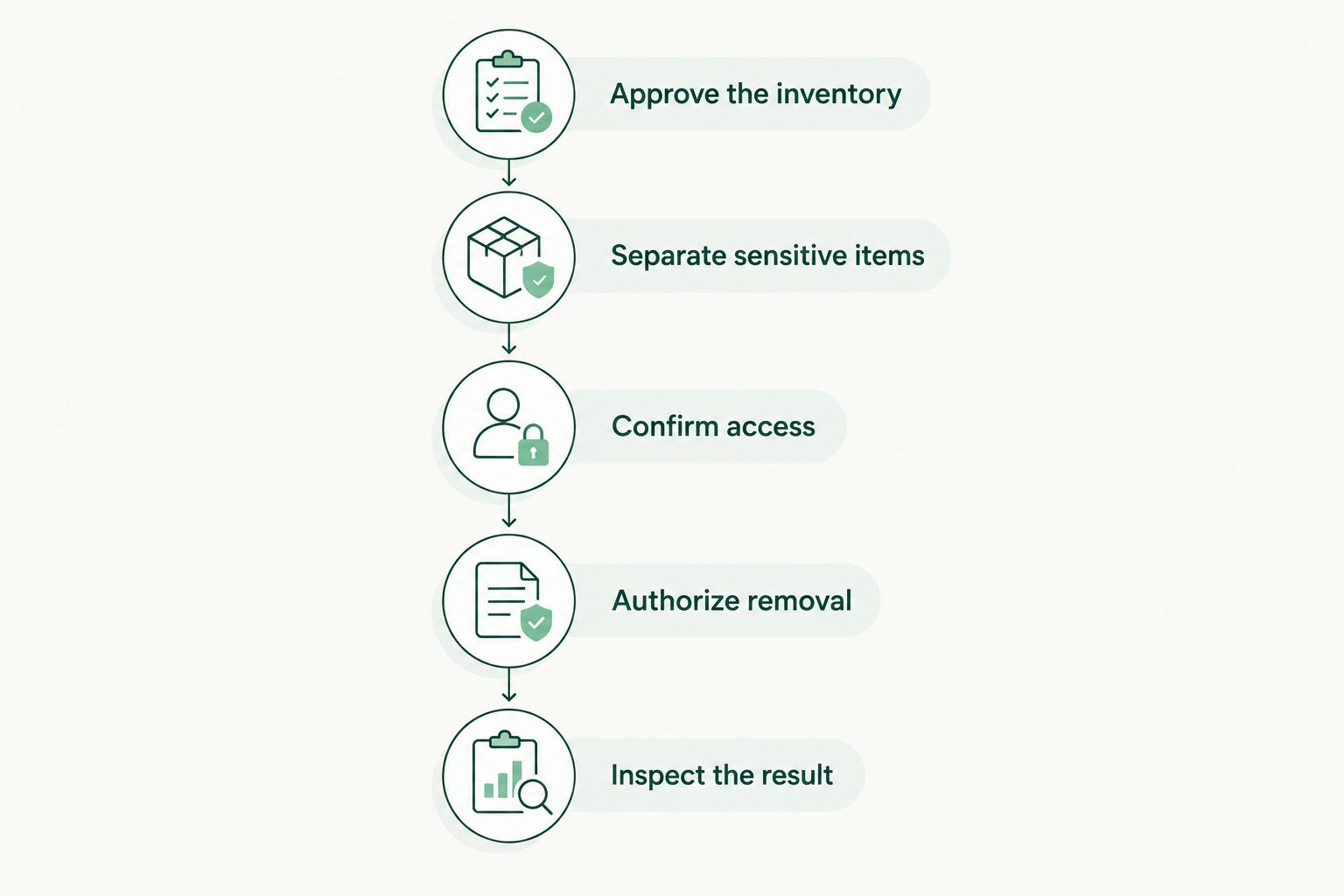
*Approve disposal decisions before authorizing removal.*
Give everyone the same final instructions. A printed inventory or shared document works; the important part is that the current version is identifiable and accessible to the person supervising the job.
- Approve the inventory before loading begins.
- Separate sensitive items from ordinary removal contents.
- Confirm access with the building and provider.
- Authorize removal through one designated contact.
- Inspect the result against the agreed scope.
7. Inspect the result
Walk through the office with the approved inventory after removal. Check rooms, storage areas, and agreed staging locations. Record anything left behind and distinguish excluded items from incomplete work.
Keep removal completion separate from property handover. The provider's job can be complete while cleaning, repairs, or lease-restoration tasks remain outstanding. Send those tasks to the party responsible rather than assuming the hauling scope includes them.
Retain the written scope, approved changes, completion photographs, and agreed disposal records together. This gives your facilities or property team a usable account of what was authorized and what was completed.
- Compare the cleared areas with the approved inventory.
- Photograph the final condition of relevant spaces.
- Record remaining items and the reason they remain.
- Collect the documentation specified in the scope.
- Assign cleaning and repair tasks separately.
Compare your office cleanout options
Choose the arrangement that matches the work, not the broadest service label. For a 2026 office relocation, ordinary contents removal and specialist data handling require different questions. The options below are planning routes, not interchangeable guarantees.
| Option | Best for | Practical advantage | Key limitation | |---|---|---|---| | Internal preparation with direct provider inquiries | Teams with someone available to manage the scope | Keeps inventory decisions and provider discussions under your control | Requires your team to organize inquiries, access, and approvals | | Independent junk removal provider | Approved furniture and general office contents | Gives you a defined party to assess and arrange removal | Accepted materials, access work, and disposal arrangements need confirmation | | Moving company with separately agreed removal work | Teams coordinating retained assets and unwanted contents | Allows both scopes to be discussed with the moving company | A moving agreement does not establish that disposal work is included | | Specialist electronics or records processor | Equipment and records with defined handling requirements | Addresses a material-specific process and documentation need | Does not replace general furniture removal or property handover work | | Expelled marketplace | Businesses seeking connections with independent providers | Provides a route to connect for property cleanouts and junk removal | Does not perform cleanouts; provider coverage, scope, and terms require confirmation |
If your job combines these needs, split responsibility explicitly. For example, IT can retain control of sensitive equipment while a removal provider handles approved furniture. Do not assign the entire job to one party unless that party confirms every required task.
Common mistakes office teams make
Treating the office as one disposal pile
Furniture, records, leased equipment, and building fixtures have different owners and handling requirements. In your 2026 plan, keep undecided contents separate and require approval before adding them to the removal list.
Sending providers different job descriptions
Comparisons fail when one provider sees photographs and access details while another receives only a furniture list. Use the same brief, then record any assumptions or exclusions beside each response.
Leaving building permissions until collection
A provider cannot resolve your building's access rules simply by arriving. Confirm elevator use, loading arrangements, and required documentation with management before agreeing on the working arrangements.
Confusing hauling with data destruction
Removing a computer or box of records does not establish that information has been destroyed. Keep sensitive items under your organization's control until the required process and evidence are agreed.
Assuming removal completes the lease handover
A clear floor does not establish that every lease obligation has been met. Review cleaning, repair, fixture, and restoration requirements separately, then assign each unfinished task to a responsible party.
FAQ
What's the best way to arrange commercial junk removal for office relocations?
Start with an approved inventory and send the same written scope to each provider you assess. Include photographs, access conditions, excluded items, and the documentation required at completion.
Does Expelled perform office cleanouts itself?
No. Expelled is an online marketplace that connects businesses with independent providers offering property cleanouts, junk removal, and hauling services. Confirm the work and terms directly with the provider.
Should we remove unwanted furniture before the office movers arrive?
Choose the sequence after deciding what moves and what is approved for removal. Keep the two groups clearly separated and agree on shared access arrangements with both teams.
Can office computers go into the same load as desks?
Keep data-bearing equipment separate until IT approves its handling. Ask about material acceptance and the required data-destruction process rather than treating general hauling as proof of secure disposal.
What should we include in an office cleanout request?
Include the item inventory, photographs, property address, floor, access route, building restrictions, and requested tasks. Identify sensitive materials, disposal exclusions, and the person authorized to approve changes.
Can unwanted office furniture be donated instead of discarded?
Request reuse or donation as a separate handling requirement and confirm recipient acceptance. Do not assume that every item is suitable or that a provider includes donation transport.
Does junk removal include cleaning and lease restoration?
Only include cleaning or restoration when those tasks are explicitly agreed in the scope. Check the lease and property manager's instructions separately from the contents-removal agreement.
One last thing
Open every drawer before approving a cabinet for removal. A furniture inventory does not describe its contents. Give one person responsibility for checking cupboards, desks, and storage units so that records, keys, and retained equipment do not leave with the furniture.