
Yes, you can get a junk removal quote without an in-home visit if the independent provider accepts photos, video, or a written inventory for assessment. Whether that quote is final depends on the provider’s terms and how completely your submission describes the job. For a 2026 request, confirm what still requires an on-site check before you authorize removal.
TL;DR
- Can I get a junk removal quote without an in-home visit? Yes, when the independent provider accepts remote assessment.
- Photos need to show both the items and the route used to carry them out.
- A remote estimate is not automatically a fixed quote; confirm the provider’s written terms.
- Expelled connects property cleanout customers with independent providers; it does not perform cleanouts itself.
Why this matters
A remote quote is only useful when you understand what it covers. A photograph of a sofa does not show a narrow stairwell, and a room overview does not reveal everything behind stacked boxes. Describe both the removal items and the work needed to reach them.
Separate assessment from scheduling. The questions in how long it takes to get a junk removal quote are different from whether a provider can perform the job on your requested date.
Can I get a junk removal quote without an in-home visit?
Yes, if the provider agrees to assess your job remotely. Ask which submission method the provider accepts before taking detailed photographs or arranging a video call. Use the following sequence for your 2026 quote request.
1. Make an inventory
List everything you want removed, grouped by room or location. Separate furniture, appliances, bagged contents, loose materials, and anything that needs special discussion.
Name the items rather than describing the job as a small load or a full room. Those descriptions leave the provider to guess what you mean. Mark anything that must remain so the removal boundary is explicit.
2. Photograph the items
Use 3 photo views as a practical starting point: a wide view, a closer item view, and an access-route view. This is a submission checklist, not a provider requirement; ask whether additional images are needed.
Show the entire pile without concealing its depth. For a bulky object, provide 2 measurements where relevant: its width and the narrowest doorway along the exit route. State the units and identify what each measurement describes.
3. Describe access
Explain where the items sit and how a crew would carry them outside. Include stairs, elevator access, locked gates, parking restrictions, and the route between the property and the loading area.
Do not assume that an exterior photograph explains interior access. If an appliance is downstairs, say so even when the driveway is easy to reach. Ask whether the provider needs further measurements or an on-site assessment.
4. Request written terms
Ask whether the response is a preliminary estimate, a conditional quote, or an amount the provider commits to for the described scope. Do not treat those labels as interchangeable.
Request written confirmation of included work, exclusions, and the circumstances that would change the quote. Ask what happens if the provider arrives and finds a different scope, including whether you can decline before loading begins.
5. Confirm before loading
Review the inventory with the provider before any items leave the property. Point out additions, access changes, or items that were not visible in the original submission.
Approve changes before work starts, not after the truck is loaded. Keep the accepted scope and any revision in the same written conversation so both parties can refer to the agreement.
!Remote quote process from making an inventory through confirming the scope before loading
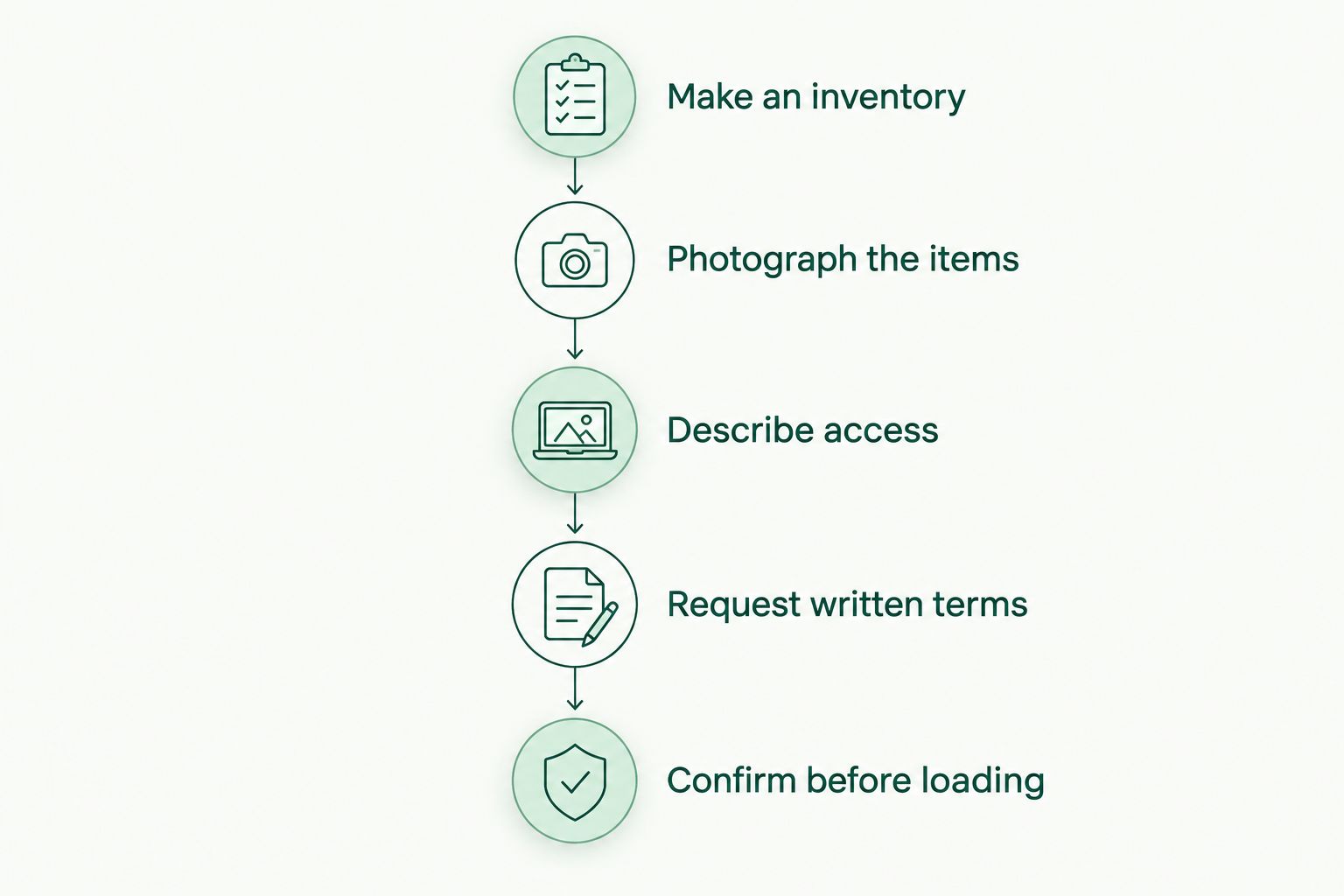
*Document the job first, then confirm the terms before removal begins.*
Which remote quote method fits your job?
Choose the method that lets you explain the job accurately, then confirm that the provider accepts it. These are assessment approaches to discuss, not services guaranteed by every provider.
| Assessment method | Best for | Practical advantage | Limitation | |---|---|---|---| | Photos and inventory | Clearly visible, itemized loads | Creates a record you can send consistently | Hidden contents and tight access need separate explanation | | Live video walkthrough | Items spread across several spaces | Lets you answer questions while showing the property | Camera coverage still leaves unseen areas | | Written inventory | Preparing an initial request | Organizes items and exclusions | Does not show size, condition, or access visually | | In-person assessment | Jobs that cannot be documented clearly | Lets the provider inspect the physical scope | Requires arranging access to the property |
Photos and inventory: best for visible, itemized loads
A photo submission gives you a record of what you asked the provider to assess. Pair each image with a short description, particularly when the photograph contains belongings that must stay.
The limitation is perspective. A close-up can hide the size of a pile, while a wide shot can make individual objects difficult to identify. Use both rather than expecting one image to explain everything.
Live video: best for connected spaces
Ask about a video walkthrough when the job extends through several rooms or access points. Start with the removal items, then show the route outside so the provider can ask specific questions.
Video does not replace a written scope. Send a summary afterward that lists the agreed items, exclusions, and unresolved questions. Do not assume the provider recorded the call.
Written inventory: best for an initial request
A written list helps you prepare before sharing images or arranging access. It also gives different providers the same starting description.
Its weakness is missing visual context. If the provider asks for pictures or an inspection, a detailed list alone does not establish that the job can be quoted remotely.
Why remote junk removal quotes vary
Differences between responses deserve questions, not assumptions. Check whether each provider assessed the same information before comparing the offers.
- Item scope: Specify loose contents, separate piles, and belongings hidden behind larger objects.
- Access route: Describe stairs, doorways, elevators, gates, and the loading location.
- Preparation work: Identify anything requiring disassembly, disconnection, sorting, or movement before loading, and ask who handles it.
- Material acceptance: List paint, chemicals, damaged containers, or unidentified materials separately for confirmation.
- Quote conditions: Check whether the response depends on an inspection or unchanged job details.
- Property requirements: Explain access authorization, building rules, and any required documentation.
These are disclosure points for a 2026 request, not a universal pricing formula. Each independent provider must explain its own assessment and terms.
How do I compare quotes without comparing different jobs?
Send the same inventory and photographs to every provider you contact. If you update the scope, send that update to everyone still under consideration. Otherwise, the responses do not describe the same work.
Use a short comparison sheet with fields for included items, access assumptions, exclusions, required preparation, and approval conditions. Record unanswered questions instead of filling gaps with assumptions. An apparently simpler offer is not necessarily a more complete one.
Expelled is a junk removal marketplace for homeowners, property professionals, and businesses seeking connections with independent providers. You can use Expelled to connect, but confirm remote-assessment methods and quote terms directly with the provider. The marketplace does not perform the cleanout or guarantee that a provider will quote without visiting.
Does a remote quote mean the provider can come sooner?
No. A remote assessment removes the need for an assessment visit only when the provider accepts that process; it does not establish a removal appointment. Discuss your requested date separately from the scope and quote.
When comparing fast junk removal options, distinguish the time needed to assess a job from the time needed to arrange removal. A quick reply does not confirm a crew, access arrangements, or acceptance of every item.
For a 2026 move-out or property handover, tell the provider your actual deadline and ask what remains unconfirmed. Do not describe an appointment as booked until the provider has confirmed it. Keep building access, occupant coordination, and removal authorization separate from the quote request so none is mistaken for approval of the others.
What should I leave out of quote photos?
Show the work, not unrelated personal information. Move financial documents, identification, medication labels, and visible access codes out of the frame when you can do so safely. Avoid including occupants or neighboring interiors.
Keep the images useful after removing those details. Do not crop out stairs or edit away objects that affect access. If a sensitive area also contains removal items, describe the concern and ask the provider how to document it without exposing private information.
For a managed property, confirm permission to enter and photograph the space before arranging a walkthrough. A request for a quote is not a substitute for the authorization needed to access the property or dispose of its contents.
What should I send in my first message?
Use one written inventory rather than scattering essential details across unrelated messages. Include the following fields in your 2026 request, and keep the same version for each provider:
- Job location: General location and property type; confirm when the exact address is needed.
- Removal scope: Items, quantities, locations, and anything that must stay.
- Access details: Floor, stairs, elevator, doorways, gates, and loading arrangements.
- Preparation needs: Disconnection, disassembly, sorting, or other work requiring discussion.
- Supporting images: Wide views, item details, and the route outside.
- Requested date: Your preferred date and any property deadline, without assuming acceptance.
- Assessment question: Whether the provider can quote remotely and what would require a visit.
Ask the provider to identify anything missing before issuing the quote. A precise follow-up question is more useful than an unexplained amount. Save the response with the inventory so you can check the accepted scope on removal day.
Is a photo quote final?
A photo quote is final only if the provider’s written terms establish that commitment for the described job. The use of photographs alone does not tell you whether the response is preliminary or conditional.
Ask which facts would trigger reassessment and when you would approve a change. Get that answer before arranging removal, not while items are being carried out.
When should I agree to an in-person assessment?
Agree to an inspection when you cannot show the contents, access, or preparation work clearly enough for the provider to assess remotely. Do not move unstable piles or enter unsafe spaces simply to avoid a visit.
For Expelled property cleanout connections, the independent provider determines whether the available information supports a remote quote. Ask what the inspection needs to resolve so the visit has a defined purpose.
FAQ
Can I get a junk removal quote by sending pictures?
Yes, if the independent provider accepts photo-based assessment. Send an inventory and access details with the pictures, then ask whether the response is final or conditional.
Do I have to be home to get a junk removal quote?
You do not need an in-home assessment when the provider agrees to assess the job remotely. If a visit is required, confirm who must attend and who can authorize property access.
Is a video walkthrough enough for a whole-house cleanout quote?
A video walkthrough is enough only when the provider accepts it as sufficient for that job. Hidden contents, inaccessible rooms, or unresolved access questions need further assessment.
Can a junk removal quote change when the provider arrives?
A quote can change under the conditions stated in the provider’s agreement. Confirm those conditions and require approval of any revision before loading begins.
Should I move everything outside before asking for a quote?
Do not move everything outside solely to request a quote. Describe where the items are now and ask whether moving them would change the proposed scope; leave unsafe or unstable items alone.
Does a remote quote confirm my pickup date?
No, a remote quote does not itself confirm a pickup date. Ask the provider to confirm scheduling separately from the assessment and quote.
Does Expelled send its own crew to inspect my junk?
No, Expelled is an online marketplace connecting customers with independent providers for property cleanouts, junk removal, and hauling. Discuss inspection arrangements directly with the independent provider.
One last thing
Photograph what must stay as carefully as what must go. A marked keep-area and a written exclusion list help define the removal boundary, especially when you will not be present. Before approving the job, ask the provider to repeat back both the removal scope and the exclusions.