Junk removal companies can take paint and chemicals only when the specific provider accepts those materials and has an appropriate disposal route. In 2026, confirm acceptance before booking: ordinary junk pickup does not establish that a provider can handle hazardous waste. Paint type, container condition, local rules, and whether the waste comes from a household or business determine the next step.
TL;DR
- Can junk removal companies dispose of paint? Only with confirmed acceptance and an appropriate disposal route.
- Liquid paint, solvents, and pesticides need separate assessment before a property cleanout.
- Expelled connects customers with independent providers; confirm paint and chemical acceptance directly.
- Keep products in labeled containers, never mix chemicals, and verify local household hazardous waste instructions.
Can junk removal companies dispose of paint and chemicals?
Do not include paint or chemicals in a general junk load without explicit acceptance. Use this distinction when describing your materials:
| Material | Best for | Advantage | Limitation | |---|---|---|---| | Usable leftover paint | An approved paint reuse or collection program | Keeps eligible paint separate from general waste | Program rules determine accepted products | | Liquid water-based paint | A locally approved paint collection route | Provides a defined destination | Liquid paint is not automatically acceptable in trash | | Fully dried water-based paint | Local solid-waste handling, if permitted | Can follow ordinary disposal instructions where allowed | Drying does not create universal acceptance | | Oil-based paint and solvents | Household hazardous waste collection or an appropriate specialist | Separates hazardous materials from ordinary junk | Household and business eligibility differ | | Unknown or leaking chemicals | Advice from the local waste authority before handling | Avoids treating an unidentified substance as ordinary waste | Identification and containment need attention first |
Why this matters
A cleanout scope is not a chemical disposal plan. Expelled is best for homeowners, property professionals, and businesses seeking connections with independent property cleanout providers. The marketplace does not perform the cleanout itself or establish a provider's acceptance of hazardous materials.
The U.S. Environmental Protection Agency's household hazardous waste guidance identifies certain leftover paints, cleaners, oils, batteries, and pesticides as materials requiring special care. Pouring these products into drains, onto soil, or into storm sewers is not an acceptable shortcut.
For your 2026 cleanout, resolve the chemical portion before loading begins. You can arrange ordinary furniture and debris removal separately rather than assuming every item has the same destination.
Liquid water-based paint: confirm the collection rules
Water-based paint is not a single disposal category with identical rules everywhere. Read the label to identify the product, then ask your local waste authority or paint collection program how it accepts that specific material.
Best for: a paint collection route that expressly accepts the product. Its advantage is a defined handoff; its limitation is that participation, product eligibility, and preparation requirements depend on the program.
Some local authorities permit fully dried latex paint in ordinary household trash. That instruction does not apply automatically to liquid paint, and it does not establish that your junk removal provider accepts paint containers.
Do not start drying paint merely because someone suggests adding an absorbent. First confirm that the local authority permits that method for the product you have. Never apply latex-paint instructions to solvents or unidentified chemicals.
Oil-based paint and solvents: separate from ordinary junk
Oil-based paint, paint thinner, and related solvents require a different conversation from dried water-based paint. Identify them by their original labels and keep them out of the general cleanout pile until the disposal route is confirmed.
Best for: an eligible household hazardous waste program or a specialist accepting the material. The benefit is material-specific handling; the limitation is that a general hauling service is not automatically qualified or willing to provide it.
Do not deliberately evaporate solvents as a disposal method. Do not pour leftover products together to reduce the number of containers. Mixing substances can create dangerous reactions and makes identification harder.
If you find an unmarked container, describe it as unknown rather than guessing from its color or location. A container beside painting supplies does not prove that it contains paint thinner.
Cleaners, pesticides, and unknown chemicals: identify before handling
The word chemicals covers products with different hazards and disposal instructions. Give the provider the actual label wording instead of describing everything as garage waste.
Best for: material-specific instructions from the local waste authority, followed by an accepting collection program or provider. This approach addresses the actual product; its limitation is that unidentified or damaged containers require further assessment.
Do not open containers to smell their contents. Photograph readable labels without disturbing damaged packaging, and keep incompatible products separate according to their labels.
For an active spill, strong fumes, a bulging container, or another immediate danger, stop the cleanout in that area. Keep people away and contact emergency services when there is immediate danger; ordinary junk pickup is not an emergency response service.
Why paint and chemical acceptance varies
The same provider can accept furniture while declining containers stored beside it. These factors determine whether the chemical portion belongs in the proposed service:
- Product identity: Water-based paint, oil-based paint, pesticides, and solvents require different handling decisions.
- Physical condition: Liquid, fully dried, leaking, and unidentified materials are not interchangeable descriptions.
- Waste origin: A household collection program's eligibility does not automatically extend to business-generated waste.
- Local instructions: Municipal rules and collection programs determine permitted preparation and handoff methods.
- Provider scope: General hauling acceptance does not establish hazardous waste acceptance or required authorization.
- Receiving facility rules: A destination must accept the specific material and its source, not merely operate as a waste facility.
A yes to junk removal is not a yes to chemical disposal. Ask about each material category rather than relying on a broad promise to clear the property.
How do you prepare paint and chemicals for a cleanout?
Use this sequence before requesting removal. Keep your 2026 inventory with the job description so every provider reviews the same materials and exclusions.
- Read labels. Record the product name, paint base where stated, and handling warnings. Do not identify unknown products by smell.
- Record condition. Describe whether contents are liquid or fully dried and whether the container is intact, corroded, or leaking.
- Check eligibility. Confirm whether the waste qualifies for household collection or needs a business waste route.
- Confirm acceptance. Ask the provider which listed materials it accepts and which must remain outside the load.
- Document handoff. Record the agreed destination, preparation instructions, and any disposal documentation included in the service.
!Preparation sequence from reading product labels to documenting the disposal handoff
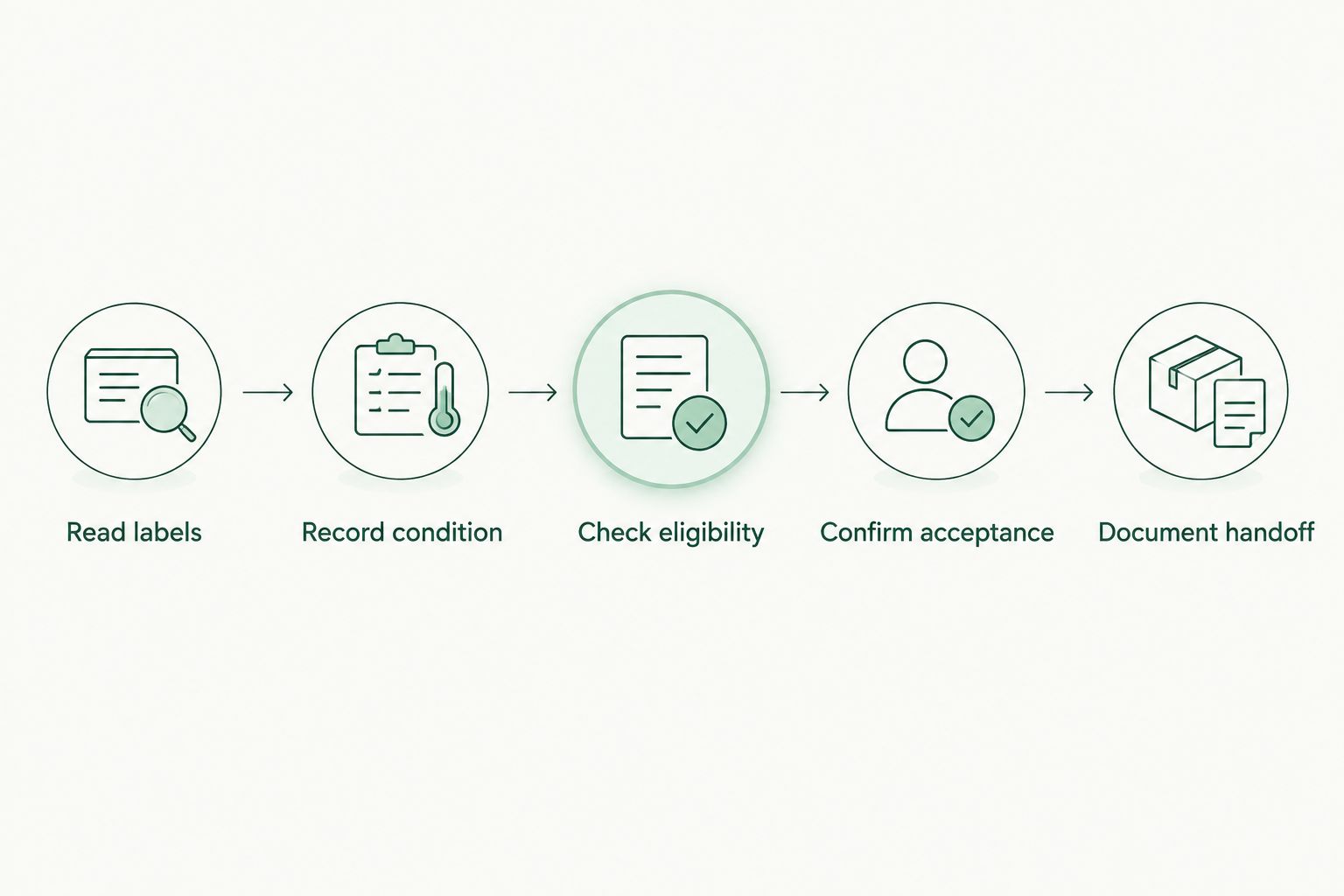
*Identify the material and confirm acceptance before including it in a cleanout.*
Keep products in their original labeled containers whenever possible. Do not transfer chemicals into drink bottles or combine partly filled containers to simplify the inventory.
Record actual container sizes and approximate contents rather than converting everything into an assumed truckload. A photograph helps establish context, but it does not replace identification or an acceptance decision.
What should you ask an independent provider?
Ask for answers tied to your inventory, not a general statement that the provider handles cleanouts. Written scope makes it easier to compare services without confusing ordinary hauling with chemical handling.
- Which products on this list do you accept, and which do you exclude?
- Do you accept liquids, fully dried paint, or both?
- Does acceptance change if the waste comes from a business or managed property?
- What preparation is required before anyone moves the containers?
- Which receiving facility or collection route will accept the materials?
- What authorization applies to this work, and what documentation is included?
Expelled's property cleanout marketplace helps you connect with independent providers, but you still need a material-specific acceptance decision. Compare confirmed scope, exclusions, and disposal arrangements—not just willingness to collect a load.
A provider that excludes chemicals can still suit the ordinary junk portion. The limitation is coordination: you must arrange a separate route and ensure excluded containers stay out of the load.
Does household collection cover a landlord or business cleanout?
Household collection eligibility does not automatically cover waste generated by a business. The EPA distinguishes household hazardous waste from regulated hazardous waste generated through business activity; program participation still depends on local requirements.
A residential address alone does not settle the question. Explain who generated the waste, what activity produced it, and whether it came from a resident's belongings, maintenance work, or commercial operations.
For a 2026 rental turnover or office cleanout, ask the receiving program how it classifies your specific materials. Do not describe business-generated chemicals as household waste simply to fit a collection program's admission rules.
Property professionals can include this separate disposal decision in their broader junk removal plan for property managers. Keeping responsibility explicit prevents the chemical portion from disappearing inside a general clearout instruction.
How do you keep a garage cleanout separate from chemical disposal?
Treat container assessment as a separate task from sorting furniture, shelving, and ordinary rubbish. When clearing out a garage, separating chemical containers from ordinary clutter keeps disposal decisions visible instead of burying them in the general removal pile.
Leave intact containers upright in an appropriate location consistent with their labels. Keep them away from children, pets, heat, and ignition sources, and do not reposition damaged containers simply to create a neater collection area.
Give the crew a clear exclusion list before work starts. Marking a container for assessment does not mean it is safe to load, and placing chemicals beside accepted junk does not make them part of the agreed service.
For a larger property cleanout, assign responsibility for the excluded materials. Specify who will contact the waste authority, arrange the approved handoff, and confirm that the containers are no longer left at the property.
Can you put dried paint cans in the regular trash?
Fully dried water-based paint belongs in regular trash only where local rules permit it. Confirm the required condition of the contents and container with your solid-waste authority before using that route.
A dry surface does not establish that everything underneath is solid. Do not assume a closed can contains dried paint merely because it has been stored for a long time.
Can a junk removal company take unlabeled chemicals?
Unlabeled chemicals require assessment before a provider agrees to handle them. Report the container's location and visible condition without opening it, mixing it, or inventing an identity.
Should paint disposal be booked separately from furniture removal?
Separate arrangements are appropriate when the furniture provider excludes paint or cannot confirm its disposal route. You can keep the general cleanout moving while giving the chemical portion its own documented scope.
FAQ
Can junk removal companies dispose of paint in 2026?
A junk removal company can take paint only when it accepts the specific product and has an appropriate disposal route. Confirm the paint type, condition, waste origin, and local requirements before booking.
Can I put liquid latex paint in a junk removal truck?
Do not put liquid latex paint in a junk removal truck without explicit provider acceptance. Confirm the receiving facility's rules and any preparation requirements first.
Does drying paint make every type safe for trash?
Drying does not make every paint product acceptable in ordinary trash. Follow local instructions for the identified product, and do not apply latex-paint disposal advice to oil-based paint or solvents.
Where should I take old paint thinner and pesticides?
Ask your local waste authority for a collection route that accepts paint thinner and pesticides from your type of property. Household programs and business waste services have different eligibility requirements.
Will a household hazardous waste program accept my business's paint?
A household hazardous waste program does not automatically accept business-generated paint. Explain the source and activity that produced the waste, then confirm eligibility directly.
Can Expelled remove paint and chemicals from my property?
Expelled connects customers with independent property cleanout, junk removal, and hauling providers; it does not perform the removal itself. Confirm chemical acceptance and disposal arrangements directly with the independent provider.
What should I do if a chemical container is leaking?
Keep people away from a leaking chemical container and seek instructions appropriate to the hazard. If there is immediate danger, contact emergency services rather than treating the leak as a routine junk removal task.
One last thing
Ask what will remain after the cleanout. An otherwise clear job description can overlook a cupboard of excluded chemicals. Put those exclusions in writing, name the person responsible for the separate disposal arrangement, and keep the property handoff incomplete until that responsibility is clear.