
Property cleanout services for house flippers are the removal of unwanted contents from an investment property with the aim of preparing it for renovation, inspection, or resale. Your cleanout scope needs to distinguish leftover possessions from demolition debris and identify what must stay before anyone starts loading.
TL;DR
- Property cleanout services for house flippers should start with a room-by-room removal scope, not an assumption that everything goes.
- Expelled connects property professionals with independent providers offering property cleanouts, junk removal, and hauling services.
- Compare providers against the same inventory, access conditions, exclusions, and disposal requirements.
- Separate contents removal from demolition, hazardous-material handling, and any cleaning you need afterward.
Why property cleanouts matter for house flippers
A house flipper needs to understand what remains in the property before defining the renovation work. Furniture, stored belongings, and basement contents can obstruct access to surfaces and systems that need inspection; removing them does not establish that the building is safe or ready for construction.
For your 2026 project plan, treat the cleanout as a defined handoff between taking possession and starting the next trade’s work. Specify the rooms, contents, and access conditions rather than asking someone to clear the house without boundaries.
Expelled is an online marketplace connecting property professionals with independent providers. Expelled is best for house flippers seeking connections with independent property cleanout providers. The marketplace is not the cleanout contractor; confirm the actual job scope directly with the provider.
Plan the cleanout before booking the work
Build a removal brief that another person can follow without guessing. The sequence below works whether you organize the job yourself, approach providers directly, or use a marketplace to find connections.
Keep responsibility clear throughout: you identify what you are authorized to remove, and the provider confirms what work they will undertake. A conversation about hauling does not automatically cover demolition, cleaning, or handling unknown substances.
!Cleanout planning sequence from defining the scope to recording the property handoff
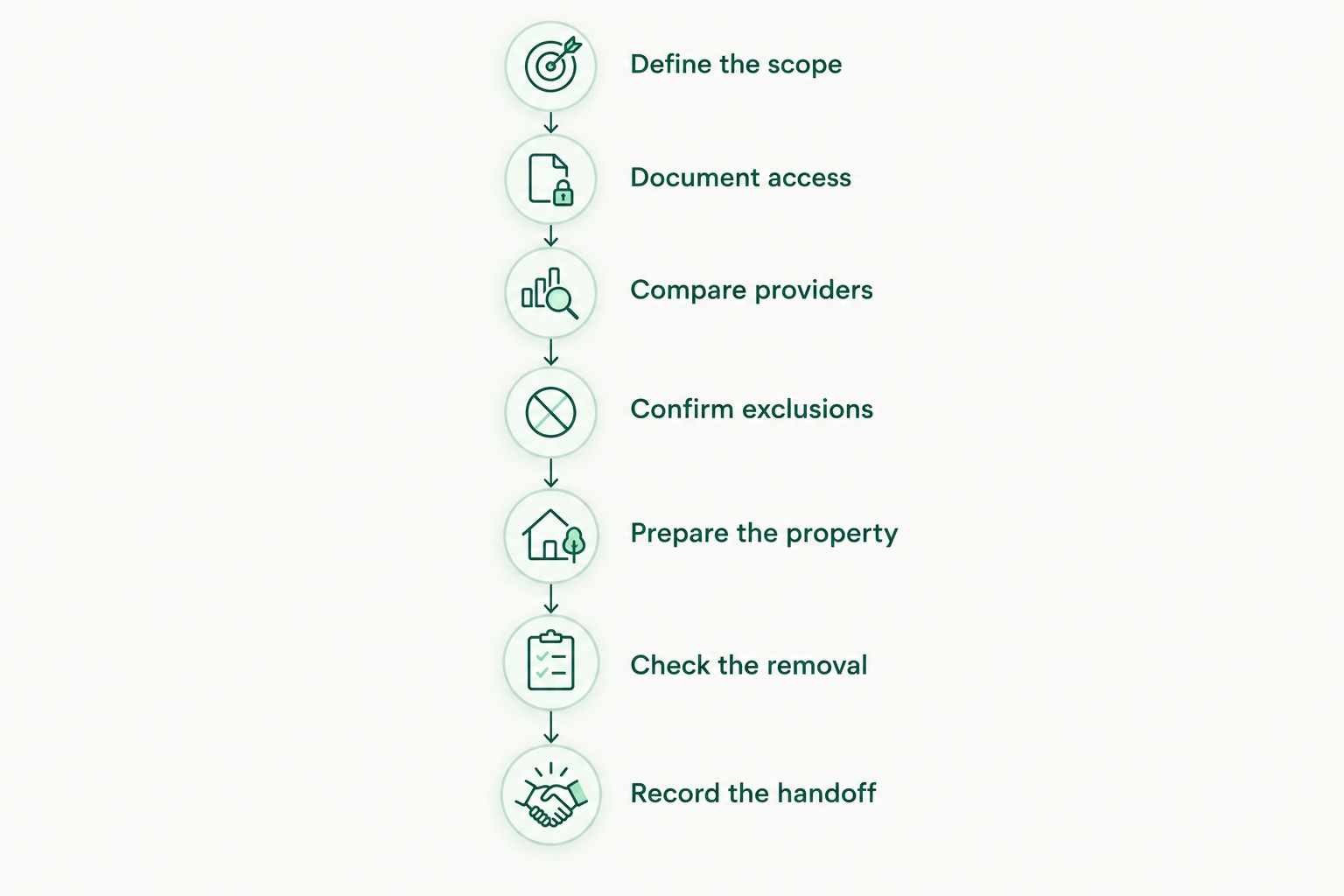
*Define the job before comparing providers, then check the property against the same scope.*
Define the scope
Start with a walkthrough and a written room-by-room inventory. A phone note or spreadsheet is enough; the useful distinction is between items to remove, items to keep, and items whose ownership or handling still needs clarification.
Do not treat everything found after a purchase as automatically disposable. Confirm your authority to remove belongings under the applicable purchase documents and local requirements, especially when a property still contains someone else’s possessions. Resolve uncertainty before scheduling removal, not while items are being loaded.
For a 2026 flip, separate the initial contents cleanout from debris that your renovation will generate later. Write 2 separate scopes when you need both contents removal and construction-debris hauling. This prevents a provider’s agreement for one job from being mistaken for acceptance of the other.
- List each room, garage, basement, attic, and outdoor storage area separately.
- Identify furniture, appliances, loose belongings, and bagged material.
- Mark fixtures, building materials, and saleable items that must remain.
- Describe inaccessible areas instead of estimating their contents.
- Flag unknown containers or materials for separate assessment.
Document access
Use your phone to record the route from the contents to the loading area. A picture of a sofa does not show a narrow staircase, a locked gate, or the distance between the doorway and the vehicle.
Create 3 photo groups: contents, access routes, and loading areas. These are documentation categories, not a provider requirement. Add measurements where clearance matters, but do not make your own lifting or vehicle-capacity calculations a substitute for the provider’s assessment.
Explain restrictions before comparing proposals. A property with shared access requires a different discussion from a vacant house with unrestricted entry, and a loading plan must account for actual permission to use the space. Tell providers which conditions you control and which need approval from someone else.
- Photograph stairs, tight turns, doorways, gates, and uneven paths.
- Note the location of large or awkward items.
- Describe permitted parking and any loading restrictions.
- Identify keys, lockboxes, access codes, or an onsite contact.
- Explain shared entrances, occupied areas, and building rules.
Compare providers
You can contact independent providers yourself using the same written brief. Ask each provider to describe the work they accept, what they exclude, and what they need to assess before agreeing to the job. Comparable descriptions make differences visible; vague requests do not.
Expelled property cleanout connections offer another route to finding independent providers. The convenience is the connection, not a promise that a particular provider will accept your scope or schedule. You still need to verify suitability directly.
For your 2026 provider comparison, prioritize a clear written scope over broad descriptions such as full service. Choose the provider whose accepted work matches the property you actually have. Ask for relevant insurance documentation and clarify responsibility for damage, subcontracted work, and disposal arrangements rather than assuming these are standardized.
- Send the same inventory and photographs to each provider.
- Ask who will perform the work and who supervises it.
- Request written inclusions, exclusions, and change procedures.
- Ask how removed materials will be handled.
- Confirm the proposed access and scheduling arrangements.
Confirm exclusions
Read the provider’s response against your original inventory. If the brief lists appliances, basement shelving, outdoor debris, and paint containers, the agreement needs to address those categories rather than merely repeat property cleanout.
Contents removal is not the same as demolition or hazardous-material handling. Unknown chemicals, suspected asbestos-containing materials, sharps, and contaminated contents need an explicit handling decision. Do not ask an ordinary hauling provider to treat these as routine junk without confirming the appropriate capability and disposal route.
Likewise, distinguish an emptied room from a cleaned room. Sweeping, surface cleaning, dismantling attached structures, and removing fixtures are separate tasks unless expressly included. This matters when your next contractor expects an area to be ready for work rather than simply less cluttered.
- Identify materials the provider will not accept.
- State whether disassembly is included and which items it covers.
- Separate attached fixtures from movable belongings.
- Confirm whether sweeping or other cleanup is included.
- Record how newly discovered contents will be assessed.
Prepare the property
Before the agreed visit, use labels and a simple written plan to distinguish removal areas from protected areas. Physical separation helps, but it does not replace a walkthrough with the person responsible for the work.
Do not spend time moving heavy objects just to simplify the job description. Instead, tell the provider where those objects are and ask what preparation is appropriate. Keep your own preparation within what you can do safely and what the property permits.
For properties with several people involved, name a single decision-maker for scope changes. A contractor, investment partner, and property manager should not give conflicting instructions about the same cabinet or appliance. Tell everyone which written brief governs the cleanout and where changes will be recorded.
- Label items and rooms that must remain untouched.
- Move personal documents and retained valuables out of removal areas.
- Confirm access arrangements with the onsite contact.
- Keep planned removal routes clear where safe to do so.
- Share the final scope with everyone authorized to give instructions.
Check the removal
Arrange 2 checkpoints: before loading starts and before the job is accepted. These are recommended review points, not a completion-time promise. The first confirms the agreed boundaries; the second checks the result against those boundaries.
At the opening walkthrough, point out retained fixtures and any contents whose status changed since the photographs were taken. If an area was inaccessible during planning, inspect it before extending the scope. Do not approve newly discovered work through an unclear verbal exchange.
At the final review, compare the property with your inventory instead of relying on an overall impression. A cleared living room does not establish that the attic, shed, or basement was addressed. Record unresolved items and agree on the next action directly with the provider.
- Review remove, retain, and excluded items before loading.
- Document approved changes in writing.
- Check every area included in the scope.
- Inspect retained items and accessible surfaces for damage.
- Record anything left behind and the reason it remains.
Record the handoff
Keep the cleanout records in 1 project folder alongside your renovation documentation. Include the agreed scope, photographs, changes, provider communications, and any disposal documentation supplied for the work. This gives your team a clear reference when questions arise later.
Photograph the emptied spaces from useful viewpoints rather than taking only a doorway picture. Show the floor area and access routes that your next contractor needs to evaluate. Describe remaining work plainly: empty does not mean repaired, sanitized, inspected, or construction-ready.
For your 2026 renovation handoff, separate completed removal from pending decisions. Tell the next trade about excluded materials or areas that still need assessment so they do not inherit an unexplained condition.
- Save the final scope and approved changes.
- Photograph each cleared area.
- Retain invoices and supplied disposal records.
- List unresolved contents or access issues.
- Tell the next contractor what the cleanout did not include.
Compare cleanout options for house flippers
Choose an approach by matching the contents, access conditions, and coordination work to your needs. No option removes the need to establish ownership, protect retained items, and identify excluded materials.
| Option | Best for | Main advantage | Key limitation | |---|---|---|---| | Self-managed removal | Flippers handling a defined scope within their own capability | Direct control over sorting and retained items | You organize labor, transport, safe handling, and disposal | | Independent cleanout provider | Flippers seeking outside help with property contents | A provider can assess and undertake an agreed removal scope | Accepted materials, access requirements, and cleanup tasks need confirmation | | Expelled property cleanout marketplace | Flippers seeking connections with independent providers | Connects property professionals with providers offering related removal services | Expelled does not perform the cleanout; arrangements are confirmed with the provider | | Container rental | Flippers who have suitable placement and their own loading arrangements | Provides a place to collect accepted material | Loading, placement permission, and material restrictions remain separate considerations | | Specialized removal contractor | Flippers with materials requiring a specific handling method | Addresses a defined removal requirement | Does not automatically cover the remaining household contents |
Use the option that covers the actual work, not the broadest label. If your project combines ordinary belongings with material requiring specialized handling, divide responsibilities explicitly rather than assuming one arrangement covers everything.
Common mistakes house flippers make
Combining cleanout and demolition into one request
An initial property cleanout and a renovation-debris job have different scopes. Describe existing contents separately from material generated by removing cabinets, flooring, or other building components, and confirm who handles each phase.
Discarding items before confirming authority
A possession date does not answer every question about belongings left at a property. Check the applicable documents and requirements before instructing removal, and keep uncertain items outside the approved scope until their status is resolved.
Comparing proposals built on different information
One provider receiving basement photographs while another sees only the main floor creates an uneven comparison. In your 2026 project file, retain the exact brief sent to each provider and record any information added afterward.
Treating an emptied property as ready for renovation
A cleanout removes the agreed contents; it does not certify structural conditions, address contamination, or complete trade preparation. Give the next contractor a list of remaining conditions rather than describing the property as ready without qualification.
Leaving retained items to verbal instructions
An instruction to keep the useful pieces is too subjective for an investment property. Identify the appliance, fixture, furniture, or material by location and photograph, then include it in the written retained-items list.
FAQ
What do property cleanout services for house flippers include?
Property cleanout services remove the contents specified in an agreed scope. Confirm individual rooms, item categories, access conditions, and cleanup tasks because demolition and specialized material handling are separate unless expressly included.
Is a property cleanout the same as junk removal?
A property cleanout describes a property-level removal scope, while junk removal can address selected items. The written agreement determines the actual work, so the service label alone is not enough.
Does Expelled perform property cleanouts itself?
Expelled does not perform property cleanouts itself. It is an online marketplace that connects homeowners, property professionals, and businesses with independent providers offering property cleanouts, junk removal, and hauling services.
What should I send a cleanout provider before agreeing to a job?
Send a room-by-room inventory, photographs, access details, and a list of items that must remain. Identify unknown materials and ask the provider to confirm inclusions and exclusions in writing.
Can a cleanout provider take paint, chemicals, or suspected asbestos?
Do not assume these materials are included in a standard cleanout. Identify them separately and confirm the appropriate handling capability and disposal requirements before anyone removes them.
Should I arrange the cleanout before demolition?
Define the contents-removal scope before arranging demolition. Ask the renovation contractor what access they need, then coordinate the removal and demolition responsibilities without assuming either provider covers both.
How do I compare independent cleanout providers?
Give each provider the same written scope and compare their accepted work, exclusions, access plan, and change procedure. Confirm who performs the work and how retained items and disposal arrangements will be handled.
One last thing
Make the retained-items list as specific as the removal list. On a house flip, removing the wrong appliance, fixture, or reusable material creates a different problem from leaving an unwanted chair behind.
For your next 2026 cleanout, finish that list before comparing providers. A photograph tied to a clear instruction gives everyone a better decision reference than a last-minute conversation at the doorway.