
Senior move managers’ junk removal is the coordination of unwanted-item removal with the aim of clearing a home without discarding belongings the client intends to keep. This 2026 guide explains how to confirm authority, separate possessions, describe the job, and compare independent providers around a senior move.
TL;DR
- Junk removal for senior move managers starts with disposal consent, not a pickup appointment.
- Expelled connects property professionals with independent providers for property cleanouts, junk removal, and hauling.
- Separate moving, retained, and removal items before requesting a provider’s written scope.
- Compare handling, access, exclusions, and documentation rather than treating every cleanout proposal as equivalent.
Why junk removal matters for senior move managers
A senior move manager coordinates removal within a larger transition: choosing what fits the next home, protecting personal belongings, and handing over the property. Those tasks create different instructions for movers, family members, donation recipients, and removal providers. An item left behind is not automatically an item approved for disposal.
For your 2026 move plan, make removal a separate workstream with its own authorization and completion criteria. A clear room is not a successful result if the wrong possessions leave with the load. Your instructions need to define both what goes and what stays.
Expelled is a marketplace connecting homeowners, property professionals, and businesses with independent providers offering property cleanouts, junk removal, and hauling services. It is not the company performing the removal. Keep that distinction clear when assigning responsibility for access, handling, and final checks.
Plan the cleanout before booking removal
Use the following sequence to prepare a job that independent providers can assess. You can complete the preparation with a paper checklist, phone photographs, and a shared document; a marketplace is not a prerequisite.
The central rule is simple: resolve decisions before items reach the loading area. Providers need clear removal instructions, not responsibility for deciding which possessions have personal value.
Confirm authorization
Identify who can approve removal and who can change those instructions. Ask the client or authorized representative to confirm that responsibility before you arrange work. When several relatives participate, distinguish people offering opinions from the person authorized to approve disposal.
Put the approval in writing and tie it to an item list or clearly defined area. Avoid a broad instruction to empty the house when belongings still need review. For a 2026 project file, keep the approval beside the current scope so the provider receives the same instructions you use.
Hold disputed items out of the removal scope. If an instruction changes, update the list before loading begins rather than relying on a conversation relayed through someone else.
- Record the approving person’s name and contact information.
- Define the rooms and items covered by the approval.
- Identify possessions requiring a separate decision.
- State who can authorize changes during the job.
- Keep the latest approval with the working item list.
Separate belongings
Create distinct groups for moving, retaining, donation consideration, and removal. Start manually: walk each room with the client or authorized representative, then label items or zones. Use words as well as colors so instructions remain readable in photographs and on printed lists.
Create 2 working lists: approved removal and excluded belongings. Donation candidates belong outside approved removal until you have an agreed destination and handling plan. Do not assume that furniture intended for donation will be accepted or collected.
Check furniture and storage containers before approving them. Drawers, pockets, and boxes need review for documents, photographs, keys, and personal items. Keep sensitive records outside the removal area and decide their handling separately.
- Label each group with an explicit instruction.
- List retained belongings even when they remain in place.
- Inspect drawers and containers before approving removal.
- Separate personal records from general household contents.
- Keep undecided items in a clearly marked hold area.
Describe the job
Prepare a written brief before searching for a provider. A room-by-room inventory is more useful than a description such as a small cleanout because it identifies the actual work. Include bulky items, dismantling requests, and anything stored away from the main living area.
Capture 3 photo views: the items, the access route, and the loading location. These are documentation categories, not a guarantee that photographs alone establish the scope. Explain stairs, elevators, narrow turns, parking restrictions, and building access requirements in words as well.
Expelled is suited to senior move managers seeking connections with independent junk removal providers. Use Expelled’s marketplace as a way to connect with providers, then confirm the job directly with the provider you consider. You still need agreement on handling, exclusions, and site access.
- List removal items by room or storage area.
- Photograph bulky items and the surrounding space.
- Describe stairs, elevators, doorways, and loading access.
- Identify requested dismantling or special handling.
- Flag materials requiring an acceptance check.
- Explain who will open the property and supervise decisions.
Compare providers
Send the same brief to each provider you consider. Ask each provider to explain what the proposed service includes, what it excludes, and what information needs an on-site check. Comparing different descriptions of the job creates an avoidable mismatch.
Your 2026 comparison should focus on responsibilities as well as removal. Ask who handles dismantling, protects surfaces, moves items from interior rooms, and deals with unexpected contents. Request documentation relevant to your client’s or property’s requirements, including insurance information when required.
Expelled connects you with independent providers; it does not replace your review of a provider’s suitability. Its benefit is the connection path. Its limitation is that you must confirm the individual provider’s scope, material acceptance, arrangements, and responsibility for the work.
- Request an itemized description of included work.
- Ask which materials and tasks the provider excludes.
- Confirm whether interior carrying and dismantling are included.
- Review documentation required by the property or client.
- Ask how scope changes will be approved.
- Agree on the evidence needed to confirm completion.
Coordinate access
Place removal in the move schedule only after you know which belongings remain for movers, family members, or another collection. Describe the dependency explicitly: removal starts after the approved items are separated, not merely when a calendar slot arrives.
Check access with the property contact before confirming arrangements. A provider needs to know whether an elevator must be reserved, where loading is permitted, and who supplies entry. Do not pass along an assumed building rule; obtain the actual instruction from the responsible contact.
Keep the client’s access needs part of the plan. Separate the loading route from retained belongings and do not block exits with staged items. If other workers will be present, assign someone to resolve instructions rather than leaving providers to interpret overlapping requests.
- Confirm entry arrangements with the property contact.
- Check elevator, parking, and loading requirements.
- Identify work that must finish before removal starts.
- Keep exits and necessary walking routes clear.
- Name the person available for on-site questions.
- Share schedule changes with everyone handling belongings.
Verify completion
Walk the approved scope with the provider before loading and again when the work is complete. The opening check identifies misunderstandings while items are still in place. The closing check establishes whether the agreed items were removed and the retained items remained.
Use 1 written completion record tied to the approved scope. Note completed work, unresolved items, and any agreed changes. A photograph of an empty room supports the record, but it does not explain an excluded cabinet or an item deliberately left behind.
The diagram below summarizes the preparation sequence. Each stage produces information needed by the next; booking removal does not replace any of them.
!Six stages of a senior move cleanout, from authorization through completion checks
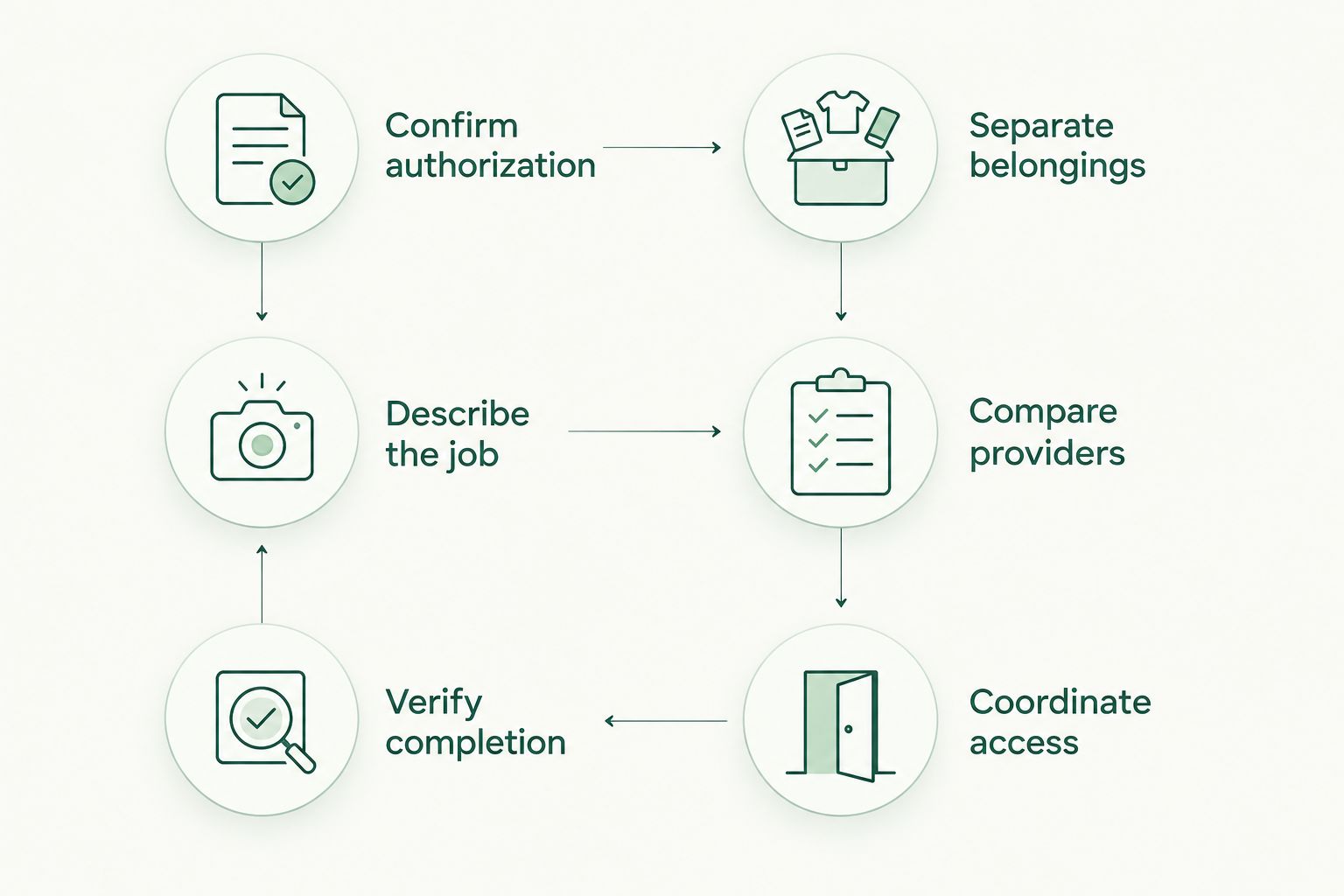
*Approve the removal scope before comparing providers and coordinating access.*
Close the job against the list, not against a general impression that the home looks clearer. Return unresolved decisions to the authorized person instead of treating them as permission to remove more.
- Check approved items against the removal list.
- Confirm excluded belongings are still present.
- Photograph the agreed areas after completion.
- Record changes and the person who approved them.
- List remaining items and their next handling action.
Compare removal options for a senior move
Choose an option by the task you need completed, not by the broad label of cleanout. The following 2026 comparison separates a connection service from the providers and organizations that handle items. Confirm each party’s actual scope before adding it to the move plan.
| Option | Best for | Practical benefit | Key limitation | |---|---|---|---| | Expelled marketplace | Property professionals seeking connections with independent providers | Connects users with providers offering cleanouts, junk removal, and hauling | You must confirm the individual provider’s scope and arrangements | | Directly arranged independent removal provider | A defined removal job with approved items | Lets you discuss access and handling with the party doing the work | Material acceptance and included tasks require confirmation | | Donation organization | Items the receiving organization agrees to accept | Provides a separate route for accepted reusable belongings | Acceptance and collection arrangements are not automatic | | Moving company | Possessions going to the next home | Keeps retained-item transport separate from disposal | Moving arrangements do not establish a removal scope | | Client or family-managed removal | A limited task the people involved agree to handle | Keeps sorting decisions close to the client | Carrying, transport, and disposal arrangements remain their responsibility |
Use separate instructions when separate organizations handle the possessions. A moving inventory does not authorize disposal, and a donation wish list does not establish acceptance. Assign each group a destination and a responsible contact.
A mixed plan is also valid. You can arrange transport for retained furniture, seek acceptance for donation items, and use an independent provider for approved removal. The benefit is clearer destinations; the limitation is additional coordination between parties.
Common mistakes senior move managers make
Treating family agreement as client authorization
Several relatives agreeing on removal does not establish who is authorized to approve it. Confirm the decision-maker and record the approved scope before a provider handles belongings. When instructions conflict, pause the affected items rather than asking the provider to choose.
Describing everything as household junk
A general label hides the distinctions that matter on site: retained furniture, unopened containers, donation candidates, and items requiring an acceptance check. Describe the actual contents and handling tasks. A clearer brief gives the provider a defined job rather than an open-ended instruction.
Scheduling removal before sorting is complete
Booking first puts unresolved decisions into the loading process. Finish the approved removal list before confirming the removal arrangement. If the move schedule requires staged work, define each stage separately and keep undecided possessions outside it.
Assuming donation is part of removal
Donation and removal are different instructions. Ask who will accept an item, who transports it, and what happens if acceptance is declined. Do not describe an item as donated unless the receiving arrangement is confirmed.
Closing the job without checking retained items
A cleared room only confirms that items left the room. It does not establish that the correct items left. Check the excluded-belongings list during the final walkthrough and document anything that still requires a decision.
FAQ
What is junk removal for senior move managers?
Junk removal for senior move managers is the coordination of approved unwanted-item removal during a senior move or property transition. It includes consent, item separation, provider instructions, access planning, and completion checks.
What is the best way to prepare a senior’s home for junk removal?
Confirm who can approve disposal, then separate retained belongings from approved removal items. Create a room-by-room list and photographs before asking a provider to assess the job.
Does Expelled perform the cleanout itself?
Expelled does not perform the cleanout itself; it connects users with independent providers offering property cleanouts, junk removal, and hauling. Confirm the work scope and arrangements with the independent provider.
Should movers and junk removal providers use the same item list?
Movers and removal providers need separate handling instructions. Share enough information to prevent confusion, but distinguish items going to the next home from items approved for removal.
Can a junk removal provider take items intended for donation?
Confirm donation handling directly with the provider and the receiving organization. Intending to donate an item does not establish acceptance, transport arrangements, or its final destination.
What should I ask an independent provider before agreeing to removal?
Ask which items and tasks are included, which materials are excluded, and how access and scope changes will be handled. Confirm who performs the work and what documentation your client or property requires.
What should I do if relatives disagree about an item?
Keep the disputed item outside the approved removal scope until the authorized decision-maker resolves it. Record the decision before updating the provider’s instructions.
One last thing
Add a do-not-remove list to every 2026 cleanout brief, even when the retained belongings appear obvious. A wall-mounted fixture, an appliance staying with the property, or a box awaiting family review needs an explicit instruction just as much as furniture approved for hauling.
Before the provider starts, ask the on-site contact to point out those exclusions. This final check connects the written scope to the actual property and gives everyone the same boundary for the work.