
Property managers’ junk removal is the coordinated removal of unwanted items from managed properties with the aim of preparing spaces for their next approved use. This 2026 guide explains how to define the job, protect retained belongings, document access, and compare independent providers without confusing removal with a full property turnover.
TL;DR
- Junk removal for property managers starts with authorization, a written scope, and clear access instructions.
- Expelled is best for property managers seeking to connect with independent junk removal and property cleanout providers.
- Compare providers against the same item list, exclusions, and completion requirements.
- Separate removal from cleaning, repairs, and decisions about belongings left behind.
Why junk removal matters for property managers
A property manager coordinates more than hauling. You also need to establish who can authorize removal, what must stay, and how the provider can enter without disrupting occupied spaces. For your 2026 jobs, treat those decisions as part of the scope rather than instructions delivered after work starts.
How to organize a property cleanout
Confirm your authority to remove items
Permission comes before pickup. A vacant unit does not establish that every remaining item can be discarded. Resolve ownership and any applicable notice or storage requirements before arranging removal.
- Confirm who approves disposal.
- Separate retained belongings from removal items.
- Check applicable requirements for belongings left behind.
- Record unresolved items as exclusions.
Write a job brief before contacting providers
Use a shared document, email, or spreadsheet to describe the work before searching for help. The Expelled junk removal marketplace connects property professionals with independent providers; the platform does not perform the cleanout itself.
Expelled is best for property managers seeking to connect with independent junk removal providers. You still need to confirm the provider’s scope, coverage, credentials, and proposed arrangements directly. Finding a provider and authorizing that provider are separate decisions.
Describe the intended result in physical terms. State whether you want specified furniture removed, an identified storage area emptied, or designated loose items collected. Avoid using a broad instruction such as clearing everything when part of the property must remain untouched.
Keep removal separate from other turnover tasks. Cleaning, repairs, demolition, and handling restricted materials are not implied by an instruction to haul away furniture. If you need related work, list it explicitly and ask who would perform it.
Your job brief should contain:
- Property address and the exact work area.
- Item descriptions, quantities, and approximate dimensions where useful.
- Items and rooms that must remain untouched.
- Requested removal work and separately requested related services.
- The person authorized to approve changes.
- The condition you expect at handover.
Photograph the items and the entire access route
Start with phone photos and a written inventory. For an initial 2026 job brief, use 6 photos as a starting checklist, not a guarantee that the job is fully documented. Add more whenever a room, obstacle, or item cannot be understood from the initial set.
Organize the images into 3 photo categories: Wide views, Item details, and Access route. Wide views establish the area being cleared. Item details show objects that need a closer look. Access route images explain how those objects would leave the property.
!Photo brief organized into wide views, item details, and access route images
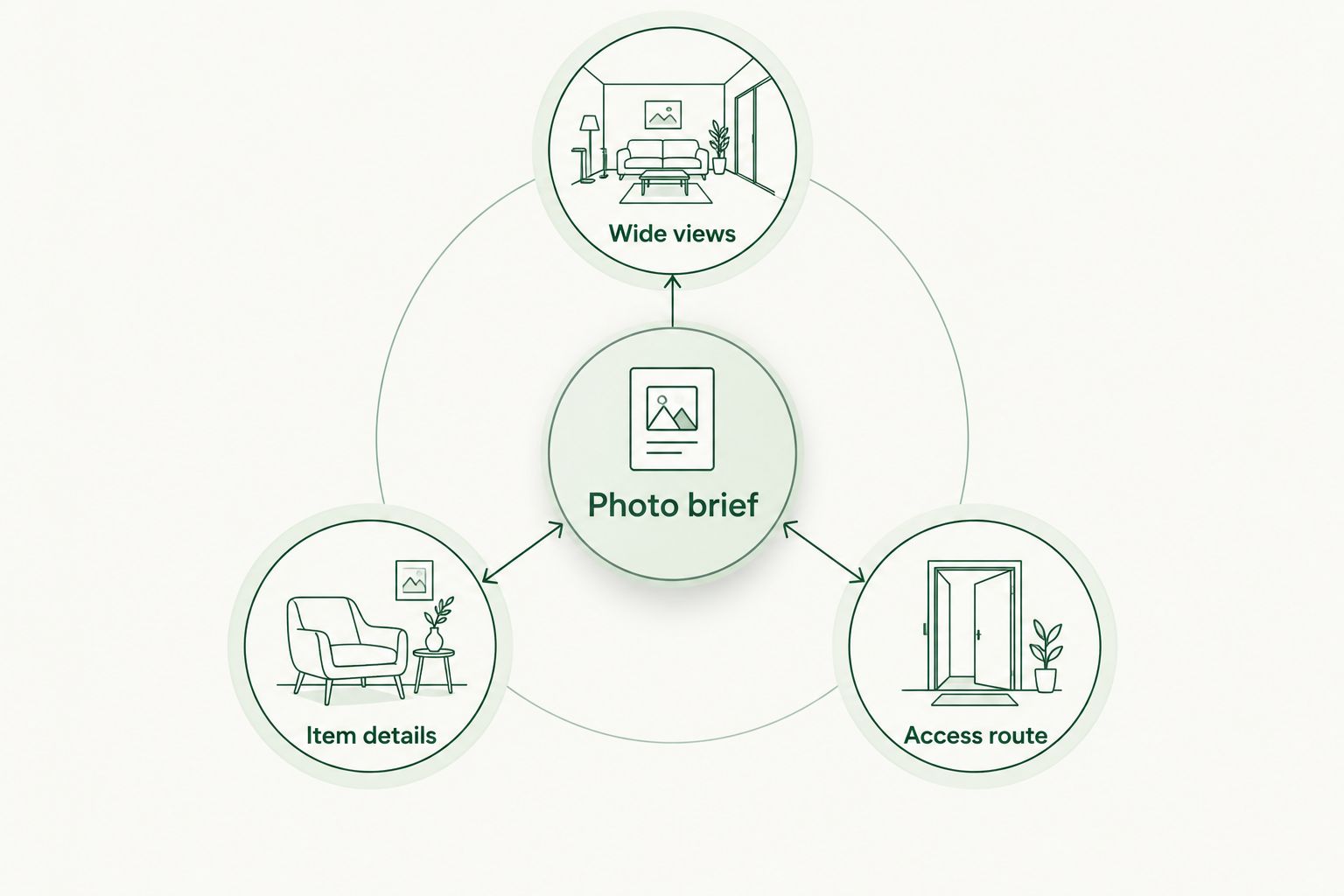
*Document the route out of the property as clearly as the items being removed.*
A photo of a sofa does not explain a narrow stairwell or a locked loading entrance. Include those details in the brief instead of asking a provider to infer them. Flag uncertainty directly: an item’s weight, condition, or contents should not become an assumed fact.
Keep tenant information, personal documents, and unnecessary identifying details out of images shared for estimating.
- Photograph each affected room or storage area.
- Capture close views of bulky or unusual objects.
- Show doorways, stairs, corridors, and loading access.
- Describe items hidden inside closed containers without exposing private records.
- Note dimensions when clearance is a concern.
- Update the brief when the removal list changes.
Plan access around the building’s actual restrictions
Write access instructions yourself before requesting a provider’s proposed plan. Include the route from the removal area to the loading point, not just the street address. A provider needs to understand which doors, elevators, gates, or common areas are part of that route.
For occupied buildings, confirm the rules that apply to shared spaces. Ask building staff about permitted work periods, elevator reservations, loading arrangements, and required protection measures. Do not promise a provider access that someone else controls.
Keep access arrangements separate from scheduling requests. A preferred work date is not a confirmed appointment, and an appointment does not resolve an unapproved loading location. Get both confirmed before issuing entry instructions.
Assign one on-site contact or one clearly identified remote contact. Give that person authority to resolve access questions, but distinguish that authority from permission to approve extra removal work. Avoid placing sensitive entry details in a broadly shared inventory.
- Identify stairs, elevator access, and loading restrictions.
- Confirm applicable building rules with the responsible person.
- Identify permitted parking or loading arrangements.
- Explain how doors or gates will be opened.
- Assign the contact responsible for access problems.
- State which common areas require protection.
Compare providers against the same written scope
Send each provider the same brief and keep the replies together. For a 2026 property turnover, compare what each provider agrees to remove, what remains excluded, and what happens when the actual job differs from the description. A shorter reply is not a substitute for a clear scope.
Ask who will perform the work and who is responsible for supervising it. Request relevant insurance documentation and check any requirements that apply to your building or job. Do not treat a marketplace connection as confirmation that a provider meets your property’s requirements.
Separate ordinary furniture and loose contents from materials needing special handling. Identify paint, chemicals, batteries, appliances, unknown liquids, and suspicious materials before work begins. Confirm acceptance and handling directly rather than adding them to a general pile.
Compare proposed disposal arrangements, too. If reuse, recycling, or donation matters to the owner, ask what the provider actually agrees to do and what documentation is available. Do not promise a destination on the provider’s behalf.
- Confirm the included items and excluded materials.
- Ask who performs and supervises the work.
- Check relevant documentation against property requirements.
- Record the proposed access and scheduling arrangements.
- Ask how scope changes require approval.
- Confirm the handling of separately identified materials.
Protect retained belongings and define change approval
Mark retained items before the provider arrives. Use labels, a separate room, or an annotated inventory, and choose a method that remains clear when furniture or boxes move. Do not rely on a verbal instruction that only one person heard.
Set 2 review checkpoints: before removal and at completion. The first confirms what can leave and what must stay. The second checks the result against the approved inventory. These are management controls, not promised service features.
Make the change process explicit. If a provider finds additional items, blocked access, or material outside the original scope, identify who can authorize a revised instruction. Tell tenants, staff, and other contractors not to expand the removal list independently.
For sensitive or valuable belongings, remove them from the work area before the cleanout where practical. If ownership remains unresolved, keep those items excluded. Do not ask the provider to decide whether an object is abandoned or worth preserving.
- Mark retained items consistently throughout the property.
- Keep unresolved belongings outside the approved scope.
- Review the removal list with the responsible contact.
- Name the person authorized to approve changes.
- Record approved changes in writing.
- Check retained items during the completion review.
Check the result and keep a usable property record
Close the job against the brief, not against a general impression that the room looks better. Use a simple sequence: Scope review, Provider confirmation, and Completion review. That sequence connects the original instruction to the provider’s agreement and the condition at handover.
!Three-step review process connecting the job scope, provider confirmation, and completed work
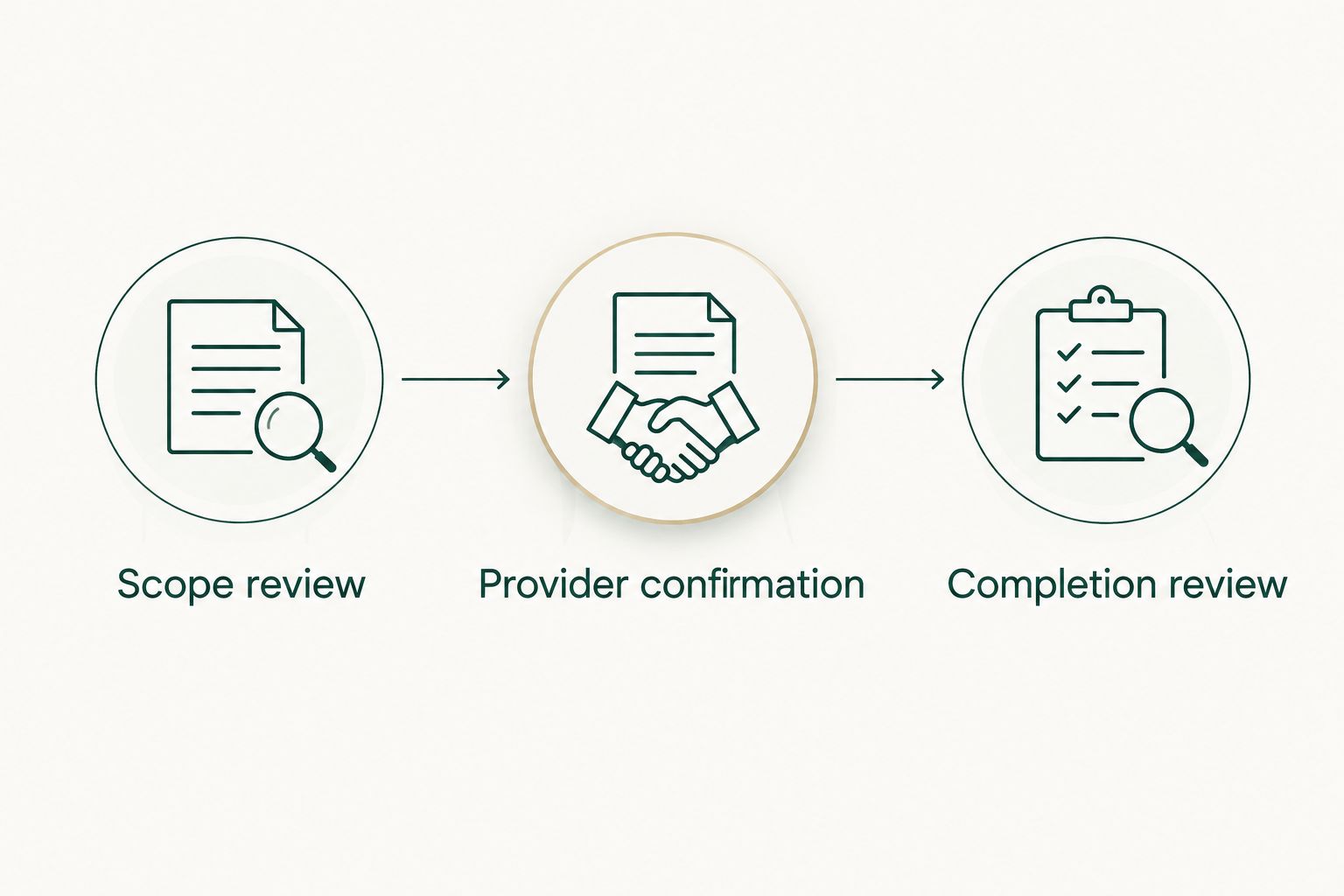
*Close the job against the agreed scope rather than a general impression of the space.*
Take completion photos from viewpoints that match the original brief. Check excluded rooms and retained belongings as well as cleared areas. If something remains, record whether it was excluded, newly discovered, or part of an incomplete agreed task.
Removal does not automatically establish that a unit is ready for occupancy. Inspect cleaning, repairs, safety issues, and other turnover work separately. Keep the cleanout record useful for whoever handles the next stage without making them reconstruct the instructions from scattered messages.
Retain documentation according to your organization’s policies and applicable requirements. Limit access to records containing personal information.
- Match completion photos to the original work areas.
- Check agreed removals and retained belongings.
- Record unresolved items and outstanding work.
- Save the brief, provider confirmation, and approved changes.
- Request agreed disposal documentation where applicable.
- Hand off remaining cleaning or repair tasks separately.
Compare removal options for property managers
Choose the option that fits the work, not just the search method. For your 2026 comparison, distinguish finding a provider from arranging transport or using an existing collection service. Each approach leaves different coordination tasks with you.
| Option | Best for | Practical advantage | Key limitation | |---|---|---|---| | Expelled marketplace connection | Property managers seeking independent cleanout and junk removal providers | A place to find and connect with independent providers | You must confirm coverage, scope, credentials, and arrangements directly | | Direct provider search | Managers who want to contact providers individually | You control the search and questions from the start | You organize the search and comparison yourself | | Existing waste collection service | Accepted items that fit the property’s current collection arrangements | You can begin with the property’s established collection contact | Acceptance, preparation, and collection rules require confirmation | | Self-managed hauling | Jobs your organization can lawfully and safely handle with its own resources | You control sorting and transport decisions | Your organization takes responsibility for labor, equipment, transport, and lawful disposal |
Start with existing arrangements if the items fall within their accepted scope. For work outside that scope, compare independent providers using the written brief. Choose self-managed hauling only after checking that your resources and disposal arrangements fit the actual job.
A search method does not establish disposal acceptance. Confirm the receiving facility or collection service’s requirements before committing to an approach, especially when the load includes materials requiring separate handling.
Common mistakes property managers make
Treating vacancy as permission to discard belongings
An empty unit and authorized disposal are different facts. Resolve ownership, notices, storage obligations, and approval before including belongings in a removal instruction. When the status remains unresolved, leave the item out of the scope rather than passing the decision to a hauler.
Using a unit number as the entire job description
A provider cannot assess a cleanout from an address alone. Send the inventory, photographs, exclusions, and access route together. A clear brief also gives you a record for checking whether the completed work matches the original request.
Letting several people change the scope
A tenant, maintenance worker, owner, and manager can give conflicting instructions. Name one approval contact and record changes through that person. Access staff can explain the building route without gaining authority to add rooms or items to the job.
Assuming removal includes every turnover task
Clearing furniture does not mean floors have been cleaned, walls repaired, or all safety concerns resolved. List related tasks separately and confirm who accepts responsibility for each. Inspect the space for its next intended use instead of treating an empty room as a completed turnover.
Promising disposal outcomes without confirmation
Do not tell an owner that contents will be donated or recycled unless the provider has agreed to that handling. Ask which items qualify and what documentation supports the arrangement. Separate the outcome you prefer from the outcome the provider confirms.
FAQ
What is junk removal for property managers?
Junk removal for property managers is the coordinated removal of authorized unwanted items from managed properties. The manager defines the scope, arranges access, and checks completion against the agreed work.
Does Expelled perform property cleanouts itself?
Expelled is a junk removal and property cleanout marketplace, not the provider performing the cleanout. It connects property professionals with independent providers, whose scope and arrangements require direct confirmation.
What should I send a junk removal provider before requesting service?
Send an item inventory, photos, exclusions, and access instructions. Identify the approval contact and explain the condition you expect at handover.
Can I remove everything a tenant leaves behind?
Do not authorize removal until you have established your authority and checked applicable requirements for belongings left behind. Vacant possession alone does not resolve every ownership or disposal question.
Is junk removal the same as a full property turnover?
No, junk removal is one part of a property turnover. Cleaning, repairs, inspections, and other work need separate scopes and responsible parties.
How do I compare independent junk removal providers?
Compare independent providers against the same written inventory, access instructions, exclusions, and completion requirements. Confirm relevant documentation, material acceptance, and the process for approving changes.
What if a provider finds additional items during the cleanout?
Require the designated approval contact to authorize any change before those items are added to the removal scope. Record the revised instruction and confirm any effect on the agreed arrangements.
How do I confirm a property cleanout is complete?
Compare the result with the approved inventory and completion requirements. Check retained belongings, record unresolved items, and inspect cleaning or repair work separately.
One last thing
Write what must stay as carefully as what must go. A cleanout brief built only around unwanted items leaves the boundary of the job unclear. Add retained fixtures, equipment, documents, and belongings to an explicit exclusion list, then review that list at handover.
For your next 2026 cleanout, reuse the brief rather than the assumptions from the previous property. Access rules, ownership questions, and accepted materials require a fresh check. Use Expelled to connect with independent providers, then make the agreement specific to the property in front of you.