Best overall: a junk removal provider that can show current, job-matched licensing and insurance documents before the job starts. Best for managed properties: a provider that meets the property's insurance requirements in writing. Best for restricted materials: a provider with the handling authorization the material requires. Skip any provider whose claims you cannot check.
This page ranks provider types, not named companies. Expelled is a marketplace that connects homeowners, property professionals, and businesses with independent providers. Expelled does not perform cleanouts itself, and no individual company is endorsed or rated here. Check every provider you find through Expelled or anywhere else against the criteria below in 2026.
TL;DR
- Licensed insured junk removal companies compared in 2026: rank providers by documents you can verify, not by badges.
- Ask for a certificate of insurance and license details before booking, every time.
- Property managers and businesses should require proof of coverage that matches the site's rules.
- Skip any provider that will not put coverage and license status in writing.
Why licensing and insurance decide who you hire
Junk removal means strangers in your property, heavy lifting, and hauling material off-site. Each step carries risk: damaged floors, injured workers, illegal dumping.
Licensing and insurance are the two things you can verify before work starts. Reviews and photos cannot show you either. A provider with both on paper is accountable if something goes wrong; one without them leaves you holding the problem.
Requirements differ by city, state, and job type. Confirm what applies where the work happens, with the local licensing office or your insurer, rather than relying on a general rule.
What makes a junk removal provider worth hiring
Use these criteria to audit any provider before you compare quotes:
- Business license: the provider can name the license or registration it operates under for your location, and you can confirm it with the issuing office.
- General liability insurance: covers damage to your property during the job. Ask for a certificate of insurance (COI) showing the policy period.
- Workers' compensation: covers injuries to the crew. Without it, an injury on your property can become your dispute.
- Disposal responsibility: the provider states where material goes and who is responsible for proper disposal.
- Material scope: the provider says in writing which items it will and will not take, such as hazardous or regulated materials.
- Written scope and terms: the job description, what is included, and how the provider prices the work are written down before the crew arrives.
Provider types at a glance
| Rank | Provider type | Best for | Standout feature | Key limitation | |---|---|---|---|---| | 1 | Fully documented independent provider | Most homeowners | License and COI available on request | Takes a few minutes to verify | | 2 | Provider meeting property-manager requirements | Landlords, HOAs, commercial sites | Coverage can be matched to site rules | May need to be named on your policy | | 3 | Provider authorized for restricted materials | Jobs with regulated items | Handling authorization for the material | Narrower service scope | | 4 | Provider with partial documents | Small, low-risk jobs | May be easy to schedule | Gaps shift risk to you | | 5 | Provider with no verifiable documents | Nobody | None | No recourse if damage or injury occurs |
1. Fully documented independent provider: best for most homeowners
This provider gives you a license reference and a current COI without being chased. For a typical garage, basement, or estate cleanout, this is the default choice.
Fully documented provider pros:
- Coverage is checkable before work starts
- Clear answers on disposal and excluded items
- Written scope reduces disputes
- Easy to compare against other quotes on equal terms
Fully documented provider cons:
- Verification takes a call or an email
- Documents show coverage exists, not that the crew will do the job well
Best for: homeowners clearing a garage, attic, basement, or full property. Verdict: Buy.
2. Provider meeting property-manager requirements: best for managed properties
Landlords, HOAs, and commercial sites often set their own insurance minimums. A provider in this slot can supply a COI that lists the property owner or manager when the site requires it.
Property-manager provider pros:
- Meets building access and insurance rules
- Reduces the chance a job is stopped at the door
- Suits recurring tenant turnover cleanouts
Property-manager provider cons:
- Requirements add lead steps before the job
- Not every independent provider will accept additional-insured terms
Best for: property professionals and businesses with written site rules. Verdict: Buy when your site requires it; otherwise hold at rank 1.
3. Provider authorized for restricted materials: best for regulated items
Some materials cannot go in a standard haul. Which items are restricted depends on your location, so ask the provider and your local waste authority. A provider in this slot states what authorization it holds for the material you have.
Restricted-materials provider pros:
- Handles items standard crews decline
- Authorization can be verified with the issuing body
Restricted-materials provider cons:
- Narrower range of jobs
- Separate quote and scheduling for those items
Best for: jobs where you know regulated items are present. Verdict: Buy for those items only.
4. Provider with partial documents: best only for low-risk jobs
This provider has one document but not the other, such as insurance without a clear license reference. The gap moves risk onto you.
Partial-documents provider pros:
- Some accountability exists
- May fix the gap quickly if you ask
Partial-documents provider cons:
- You cannot confirm the missing piece
- Hard to compare against fully documented quotes
Best for: small, low-risk jobs, and only after the provider closes the gap in writing. Verdict: Hold.
5. Provider with no verifiable documents: best for nobody
No license reference, no COI, only a phone number and a price. Damage, injury, or illegal dumping becomes your problem.
No-documents provider pros:
- None that outweigh the risk
No-documents provider cons:
- No recourse on damage or injury
- No clarity on where your material goes
Verdict: Skip.
How to check a provider in four steps
- Ask for the license or registration reference for your location and confirm it with the issuing office.
- Request a current COI and check the policy dates cover your job date.
- Ask who is responsible for disposal and where material goes.
- Get the scope and terms in writing before the crew arrives.
!Four steps for checking a junk removal provider before booking
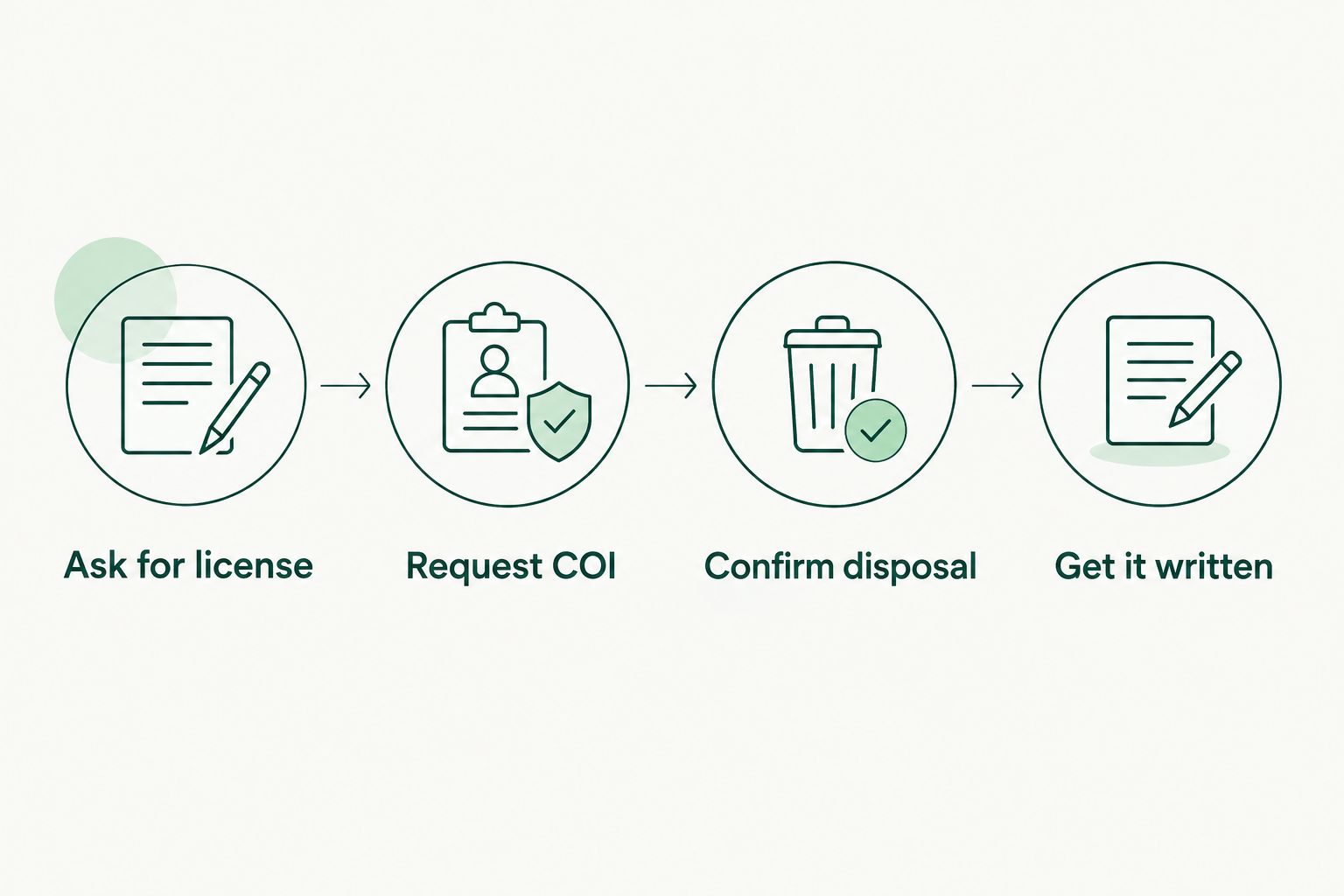
*Verification happens before booking, not after damage.*
How to compare providers on Expelled
Expelled connects you with independent providers for property cleanouts, junk removal, and hauling. Provider coverage, availability, and pricing vary and are set by each provider, not by Expelled.
When you describe a job, include:
- Property type and what needs to go
- Access details such as stairs, elevators, or gate rules
- Any items you suspect are regulated
- Any insurance or COI requirements from your property manager or building
Then ask each provider that responds the same questions and compare their written answers side by side. Start at Expelled to describe your job.
Describe your cleanout job
Connect with independent junk removal providers and compare them.
[Start on Expelled](https://expelled.online/)
How these types were ranked
The ranking follows the criteria above: how much of a provider's licensing, insurance, disposal, and scope you can verify before work begins. More verifiable documentation ranks higher. The ranking says nothing about price or speed.
Which provider type should you choose in 2026?
Choose a fully documented independent provider unless your site or your materials demand more. Managed properties add the property-manager requirements; regulated items add the handling authorization. Anything below partial documentation is a skip.
FAQ
What makes a junk removal company licensed and insured?
It holds the business license or registration required where it works and carries insurance such as general liability. Ask for the license reference and a certificate of insurance to confirm both.
How do I verify a junk removal company's insurance?
Request a certificate of insurance and check the policy dates cover your job date. You can also contact the insurer listed on the certificate to confirm the policy is active.
Is a licensed junk removal company always insured?
No. A license and insurance are separate. Check both individually, because having one does not prove the other.
Do I need workers' compensation proof from a junk removal provider?
It is worth asking for. Workers' compensation covers crew injuries, and without it an injury on your property can become a dispute. Requirements vary by state.
Does Expelled perform junk removal itself?
No. Expelled is a marketplace that connects you with independent providers. Each provider sets its own coverage, availability, and pricing.
What should I tell providers when describing a cleanout job?
Give the property type, what needs to go, access details, any suspected regulated items, and any insurance requirements from your property manager. The same details let you compare providers fairly.
Are junk removal companies compared on price here?
No. This page ranks provider types by verifiable licensing and insurance documentation. Pricing is set by each provider, so compare written quotes directly.
One last thing
A provider's willingness to hand over a COI quickly tells you more than any badge on their website. If the answer to a basic documentation request is vague in 2026, treat that as the answer.