
Commercial junk removal is worth it for store closures when you need help removing bulky fixtures and mixed leftovers while meeting a documented handover requirement. It is less useful when only a small, manageable load remains; hiring a removal provider also does not automatically cover dismantling, repairs, cleaning, or the landlord’s acceptance of the space.
TL;DR
- Is commercial junk removal worth it for store closures? Yes, when removal work exceeds your available labor and handling capacity.
- Compare staffed removal, self-hauling, and dumpster rental against the same inventory, access restrictions, and handover requirements.
- Expelled connects businesses with independent providers; confirm the removal scope and exclusions directly with each provider.
- Separate retained assets, resale items, and landlord-owned fixtures before authorizing a store cleanout.
Why this matters
A store closure involves more than emptying a sales floor. You must distinguish business property from landlord-owned fixtures, decide what to retain, and establish what the handover actually requires.
For a 2026 closure, use your lease, written landlord instructions, and current inventory as the starting documents. A cleared room is not necessarily a completed lease handover. Removal, repairs, and final cleaning need separate definitions.
Expelled is a property cleanout marketplace that connects businesses with independent providers. You still need to confirm whether a provider handles your materials, access conditions, and requested work.
Is commercial junk removal worth it for store closures?
Commercial junk removal is worth considering when the remaining work involves lifting, loading, hauling, and sorting that your staff cannot reasonably absorb. The strongest case is a defined removal job with bulky items, constrained access, and a handover deadline already agreed with the landlord.
It is not automatically the right choice for every closing store. Compare the work you would retain under each option, rather than treating all ways of emptying the premises as equivalent.
| Option | Best for | Main advantage | Main limitation | |---|---|---|---| | Staffed commercial junk removal | Bulky leftovers requiring loading assistance | Assigns agreed lifting and hauling work to a provider | Dismantling, repairs, and cleaning require explicit agreement | | Self-hauling | Small loads your team can handle safely | Keeps sorting and handling under your control | Your team handles loading, transport, and disposal arrangements | | Dumpster rental | Staged disposal with suitable placement and loading arrangements | Provides a container while you clear approved materials | Does not itself provide the labor to empty the store | | Resale or donation before removal | Usable assets with an identified recipient | Keeps selected items out of the disposal pile | Depends on acceptance and collection arrangements |
Choose the option that covers the work you cannot complete yourself. A container does not solve a lifting problem, and a removal crew does not resolve uncertainty about who owns the fixtures.
Staffed removal: best for bulky store leftovers
Staffed removal suits a closure where shelving components, counters, damaged furniture, or accumulated backroom contents need to leave the premises. Its value comes from assigning specific physical tasks, not simply arranging a vehicle.
Ask the provider to describe where its work begins. Collecting an already dismantled counter beside a loading door is different from disconnecting, dismantling, and carrying that counter from inside the store.
The limitation is scope. Do not assume hauling includes electrical work, structural alterations, appliance disconnection, or handling every material on site. Get the accepted items and excluded tasks in writing before authorizing removal.
Self-hauling: best for small, manageable loads
Self-hauling fits a closure where you have suitable transport, safe handling arrangements, and a confirmed destination for the remaining material. You keep direct control over what leaves and what stays.
The drawback is the work you retain. Staff must sort, carry, load, transport, and arrange disposal while other closure tasks remain unfinished.
Use self-hauling only after checking the practical route from the item to its destination. A manageable object on the sales floor can become a different handling task when stairs, narrow doors, or restricted loading access are involved.
Dumpster rental: best for staged loading
Dumpster rental fits a closure where approved materials can be loaded gradually and the property permits suitable container placement. It separates the container arrangement from the labor needed to fill it.
That separation is also its limitation. Your team still needs to move the material, follow the rental provider’s acceptance rules, and coordinate placement and collection.
Before choosing this option for a 2026 closure, confirm property permission and the loading arrangement. Do not assume a shared parking area, delivery lane, or public curb is an authorized container location.
Why the value of commercial junk removal varies
The value depends on the work remaining after you remove items for retention, resale, or transfer. These factors determine whether outside help addresses your actual closure problem:
- Handling demands: Bulky, awkward, or heavy objects require a different plan from bagged lightweight material.
- Access restrictions: Stairs, elevators, loading docks, narrow routes, and building access rules shape the job.
- Preparation required: Loose items differ from fixtures that need dismantling or authorized disconnection.
- Material mix: Electronics, liquids, batteries, and ordinary furniture need clearly stated acceptance arrangements.
- Handover scope: Removal alone differs from a requirement that also includes repairs, cleaning, or fixture restoration.
- Your remaining capacity: Staff assigned to records, inventory transfers, or customer matters are not automatically available for physical clearance.
Judge value against the complete job, not the visible pile. An apparently simple removal can remain incomplete if access, ownership, or preparation has not been settled.
How do I prepare a store closure for removal?
Use the following sequence to turn an unclear cleanout into a job providers can assess. For a 2026 handover, keep the inventory and instructions current as assets leave the store.
1. Confirm ownership
Identify landlord-owned fixtures, leased equipment, business-owned assets, and property belonging to other parties. Mark anything that must remain.
Do not authorize disposal because an item looks abandoned or obsolete. Resolve ownership with the relevant party before including it in the removal scope.
2. Sort assets
Separate retained items, confirmed transfers, proposed resale or donation items, and disposal items. Keep uncertain items outside the authorized removal group.
This prevents a provider from having to interpret your intentions during loading. It also lets you update the job when a planned collection falls through.
3. Record access
Photograph the sales floor, stockroom, items for removal, and the route to the loading point. Describe stairs, door restrictions, elevator arrangements, and building rules.
Include storage areas beyond the main shop. A provider cannot assess an unmentioned basement or stockroom from photographs of an empty sales floor.
4. Define scope
List what the provider should remove and what must stay. State separately whether you need dismantling, carrying from upper floors, sweeping, or documentation of agreed disposal arrangements.
Use plain descriptions rather than calling everything a full cleanout. The phrase alone does not establish which tasks are included.
5. Confirm handover
Agree who can approve changes and who will inspect the premises after removal. Keep the landlord’s acceptance criteria separate from the provider’s completion criteria.
A provider can complete the agreed removal while other lease obligations remain. Your final inspection should check both lists without treating them as the same service.
!Store closure preparation sequence from confirming ownership to confirming handover
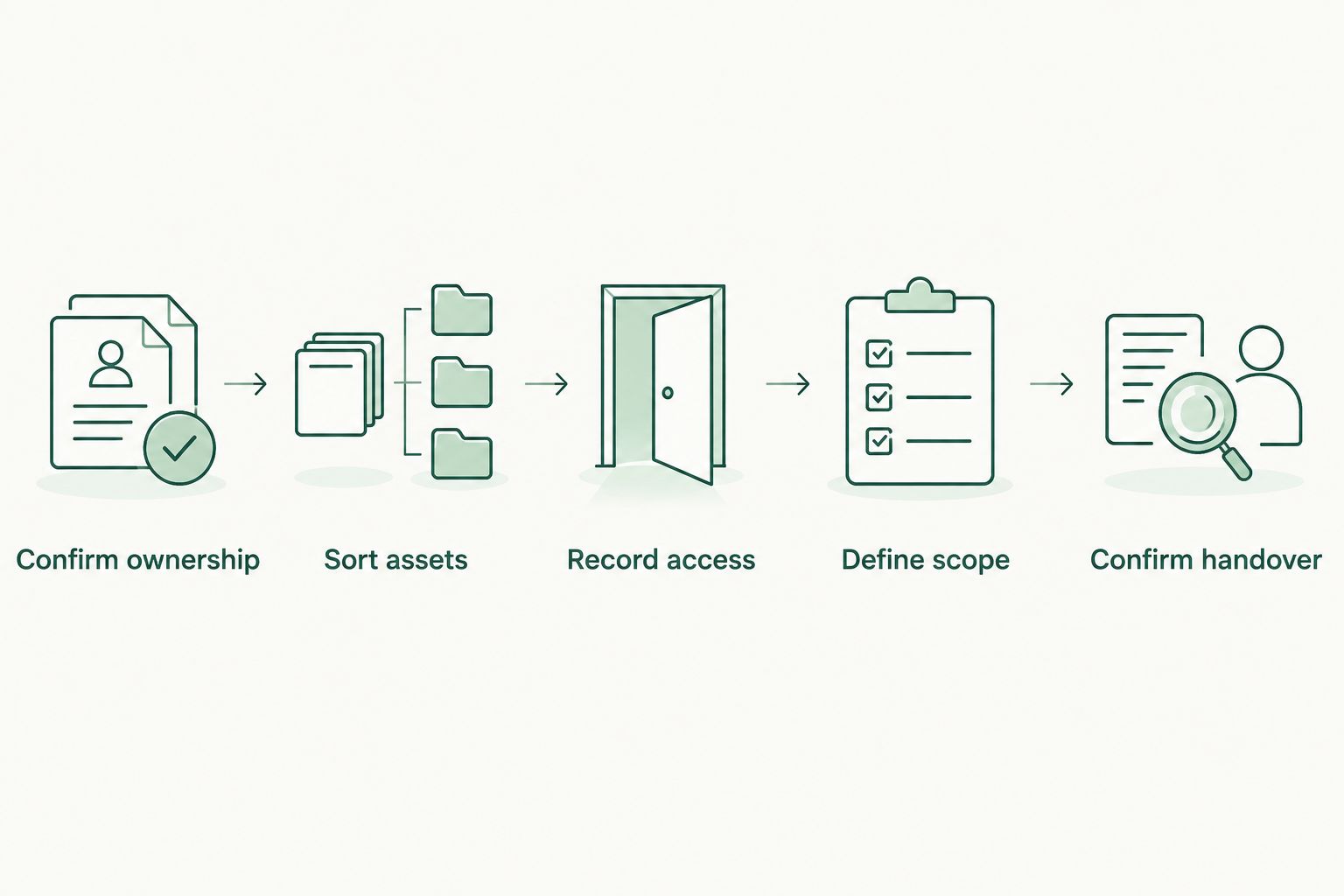
*Define what can leave before asking a provider to assess the removal job.*
What changes when a store fit-out must come out?
Removing loose contents and stripping out a retail fit-out are different jobs. A counter resting on the floor differs from a counter fixed to walls, connected to power, or integrated with plumbing.
Before comparing retail fit-out waste removal options, separate dismantling responsibilities from collection and hauling responsibilities. That distinction belongs in the scope regardless of where the store is located; local permissions and material requirements still need confirmation for your property.
Ask who will make fixtures ready for removal. Where disconnection or specialist work is required, confirm the appropriate arrangements before the hauling task begins.
Do not authorize a strip-out from a photograph alone. Confirm ownership, removal permission, and the physical work involved, especially where fixtures touch building systems or surfaces that must remain intact.
How do I compare independent providers fairly?
Send each provider the same inventory, photographs, access description, and requested tasks. Comparing different scopes tells you little about which provider fits the closure.
For a 2026 store closure, keep a dated version of that job description. If stock transfers or resale collections change the contents, send the revision to every provider you are still considering.
Ask each provider to confirm:
- Which listed items and materials it accepts.
- Whether dismantling and loading are included.
- Which access restrictions it has accounted for.
- What remains your responsibility before arrival.
- How additions or unexpected conditions require approval.
- What completion documentation it will provide, if agreed.
Expelled is best for businesses seeking to connect with independent property cleanout providers rather than hire a marketplace to perform the removal. Its role is connection; you must establish the provider’s scope, suitability, and arrangements directly.
That division matters. Do not treat a marketplace listing as confirmation that a provider accepts every material or can meet your requested schedule.
Should I sell fixtures before booking junk removal?
Sell or transfer fixtures first when you have an identified recipient and an agreed collection arrangement. Keep those assets separate from the disposal inventory until the transfer is complete or formally abandoned.
Resale adds coordination. An interested buyer is not the same as a completed collection, and a fixture still on site remains part of your handover planning.
Give each retained or transferred item a clear status. If a collection fails, update the removal scope rather than expecting a provider to absorb the change without discussion.
Does junk removal include final cleaning?
Junk removal includes final cleaning only when the provider explicitly agrees to that work. Taking away contents, sweeping loose debris, and preparing a space for landlord inspection are distinct scopes.
Write down the expected condition of floors, walls, stockrooms, and loading areas. Assign repairs and cleaning separately wherever they fall outside the removal agreement.
What should I check before handing back the keys?
Inspect the entire leased area against the agreed handover requirements. Include stockrooms, cabinets, storage areas, and any other spaces that form part of your occupancy.
For a 2026 closure, retain the final inventory, agreed scope changes, and completion photographs with your handover records. Record unresolved work separately instead of marking the whole closure complete because the largest items are gone.
FAQ
Is commercial junk removal worth it for a small store closure?
Commercial junk removal is worth it for a small store when the remaining items require handling or hauling your team cannot reasonably manage. A small floor area does not establish whether the removal task is simple.
Is renting a dumpster better than hiring a removal crew?
Dumpster rental fits staged loading, while a removal crew fits jobs requiring agreed lifting and hauling assistance. Compare placement permission, labor, accepted materials, and access before choosing.
Can a junk removal provider dismantle retail shelving?
A provider can dismantle retail shelving only if it accepts that task as part of the agreed job. Confirm ownership, fixing methods, and any specialist work before authorizing removal.
Do I need to empty the stockroom before requesting an assessment?
You do not need to empty the stockroom to describe the job, but you should show its contents and access route. Identify retained stock and property that must not be removed.
Can I assume leftover electronics will be accepted?
Do not assume a provider accepts leftover electronics. Identify the equipment in your inventory and confirm its acceptance and handling arrangements directly.
Does Expelled perform commercial store cleanouts?
Expelled does not perform the cleanout itself; it is a marketplace connecting businesses with independent providers. Confirm the removal scope and service arrangements with the provider.
What if the landlord wants the fixtures left in place?
Leave fixtures in place when the agreed handover requirements call for them to remain. Mark them clearly and exclude them from the authorized removal list.
One last thing
Photograph what must stay, not just what must go. A removal list identifies the load; a separate keep-in-place record protects fixtures, equipment, and other property that should remain untouched.
Send both records with the job description. That gives the provider a defined boundary for the work and gives you a clearer basis for the final walkthrough.