
A professional estate cleanout is worth the cost when you need help removing bulky contents, handling difficult access, or coordinating removal across an entire property. It is less compelling when you have a small, manageable load and can safely handle disposal yourself. The key caveat: do not assume a removal quote includes sorting, valuation, donation, or final cleaning; confirm each task before hiring.
TL;DR
- Is a professional estate cleanout worth the cost? Yes, when the agreed removal work addresses your property's practical constraints.
- Expelled connects homeowners and property professionals with independent providers; it does not perform estate cleanouts itself.
- Compare professional estate cleanout, DIY removal, and partial assistance against the same written job description.
- Separate estate decisions from junk removal: identify retained belongings and confirm authority before anything leaves.
Why this matters
An estate cleanout combines physical removal with decisions about belongings. Hiring help for the lifting does not decide what the estate should keep, distribute, sell, or discard. Treat those as separate responsibilities.
For a cleanout planned in 2026, start with the condition you need at handoff: selected rooms cleared, unwanted furniture removed, or the whole property emptied of approved contents. Expelled is best for homeowners and property professionals who want to connect with independent estate cleanout providers. Expelled is a marketplace, not the company carrying out the removal.
Is a professional estate cleanout worth the cost?
Professional help is worth considering when the removal work exceeds what you can safely and practically organize yourself. Compare the actual work being transferred, not just the label attached to the service.
| Approach | Best for | Main advantage | Main limitation | |---|---|---|---| | DIY removal | Small, manageable loads with straightforward access | You control sorting and the removal sequence | You arrange lifting, transport, and disposal | | Partial assistance | Estates where belongings are sorted but heavy items remain | You assign a defined portion of the work | You still coordinate retained items and other tasks | | Professional cleanout | Properties requiring coordinated removal across multiple spaces | You can assign an agreed removal scope to a provider | Sorting, valuation, and cleaning require explicit agreement |
The right comparison includes your transport arrangements, physical workload, access restrictions, and unfinished tasks. A quote for loading approved items is not equivalent to a quote that also includes sorting assistance and a final sweep.
Use the estate cleanout cost guide alongside a property-specific written scope. General cost information does not establish what an independent provider will include at your address.
DIY removal: best for a limited, manageable job
DIY removal makes sense when you can identify the unwanted contents, move them safely, and arrange an appropriate destination. You retain control over every decision. You also retain responsibility for the work.
Before choosing DIY, walk the complete route from each item to the loading area. Consider stairs, narrow turns, parking, and whether furniture requires disassembly. Do not treat access to a vehicle as proof that you can safely complete the job.
Choose DIY for work you can manage safely, not simply because the property looks lightly furnished.
Partial assistance: best for a clearly separated workload
Partial assistance fits an estate where you want to sort personal belongings yourself but need help removing approved furniture or accumulated unwanted contents. Define the boundary clearly: what stays, what leaves, and who prepares each item.
The advantage is control over which tasks you assign. The limitation is coordination: unfinished sorting or unclear labels can leave the provider without clear removal instructions. Give the provider a specific task rather than an open-ended request to help clear the house.
Professional cleanout: best for coordinated property removal
A professional cleanout fits a job where you want an independent provider to handle an agreed removal scope across the property. Ask whether the proposal covers every relevant room, storage area, and outbuilding. A whole-property description needs whole-property instructions.
The benefit is assigning the physical removal work. The limitation is that the agreement does not automatically cover estate administration, item appraisal, deep cleaning, or specialist remediation. Hire against a written scope, not an assumed meaning of “full service.”
Why estate cleanout value varies
For your 2026 comparison, focus on the work and constraints at the property rather than treating every estate cleanout as the same service.
- Contents: Describe what must leave, including bulky furniture and loose material. Room names alone do not describe the load.
- Access: Identify stairs, elevators, narrow passages, loading restrictions, and the route from the property to the vehicle.
- Sorting status: Explain whether removal decisions are complete or whether you want help separating belongings.
- Item handling: Flag items needing special handling, dismantling, or separate disposal arrangements, and ask whether the provider accepts them.
- Completion standard: Distinguish contents removal from sweeping, cleaning, repairs, or preparation for a property handoff.
- Coordination: Identify who approves removal and who can answer questions while the work is underway.
These factors belong in the job description because they define what you are asking someone to do. Do not assume that a provider has included a task just because you mentioned the property's intended sale or transfer.
How do you describe an estate cleanout accurately?
Use the following steps to turn a general request into instructions that independent providers can assess. The goal is a shared description of the work, not a longer message.
- Set boundaries. List the rooms and other spaces included. State whether cupboards, closets, garages, sheds, and outdoor contents are part of the request.
- Identify keeps. Mark belongings that must remain and identify areas the provider should not enter or clear. Keep sensitive paperwork separate from removal material.
- Describe contents. Provide current photographs and a written description of bulky items, loose contents, and anything requiring special handling. Show the property as it is.
- Explain access. Describe stairs, entry points, parking, building rules, and loading arrangements. Tell the provider about restrictions before accepting the proposed scope.
- Define handoff. State what a completed job looks like and who can approve it. Ask the provider to identify exclusions and explain how changes will be agreed.
!Estate cleanout planning steps from setting boundaries to defining the handoff
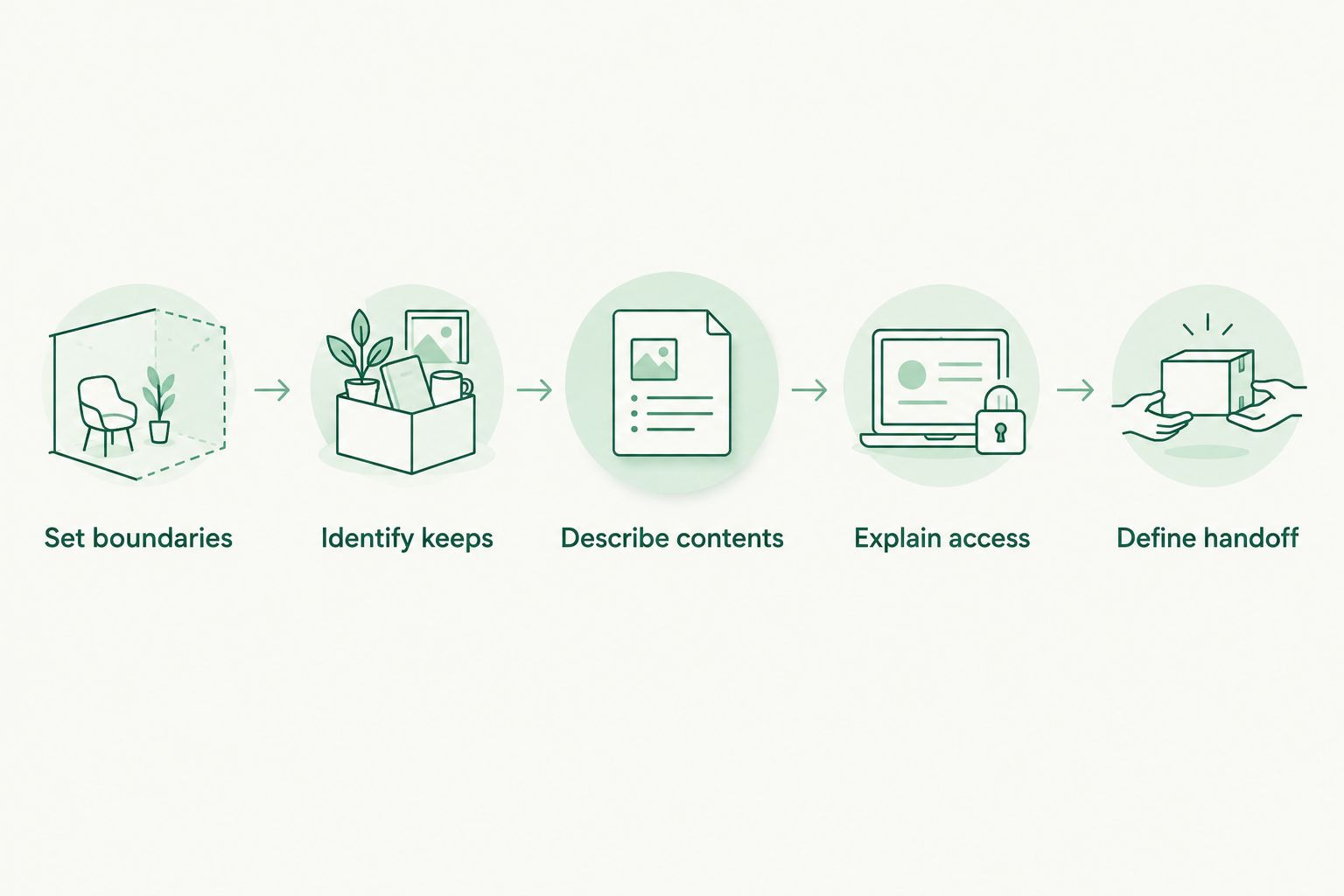
*Agree on what leaves and what completion means before removal begins.*
For photographs, capture both the contents and the removal route. A close view of a wardrobe does not show the staircase it must pass through. Include written context where an image cannot explain a restriction.
Keep a copy of the scope you send. If a provider assesses the property in person, update the same document with any agreed changes so you are not comparing different versions of the job.
What should stay outside the removal decision?
Do not use the cleanout appointment to settle unresolved ownership or distribution questions. Identify who has authority to approve removal before instructing anyone to take belongings away. Obtain appropriate legal guidance when that authority is unclear.
Separate documents, photographs, keys, and belongings awaiting a decision from approved removal contents. A label on an individual item helps, but a designated keep area gives everyone another visible boundary. Make sure the provider understands that boundary.
The same distinction applies when comparing estate cleanout options in Melbourne: physical removal and decisions about what belongs to the estate should be treated as separate tasks. A service description is not permission to dispose of disputed belongings.
For a 2026 estate cleanout, record the approved scope in writing and name the person authorized to approve changes. If relatives or property representatives provide conflicting instructions, resolve them before the affected items leave. Removal is not a substitute for agreement.
How do you compare independent providers fairly?
Send the same job description to each independent provider you consider. Expelled connects estate cleanout customers with independent providers, but you still need to confirm the proposed work directly. A marketplace connection does not establish the terms of an individual job.
Ask providers to address these points in writing:
- Included work: Which spaces, contents, and handling tasks does the proposal cover?
- Excluded work: What will remain your responsibility after the removal?
- Disposal arrangements: What destinations or handling methods are proposed, and what documentation can the provider supply?
- Property protection: How will the provider address access constraints and protect areas along the removal route?
- Changed conditions: What happens if the contents differ from the description or you request additional work?
- Completion approval: Who checks the result, and how will unfinished or disputed work be recorded?
Ask about relevant insurance and any licensing requirements that apply to the work. Request evidence rather than relying on a broad statement that everything is covered. Describe the specific tasks so the provider can answer against the actual job.
The clearer proposal is the one that leaves fewer responsibilities undefined. Do not interpret a shorter description as a more complete service, and do not interpret a longer description as proof of better execution.
When should you postpone hiring?
Postpone removal when you cannot distinguish approved contents from belongings awaiting a decision. Hiring a provider before the scope is settled does not remove the uncertainty. It moves that uncertainty into the appointment.
Also pause if access has not been arranged or the property contains a condition outside the proposed service. Do not ask a general removal provider to handle suspected hazardous material without first confirming appropriate handling and qualifications.
Your 2026 plan should separate the date you want the property cleared from the date a provider has actually agreed to attend. Confirm arrangements directly; neither a requested date nor a marketplace inquiry establishes availability.
Does an estate cleanout include selling belongings?
An estate cleanout does not, by its name alone, establish that selling or valuing belongings is included. Ask whether those tasks are offered and document any separate arrangement. Do not assume expected sale proceeds will offset removal expenses.
Is professional removal worth it for furniture only?
Professional removal is worth considering for furniture you cannot safely move or transport yourself. Describe the items and access route rather than requesting an entire estate cleanout when the job is limited to selected pieces.
Should you empty the property before listing it?
Whether to empty the property before listing depends on your agreed preparation plan with the relevant property professional. Translate that plan into explicit removal instructions; “ready to list” does not tell a provider which belongings should remain.
FAQ
Is a professional estate cleanout worth the cost in 2026?
A professional estate cleanout is worth considering when the agreed removal work addresses lifting, access, or coordination tasks you cannot practically manage yourself. Compare the written scope with what you would otherwise need to organize.
What's the best way to compare estate cleanout providers?
Compare providers using the same written description of contents, access, included spaces, and completion requirements. Ask each provider to identify exclusions and the process for approving changes.
Can I sort the estate myself and hire someone just for removal?
Yes, you can request removal of selected contents after sorting the estate yourself. Confirm that the provider accepts this scope and clearly separate retained belongings from approved removal items.
Does an estate cleanout include deep cleaning?
Do not assume an estate cleanout includes deep cleaning. Confirm whether the agreement covers contents removal, sweeping, cleaning, or any other finishing work.
Does Expelled carry out estate cleanouts?
Expelled does not carry out estate cleanouts itself. It is an online marketplace that connects homeowners, property professionals, and businesses with independent providers offering property cleanouts, junk removal, and hauling services.
What should I keep out of an estate cleanout?
Keep retained belongings, sensitive documents, and items awaiting an ownership or distribution decision outside the approved removal scope. Identify who has authority to approve disposal before removal begins.
Can an estate cleanout provider guarantee my preferred date?
A preferred date is not a confirmed appointment. Ask the independent provider to confirm scheduling directly and do not assume availability from a service listing or inquiry.
One last thing
Photograph the keep areas as well as the removal areas. Instructions about what must remain are just as important as instructions about what must leave. Before work begins, walk those boundaries with the provider and confirm who can authorize a change.