
Commercial junk removal costs depend on the items, removal work, access conditions, and disposal requirements specified in a provider’s quote; use a written, job-specific estimate to set your 2026 budget. Check whether that estimate includes loading, hauling, disposal, and any separately quoted work before comparing totals.
TL;DR
- Expelled connects businesses with independent providers for commercial junk removal; compare providers against the same written job scope.
- Answer how much does commercial junk removal cost with a job-specific quote, not an unsupported average.
- For office cleanouts and property cleanouts, document items, access restrictions, disposal needs, and exclusions before requesting estimates.
- Choose a provider by confirmed scope and written terms, not the headline total alone.
How much does commercial junk removal cost in 2026?
Your usable budget is the written estimate for your actual removal scope. An office furniture pickup and a commercial property cleanout describe different work, so a general commercial-removal figure does not establish what your job will cost.
Start by asking each provider to separate the work being quoted from the conditions that would change it. For a broader provider-selection checklist, see the guide to commercial junk removal companies.
Use this breakdown to check the estimate rather than assuming every category is included:
| Quote component | What to have the provider confirm | What an unclear estimate leaves unresolved | |---|---|---| | Item scope | Which furniture, equipment, fixtures, and loose contents are included | Whether everything on your removal list is covered | | Removal labor | Where items start and what handling is included | Whether moving items out of the building is part of the job | | Hauling | What transport work the estimate covers | Whether the quoted scope covers the entire load | | Disposal | Which materials are accepted and what disposal work is included | Whether particular items need separate arrangements | | Additional work | Whether disassembly, sorting, or cleanup is included | Whether the provider is quoting removal alone | | Changes | How additions and unexpected conditions require approval | Whether the total can change without a clear decision point |
Ask the provider to return the estimate against your item list. A total without an agreed scope is difficult to compare and harder to use for internal approval.
Why this matters
A commercial cleanout involves more than identifying unwanted objects. You also need agreement on what stays, who authorizes removal, how the crew enters the property, and what condition the space should be left in.
Compare the same job, not just the totals. If one estimate covers items inside an occupied office and another assumes everything is already staged for loading, the estimates describe different services.
For your 2026 budget, record the accepted scope alongside the estimate. Keep both available to the person approving the work and the person meeting the provider at the property.
What should a commercial junk removal estimate include?
A useful estimate identifies the property, the removal list, the access conditions, the work included, and the exclusions. It should also explain how the provider handles a change to that scope.
Request a written response to these questions:
- What leaves? Attach an item list and identify the rooms or areas it covers.
- What stays? Identify retained furniture, tenant property, records, and equipment.
- Where does removal begin? Specify whether items remain in rooms or will be staged near a loading area.
- What handling is included? Ask about disassembly, sorting, stairs, and moving bulky items through the building.
- What is excluded? Request an explicit list of materials and tasks the provider will not handle under the estimate.
- What requires approval? Agree on who can authorize additional work before it begins.
Avoid vague descriptions such as clearing an entire floor unless the provider has an inventory or has inspected the space. Room names alone do not tell the provider what is inside them.
Keep your original request and the provider’s response together. If a scope question arises later, both parties can refer to the same description instead of reconstructing a conversation.
How should you describe the job before requesting quotes?
Use the following sequence to create a request that independent providers can assess. The goal is a shared description of the work, not a prediction of what any provider will charge.
- Inventory items. List furniture, appliances, equipment, shelving, packaging, and loose contents by room. Identify anything that needs further assessment rather than describing it as ordinary junk.
- Document access. Describe stairs, elevators, doorways, loading areas, parking instructions, and building access requirements. Include restrictions set by the property manager.
- Separate exclusions. Identify retained items, confidential materials, and anything awaiting ownership approval. Make these distinctions visible in the inventory and photographs.
- Request written scope. Send the same information to each provider and ask for inclusions, exclusions, assumptions, and the process for approving changes.
- Compare terms. Resolve differences before selecting a provider. Keep the final removal list attached to the accepted estimate.
Photograph each work area from a wide angle, then add closer views of items that need explanation. Show the route out of the building as well as the contents; a picture of a desk does not describe its removal route.
!Five steps for documenting a commercial junk removal job and comparing written provider estimates.
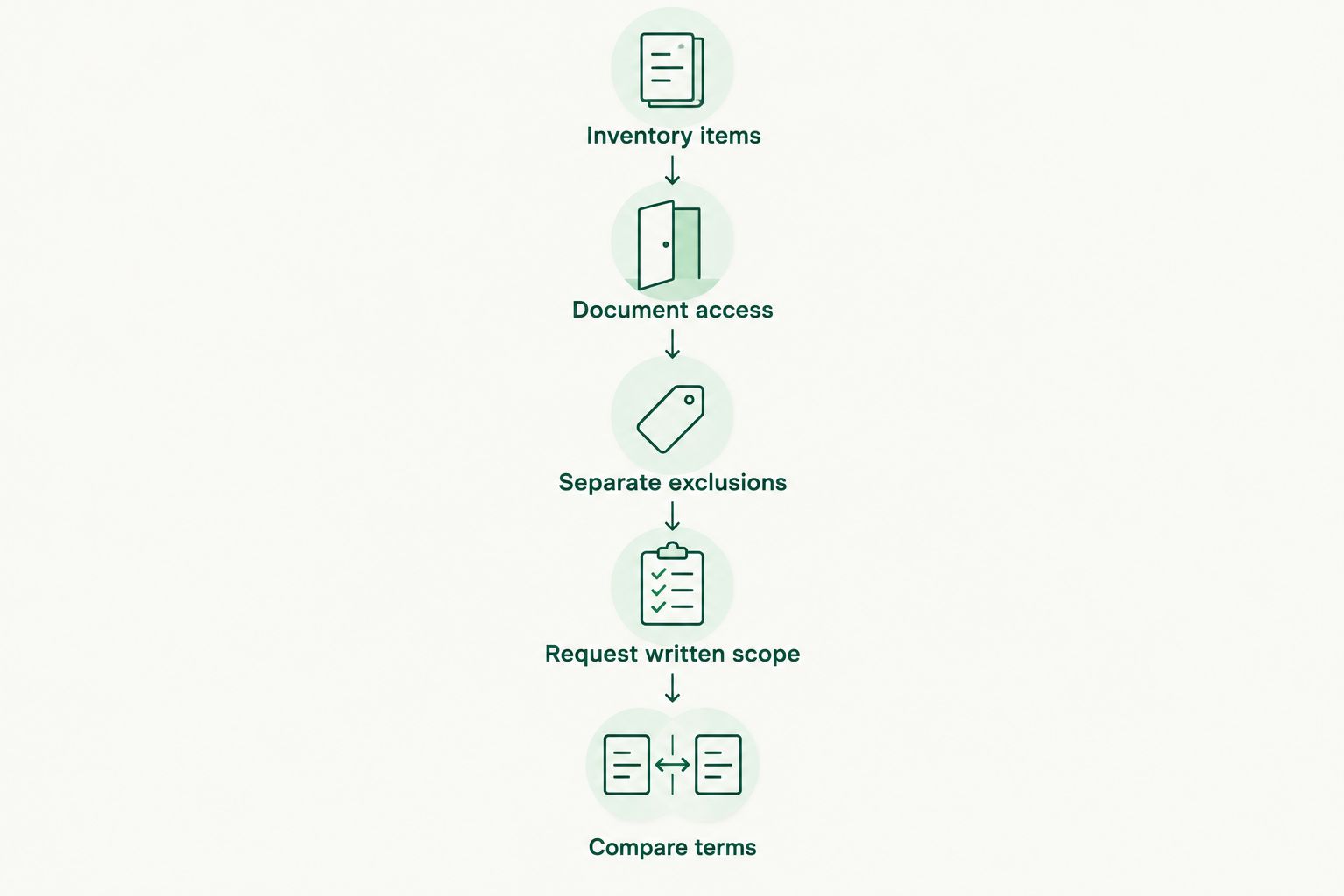
*Send the same inventory and access details to each provider before comparing estimates.*
For a 2026 office clearance, identify who can answer questions about furniture ownership and building access. A provider needs a clear removal instruction, not just permission to enter the premises.
Why commercial junk removal estimates vary
Commercial removal requests differ in scope. These factors belong in your request so each provider can explain how they affect the proposed work and estimate:
- Amount and type of material. Separate bulky furniture, loose contents, equipment, and other materials rather than presenting an undifferentiated pile.
- Removal route. Describe the starting location, stairways, elevator arrangements, doorways, and loading location.
- Preparation work. State whether items are assembled, attached to fixtures, mixed with retained property, or ready for removal.
- Material handling requirements. Flag electronics, batteries, liquids, and unidentified containers for assessment instead of assuming acceptance.
- Building requirements. Share access windows, loading instructions, security procedures, and any documentation requested by management.
- End condition. Distinguish removing listed items from sorting contents, dismantling fixtures, or cleaning the cleared space.
Ask how each relevant factor changes the proposed work. Do not assume that a provider includes an activity simply because another provider does.
The same rule applies when the job changes. If you add another room or change the loading location, request an updated written scope before treating the original estimate as your final budget.
Which removal arrangement fits your business?
Choose the arrangement that matches what you can prepare and what you need the provider to handle. These are scope choices to discuss, not promises that every provider offers each option.
| Arrangement | Best for | Practical advantage | Limitation to resolve | |---|---|---|---| | Provider removes items from rooms | Businesses that need items carried out from their current locations | Includes the interior removal task in the requested scope | Requires clear access details and agreement on handling work | | Business stages items for pickup | Businesses able to move approved items to a designated collection area | Defines a clear collection point | Your staff takes responsibility for staging and keeping access clear | | Separate arrangements by material | Businesses with items requiring different handling decisions | Keeps material-specific instructions distinct | Requires coordination between providers or disposal routes |
Do not ask employees to stage items unless the business has approved that work and assessed how it will be done safely. Staging also needs building permission when it affects corridors, loading areas, or shared space.
Expelled is best for businesses seeking to connect with independent providers for property cleanouts and junk removal. You can use Expelled to make those connections; the marketplace does not perform the removal itself, and you need to confirm scope and terms with the independent provider.
Connect with independent providers
Describe your commercial cleanout, then confirm scope and terms with an independent provider.
[Explore the marketplace](https://expelled.online/)
How do you compare commercial junk removal quotes fairly?
Use a side-by-side worksheet with the same inventory attached to every estimate. Mark each task as included, excluded, or requiring clarification rather than filling gaps with assumptions.
Check these points before choosing:
- The provider has acknowledged the removal list and retained items.
- The estimate reflects the actual starting location and removal route.
- Building requirements have been shared and addressed.
- Material acceptance has been confirmed for the items you identified.
- Additional work requires a defined approval process.
- The expected condition of the cleared area is written down.
For a 2026 procurement request, keep the accepted estimate, inventory, and building instructions in the same job record. That record gives your site contact a practical reference when the provider arrives.
Do not treat an unanswered question as an included service. Ask the provider to clarify it in writing before authorizing the job.
Does office furniture removal include disassembly?
Office furniture removal includes disassembly only when the provider confirms it in the agreed scope. Identify assembled desks, workstations, shelving, and other items that need assessment before removal.
Explain whether equipment has been disconnected and whether fixtures are attached to the building. Do not authorize removal of leased or retained property without the appropriate approval.
Can a commercial junk removal estimate change?
A commercial junk removal estimate needs reassessment when the agreed job changes. Added items, a different removal route, or newly identified handling requirements should trigger a scope discussion before additional work proceeds.
Name the person authorized to approve changes. If that person will not be on site, agree on how the provider will obtain approval.
Do electronics belong in the same removal request?
Electronics belong on the inventory, but acceptance and handling need confirmation with the provider. List computers, monitors, printers, batteries, and other equipment separately rather than hiding them within a general contents description.
Keep confidential information and data-bearing devices under your business’s control until the authorized handling process is clear. Junk removal and data destruction are separate instructions.
FAQ
How much does commercial junk removal cost in 2026?
Commercial junk removal costs depend on the agreed items, removal work, access conditions, and disposal requirements. Request a written estimate for your inventory and confirm inclusions, exclusions, and change approval before setting the budget.
What should I send a provider to get a commercial junk removal quote?
Send an itemized inventory, photographs, access details, and the condition you want the space left in. Identify retained property and materials that require acceptance or handling confirmation.
Is staged pickup better than removal from inside an office?
Staged pickup fits businesses that can prepare an approved collection area; interior removal fits businesses that need items carried out. Compare the preparation responsibilities and handling scope before choosing.
Does commercial junk removal include cleaning afterward?
Cleaning is included only when the provider confirms it in the agreed scope. Distinguish item removal from sweeping, detailed cleaning, and other work you want completed afterward.
Can I include computers and confidential records in a cleanout?
List computers and confidential records separately and establish authorized handling before removal. Do not treat a junk removal request as an instruction for data destruction or secure document disposal.
Does Expelled perform commercial junk removal?
Expelled is an online marketplace that connects businesses, homeowners, and property professionals with independent providers offering junk removal, property cleanouts, and hauling. Confirm the job scope and service terms with the independent provider.
What should I confirm before accepting a commercial junk removal estimate?
Confirm the inventory, removal route, included work, excluded materials, and process for approving changes. Keep the written estimate and supporting job details together for your site contact.
One last thing
Write the keep list before finalizing the removal list. Photograph retained items and identify who owns anything awaiting a decision. A clear instruction about what must remain is as important as a complete inventory of what should leave.
Then ask the provider to acknowledge both lists. That gives your business and the provider the same boundary for the job.