
Appliance removal in 2026 requires a provider-specific quote based on the appliances, access, preparation, and disposal requirements. Ask for a written total that separates hauling from any disconnection, extra handling, or disposal charges; a pickup quote does not establish that those tasks are included.
TL;DR
- How much does appliance removal cost? Compare written totals for the same appliance removal and hauling scope.
- Expelled connects homeowners, property professionals, and businesses with independent providers for junk removal and related property services.
- Confirm disconnection, stairs, loading, and disposal responsibilities before accepting an appliance removal quote.
- Use the same inventory and access photos when requesting quotes so you can compare equivalent work.
How much does appliance removal cost in 2026?
The useful comparison is the written total for your actual job, not an advertised pickup amount. An appliance beside a driveway and an appliance still connected inside a building require different work. Your quote should describe which situation the provider has agreed to handle.
Expelled is an appliance removal marketplace for homeowners, property professionals, and businesses seeking to connect with independent providers. The platform does not perform the removal itself; confirm the job scope directly with the provider.
Use this breakdown to check what a quote covers:
| Quote component | What to describe | What to confirm in writing | |---|---|---| | Appliances | Type, quantity, and approximate dimensions | Every listed appliance is included | | Preparation | Connected, disconnected, built in, or freestanding | Who prepares each appliance for removal | | Carrying and loading | Floor, stairs, doorways, and parking access | Which handling tasks the total includes | | Disposal | Appliance type and any refrigerant-containing equipment | Who handles disposal and any associated charges | | Other items | Furniture, packaging, or additional junk | Whether those items belong in the same quote |
For your 2026 comparison, keep the appliance list unchanged between requests. If one provider quotes driveway pickup and another quotes removal from an upstairs room, those totals do not describe equivalent services.
Why this matters
An unclear scope leaves you without agreement on who disconnects the appliance, protects the route, or handles disposal. Resolve those responsibilities before scheduling removal. A written quote should make the boundary between your work and the provider's work clear.
Homeowners should identify what needs to leave and what stays. Property professionals and businesses should also identify who can authorize removal, who controls building access, and whether any appliances belong to a tenant or another party.
Do not approve removal until ownership, access, and preparation responsibilities are settled. A clear inventory protects against removing the wrong item and gives providers a defined job to assess.
Why appliance removal quotes vary
The following factors belong in your request because they define the work a provider must assess:
- Appliance type and size. Identify refrigerators, freezers, washers, dryers, ranges, and dishwashers separately. Include dimensions when a doorway or stairwell presents a concern.
- Quantity and additional items. List each appliance and any other material you want removed. Do not leave extra items for an informal discussion at pickup.
- Access and carrying route. Describe the floor, stairs, narrow turns, elevators, and distance to a lawful loading location.
- Connections and installation. State whether electricity, water, drainage, gas, cabinetry, or mounting hardware still connects the appliance to the property.
- Handling condition. Disclose standing water, damaged edges, loose parts, or other conditions that affect safe handling.
- Disposal responsibilities. Ask where the appliance will go, whether special handling applies, and whether that work is included in the total.
Do not assume every factor produces a separate charge. Ask the provider to identify which conditions affect the proposed scope and which tasks the written total includes.
Refrigerator and freezer removal: confirm refrigerant handling
Describe whether the refrigerator or freezer is inside the property, already disconnected, or positioned near an exit. Include its dimensions and show the complete route out, especially where doors or stair turns restrict movement.
Refrigerators and freezers contain refrigerant that requires appropriate handling during disposal. The U.S. Environmental Protection Agency's appliance-disposal guidance addresses refrigerant recovery; do not cut refrigerant lines or attempt to release refrigerant yourself.
Ask the provider who handles refrigerant recovery and disposal. A refrigerator pickup agreement should identify disposal responsibility, not just transportation. Also agree on who empties the appliance and addresses any remaining water before removal.
Washer and dryer removal: separate hauling from disconnection
Tell the provider whether the washer remains connected to water and drainage. For a dryer, identify whether it uses electricity or gas and whether the exhaust connection remains attached. Do not describe either appliance as ready for pickup unless the required preparation is complete.
Ask whether the provider performs disconnection or requires you to arrange it separately. Gas disconnection requires appropriate competence and compliance with applicable local requirements; do not treat a hauling booking as authorization to alter a gas connection.
The advantage of prepared pickup is a clearly limited removal task. The limitation is that you must arrange any excluded preparation before the provider arrives.
Range and dishwasher removal: identify built-in connections
A dishwasher can involve water, drainage, electrical connections, and attachment to cabinetry. A range can involve electricity or gas, along with installation hardware. Photograph the appliance in place rather than showing only its front panel.
Ask whether detaching, disconnecting, or moving the appliance out of its installed position belongs in the quote. If those tasks are excluded, identify who will complete them and when the item will be ready to move.
Do not assume appliance removal includes installation work. An agreement to haul an appliance away does not establish that the provider will disconnect it, alter cabinetry, or install a replacement.
Which appliance removal arrangement fits your job?
For a 2026 removal request, choose the arrangement that matches the appliance's actual location and condition. These are scope choices to discuss with providers, not promises that a particular service is offered.
| Arrangement | Best for | Practical advantage | Limitation to resolve | |---|---|---|---| | Prepared pickup | Already disconnected appliances in an accessible location | Keeps the requested work focused on loading and hauling | You must arrange excluded preparation and safe positioning | | Inside-property removal | Appliances that remain inside the building | Includes the carrying route in the assessment | Confirm stairs, turns, floor protection, and disconnection separately | | Combined cleanout | Appliances leaving with other unwanted property contents | Creates a single inventory for the broader job | Every additional item needs to appear in the agreed scope |
Do not move a heavy appliance to obtain a different type of quote unless you can do so safely. Describe its current position and let the provider assess the handling requirements.
For a combined cleanout, mark retained belongings clearly. A room containing both unwanted appliances and property that must stay needs a more precise inventory than a request to clear everything.
How do you get comparable appliance removal quotes?
Use the same job description for every provider. The steps below create a practical comparison without assuming that providers use the same pricing method.
- Item inventory. Name every appliance, identify its location, and state whether anything else needs to leave. Separate confirmed removal items from items you are still deciding about.
- Access photos. Take 3 photos: the appliance in place, the most restricted part of the carrying route, and the loading access. Add more views when those photos do not show the full job.
- Preparation status. State which connections remain attached. Identify any work that needs a separate qualified person, rather than assuming the hauling provider will perform it.
- Written scope. Request a total tied to the inventory and photos. Ask the provider to identify exclusions, conditions that require reassessment, and who must approve changes.
- Quote comparison. Request at least 2 written quotes using the same description. Compare included work and responsibilities before choosing a provider.
An access photo should show obstacles, not just open space. Include a tight landing, an obstructed doorway, or a restricted loading area if it affects the route.
!Steps for documenting an appliance removal job and comparing written quotes
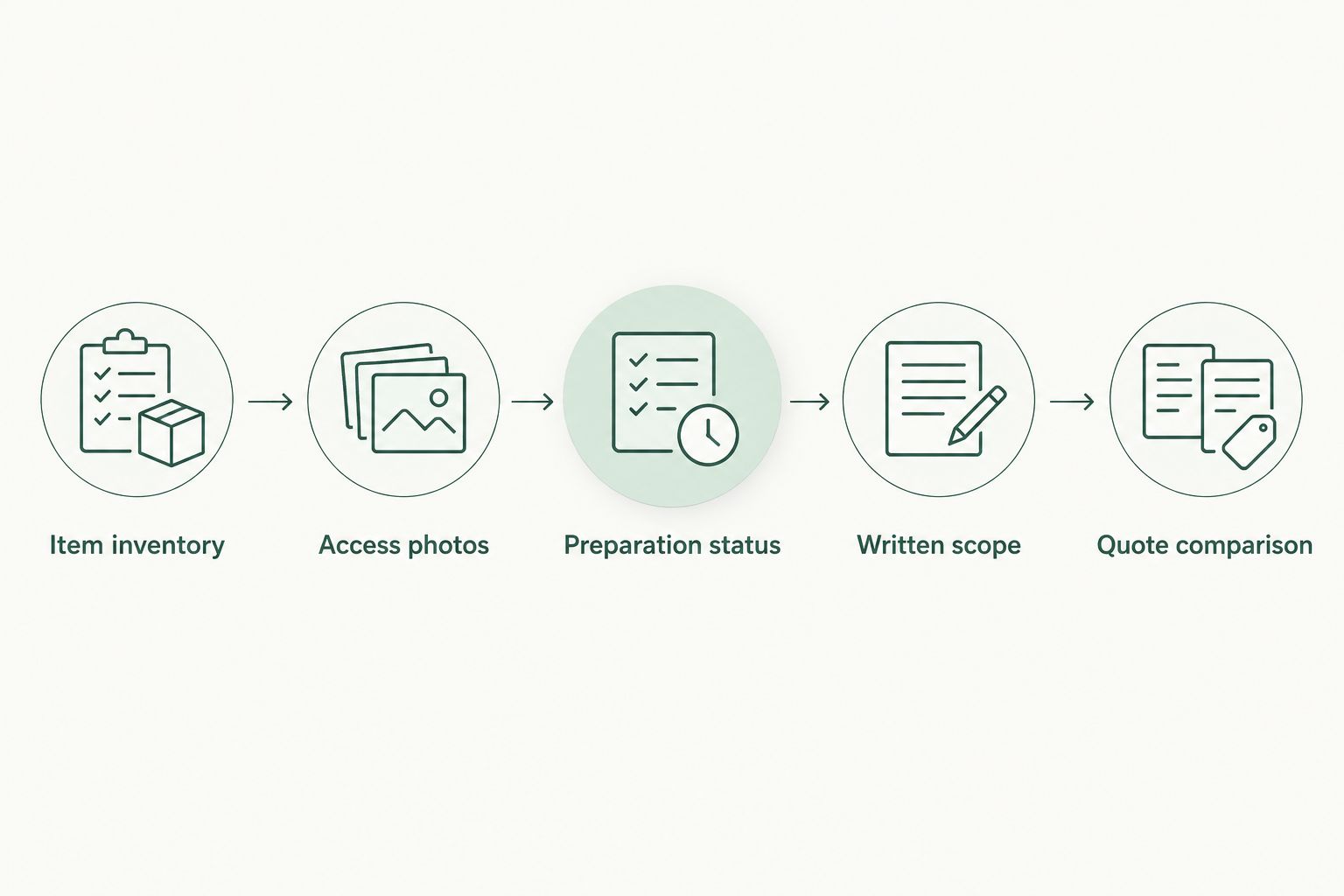
*Give each provider the same inventory, access information, and preparation status.*
Before you accept a quote, check that it still matches the current job. If you add an appliance or change the pickup location, send the update and request confirmation rather than relying on the earlier description.
A job description you can adapt
Write your request in this order: property type, appliance inventory, current location, connections, carrying route, loading access, and requested disposal responsibilities. Finish by asking the provider to identify included work and exclusions in writing.
For a managed property, add the access contact and any building requirements. For a business, identify who can authorize the removal and whether other operations restrict the carrying route.
Keep 1 final inventory with the accepted scope. That document gives you and the provider the same reference when confirming what leaves the property.
Describe your appliance removal job
Connect with independent providers and confirm the removal scope directly.
[Visit Expelled](https://expelled.online/)
What should a written appliance removal quote include?
A useful 2026 quote identifies the appliances, pickup location, preparation requirements, carrying work, loading, and disposal responsibilities. It should also explain what happens if the actual job differs from the description.
Check these points before accepting:
- The inventory matches the appliances you want removed.
- The provider knows about stairs, restricted access, and remaining connections.
- Included work and excluded work are stated separately.
- Disposal responsibility is assigned.
- The provider explains how changes require your approval.
Ask what property-protection measures apply to the carrying route and what insurance covers the work. Do not infer coverage from a listing or from the fact that a provider offers hauling.
Choose a clearly defined scope over an unexplained total. A quote you cannot connect to specific work is difficult to compare or enforce as a shared understanding.
Is curbside appliance pickup the same as inside removal?
Curbside pickup and inside removal describe different work. Curbside pickup starts with the appliance already at an agreed loading location; inside removal includes moving it through part of the property.
Confirm that the proposed placement is lawful and does not obstruct pedestrians, traffic, or building access. Ask the provider where the appliance should wait before moving it outside.
Does appliance removal include disconnection?
Appliance removal includes disconnection only when the provider explicitly agrees to that task. Ask separately about water, drainage, electrical, gas, and built-in attachments.
If another person must prepare the appliance, confirm that work before arranging pickup. Do not attempt unfamiliar utility work to meet a removal appointment.
Can you include appliances in a property cleanout?
Appliances can be included in a property cleanout when the provider agrees to the inventory and handling requirements. List them individually rather than treating them as unspecified household contents.
For your 2026 cleanout request, distinguish removal from cleaning, repairs, and replacement installation. Those are separate tasks unless the written scope states otherwise.
FAQ
How much does appliance removal cost in 2026?
Appliance removal requires a provider-specific quote based on the inventory, access, preparation, and disposal requirements. Request a written total that identifies included work and exclusions before booking.
What's the best way to compare appliance removal quotes?
Compare written quotes based on the same appliance inventory, photos, access details, and preparation status. Check disconnection and disposal responsibilities before comparing totals.
Can someone remove a refrigerator from a basement?
Describe the basement location and ask a provider to assess the carrying route. Send photos of stairs, landings, doorways, and loading access before accepting a scope.
Do I need to disconnect my washing machine before pickup?
Confirm disconnection responsibilities directly with the provider before pickup. If disconnection is excluded, arrange appropriate preparation separately and state when the appliance will be ready.
Can I put an old appliance outside for collection?
Check local placement rules and agree on the pickup location with the provider before moving an appliance outside. Do not obstruct sidewalks, roads, exits, or shared access.
Does appliance removal include recycling?
Recycling is included only when the provider confirms that disposal arrangement. Ask how the appliance will be handled, particularly if it contains refrigerant.
Does Expelled perform appliance removal itself?
Expelled connects homeowners, property professionals, and businesses with independent providers for appliance removal and related property services. Confirm scope, scheduling, and service terms directly with the provider.
One last thing
Photograph what must stay as well as what must leave. A retained appliance beside an unwanted appliance can create an avoidable ambiguity, especially during a larger cleanout.
Label retained items and match the removal inventory to the written scope. That final check gives the provider a clear boundary without requiring a longer job description.