
An estate cleanout cost in 2026 depends on what needs to leave the property, the work required to remove it, and the services included in the provider’s written quote. Get a property-specific, itemized quote rather than budgeting from a whole-house label alone. Confirm whether sorting, furniture disassembly, hauling, disposal, and final cleaning are included or handled separately.
TL;DR
- How much does an estate cleanout cost? Get an itemized quote covering removal, hauling, disposal, and exclusions.
- Compare estate cleanout quotes against the same room inventory and access details.
- Separate belongings to keep from items approved for junk removal before requesting quotes.
- Expelled connects homeowners, property professionals, and businesses with independent providers for property cleanouts and related services.
Why this matters
A quote for removing selected furniture is not the same scope as clearing every room, the garage, and the basement. Treating those jobs as equivalent makes the quoted totals difficult to compare. Your first task is to define the work, not choose the smallest number.
Expelled is best for homeowners, property professionals, and businesses seeking connections with independent property cleanout providers. The marketplace does not perform the cleanout itself; you need to confirm the work and terms with the independent provider.
How much does an estate cleanout cost in 2026?
Your estate cleanout quote should describe the property, the contents approved for removal, and the condition you expect afterward. A useful quote tells you both what the provider will remove and what the provider will leave behind. Without that distinction, even a detailed inventory leaves room for disagreement.
Ask the provider to separate these parts of the job in writing:
| Scope component | What to describe | What to confirm in the quote | |---|---|---| | Sorting | Mixed belongings, documents, and items awaiting family decisions | Whether sorting is included or must happen beforehand | | Removal labor | Furniture, boxed contents, loose items, and bulky objects | Which items and rooms the provider will handle | | Access | Stairs, elevators, parking restrictions, and loading routes | Whether the quote reflects the actual route out | | Hauling and disposal | Contents approved to leave the property | Which handling and disposal charges are included | | Separate destinations | Items intended for relatives, donation, or another location | Whether those trips are part of the agreed work | | Final condition | Empty rooms, remaining fixtures, debris, and floor cleaning | Exactly what completion means |
For a 2026 comparison, send the same description and photographs to every provider. If you change the scope after receiving an estimate, send the updated information to each provider before choosing.
Do not treat an estimate based on photographs as permission to add unlisted items. Ask what happens if the provider arrives and finds more contents, restricted access, or materials outside the original description.
Selected-item removal: best for a limited, approved list
Selected-item removal fits an estate where the family has already decided what stays and only specific contents need to leave. Its main advantage is a clear boundary: you can identify each approved item and keep unrelated rooms outside the job.
The limitation is that anything omitted remains outside the agreed scope. A furniture list does not automatically cover drawers full of belongings, loose garage contents, or items discovered later in storage.
Choose selected-item removal when you can identify everything leaving the property. Photograph each item in its current location and describe the route to the loading area. Mark nearby belongings that must remain so the removal instructions do not depend on appearance alone.
Room-by-room cleanout: best for a partially cleared property
A room-by-room scope fits an estate where some spaces are ready to clear while others still contain belongings under review. It gives you a practical way to separate approved work from unresolved decisions.
The drawback is boundary management. Instructions such as clear the upstairs are less precise than naming each bedroom, closet, and hallway storage area. Shared spaces also need explicit instructions when approved removal items sit beside belongings that must stay.
Choose room-by-room removal when decisions are complete for particular spaces, not the entire property. List every included room and every exclusion. Ask how the provider will handle anything found behind furniture or inside cabinets during the job.
Whole-property cleanout: best for an agreed property-wide scope
A whole-property cleanout fits an estate where removal decisions cover the property rather than a short item list. It allows you to describe the intended end state across living areas, storage spaces, and any included outbuildings.
The limitation is that whole-property wording can conceal different assumptions. One quote might address movable contents while another also describes loose debris or cleaning. Neither label tells you what happens to attached fixtures, outdoor items, or belongings awaiting collection.
Choose a whole-property scope only after identifying everything that must remain. The guide to junk removal companies for estate cleanouts provides a related starting point for organizing your provider comparison.
| Approach | Best for | Main advantage | Main limitation | |---|---|---|---| | Selected-item removal | A limited list approved for removal | Clear item-level instructions | Unlisted contents need separate agreement | | Room-by-room cleanout | A property with decisions completed in stages | Keeps unresolved areas outside the work | Room boundaries and exceptions need detail | | Whole-property cleanout | A property-wide removal plan | Defines the intended end state across included spaces | The label alone does not establish inclusions |
Why estate cleanout quotes vary
Compare the work described before comparing totals. These are the details to disclose when requesting estate cleanout quotes in 2026:
- Contents: Identify furniture, loose belongings, packed boxes, and bulky objects. Include storage spaces rather than describing only the main rooms.
- Access: Explain stairs, elevator rules, parking restrictions, gates, and the route between the contents and the loading area.
- Preparation: State whether belongings are sorted, drawers are empty, and items are ready for removal. Do not imply preparation is complete when decisions remain open.
- Handling requirements: Flag items that need disassembly or special assessment. Identify unknown containers or damaged materials instead of including them under a general junk description.
- Destinations: Distinguish disposal from deliveries to relatives, donation drop-offs, or other requested stops. Ask which destinations the provider agrees to handle.
- Completion standard: Specify whether you want contents removed, loose debris collected, or separate cleaning work. Do not assume those instructions mean the same thing.
A provider should explain how the written scope affects its quote. If an answer is unclear, request clarification before accepting the work rather than relying on a general assurance that everything is covered.
How to prepare a comparable estate cleanout request
Use the same job brief for every provider you contact. A consistent brief gives you a way to identify differences in service without guessing why the quoted totals differ.
Inventory
Walk through every included space and list the contents approved to leave. Name closets, attics, basements, garages, sheds, and outdoor areas individually where relevant. Identify items inside furniture rather than assuming they are included with the furniture itself.
Record unresolved decisions separately. A provider needs to know whether an item is approved for removal, not simply whether it appears in a photograph.
Keep list
Create a written list of belongings that must remain, including documents, photographs, keys, personal records, and items promised to relatives. Mark those belongings clearly and tell the provider how to handle anything uncertain.
Do not rely on instructions such as keep anything valuable. Value is a decision for the person authorized to direct the estate’s contents, not a substitute for removal instructions.
Access details
Photograph the route from the contents to the loading area, not just the contents themselves. Describe locked doors, stairs, narrow passages, elevator arrangements, and property-management requirements that affect access.
Confirm who will provide entry and who can answer questions during the work. Give the provider one point of contact with authority to resolve scope questions.
Written scope
Ask each provider to return a written description of included rooms, approved contents, exclusions, and completion conditions. Request an explanation of the process for approving additional work.
Keep your photographs and instructions attached to the same request. If a conversation changes the plan, ask for that change to appear in the written scope too.
Final check
Before accepting a quote, read it against your inventory and keep list. Check for missing spaces, unclear destinations, and cleaning assumptions. Resolve those differences before treating the quotes as comparable.
!Estate cleanout planning sequence from inventory and keep list to written scope and final check
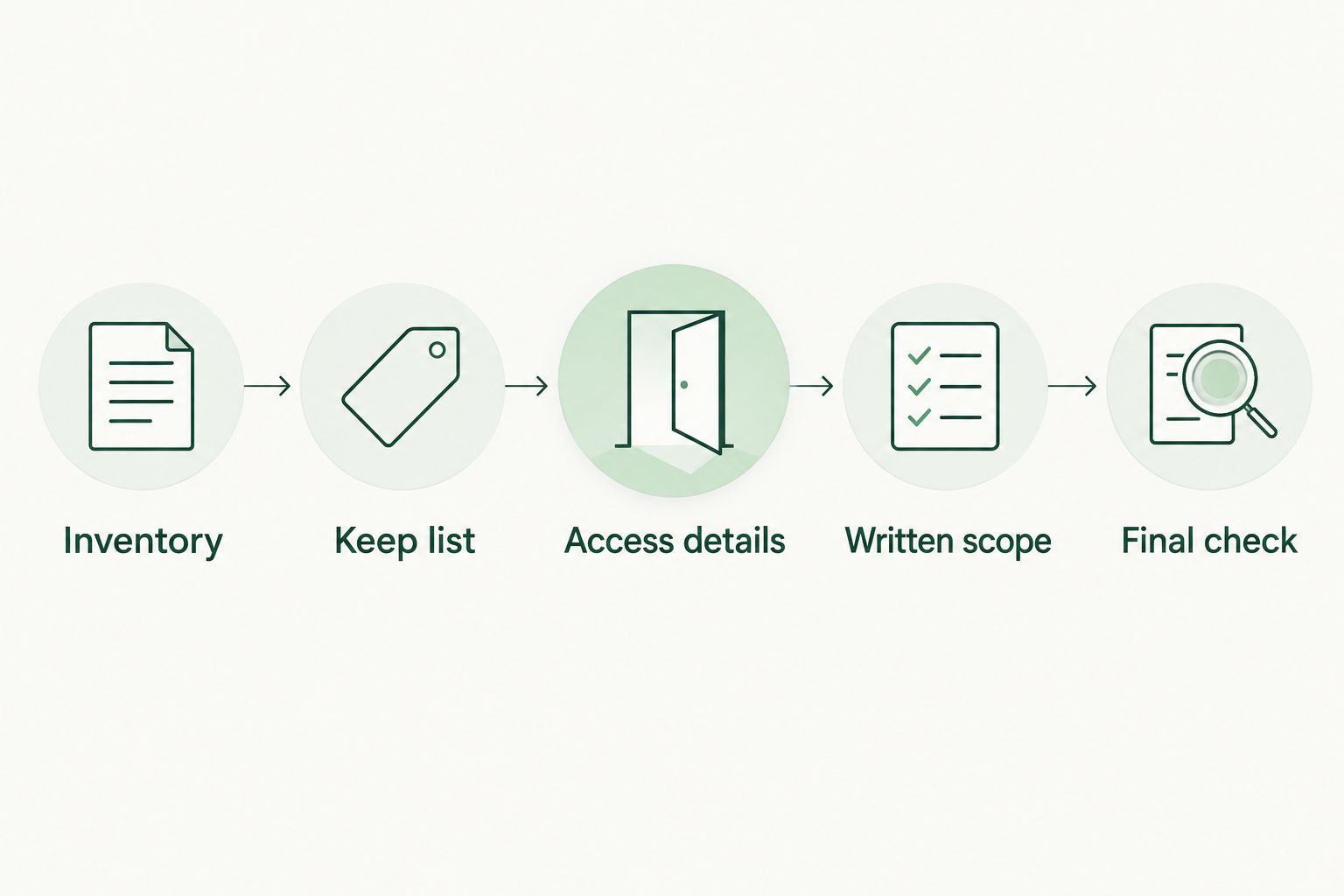
*Use the same inventory and instructions when comparing independent providers.*
How do I compare estate cleanout quotes fairly?
Compare matching scopes, not matching service names. Put each written quote beside your job brief and check whether it includes the same rooms, contents, destinations, and final condition.
For your 2026 comparison, ask each provider how additional work receives approval. You need to understand who can authorize a change and how that change will be documented before removal begins.
Ask about insurance, relevant credentials, and any requirements imposed by the property owner or building manager. Request documentation directly rather than assuming a marketplace connection establishes the provider’s qualifications for your particular job.
Connect with independent providers
Use your inventory, access details, and written scope to discuss a property cleanout.
[Explore property cleanouts](https://expelled.online/)
Does an estate cleanout include sorting and cleaning?
Sorting and cleaning belong in the written scope; do not assume either is included with removal. Ask whether the provider expects the contents to be sorted beforehand and what condition the rooms will be left in.
Describe the required result in ordinary terms. Empty rooms, removal of loose debris, floor cleaning, and preparation for a property handover are separate instructions that need separate confirmation.
Should I sell or donate belongings before the cleanout?
Separate anything intended for sale or donation from items approved for disposal before the cleanout. Confirm acceptance and handoff arrangements with the recipient rather than assuming the removal provider will manage them.
Do not subtract an expected resale value from your cleanout budget unless an agreed arrangement documents that treatment. Belongings still awaiting a buyer or recipient need explicit instructions so they are not mistaken for approved removal items.
FAQ
How much does an estate cleanout cost in 2026?
An estate cleanout cost in 2026 depends on the property’s contents, access, handling requirements, and agreed scope. Request an itemized written quote that identifies included work, exclusions, and the process for approving changes.
Can I get an estate cleanout quote from photos?
Ask the independent provider whether photographs are sufficient for its estimate or whether it requires a property visit. Include every relevant room and storage area, plus photographs of access routes and bulky items.
Is a whole-house cleanout the same as an estate cleanout?
A whole-house label does not establish the scope of an estate cleanout. Confirm which contents, storage areas, handling tasks, and final cleaning instructions are included.
Do I need to empty drawers before an estate cleanout?
Confirm drawer contents with the provider before removal rather than assuming they are included. Remove belongings that must stay and identify any contents still awaiting a decision.
Will an estate cleanout provider take everything?
Confirm acceptance of each item category before booking the work. Flag chemicals, unknown containers, damaged materials, and anything requiring special handling instead of treating them as ordinary contents.
Who should approve changes during an estate cleanout?
Designate a person authorized to approve the estate’s removal instructions and scope changes. Give the provider that person’s contact details and agree on a written approval process.
Does Expelled perform estate cleanouts?
Expelled is an online marketplace that connects homeowners, property professionals, and businesses with independent providers offering property cleanouts, junk removal, and hauling services. Confirm the job scope and terms directly with the independent provider.
One last thing
Write down what stays before you finalize what leaves. A removal inventory alone does not protect an unmarked cabinet of documents or a chair promised to a relative. For your 2026 estate cleanout plan, pair every removal instruction with clear exceptions and a named decision-maker.
At handoff, review the included spaces against the written scope. Record unresolved items and agreed follow-up work instead of treating an empty-looking room as proof that every instruction was completed.