
A whole-house cleanout cost in 2026 depends on the contents you need removed, the work needed to remove them, and the independent provider’s written scope. Ask whether the quote includes loading, hauling, disposal, and any requested sorting or cleanup; a quote for removal alone does not establish what other work is included.
TL;DR
- How much does a whole-house cleanout cost? Get a written quote tied to the contents, access, and removal scope.
- Expelled connects homeowners, property professionals, and businesses with independent providers for property cleanouts, junk removal, and hauling.
- Compare whole-house cleanout quotes against the same inventory, exclusions, and completion requirements.
- Separate junk removal from sorting, cleaning, and specialized handling before choosing a provider.
Why this matters
A house is not a useful unit of removal work by itself. An almost-empty property and a furnished property require different scopes, even when their floor plans match. Describe the contents and access rather than asking a provider to quote only from the number of bedrooms.
Expelled is a property cleanout marketplace for homeowners, property professionals, and businesses seeking connections with independent providers. The convenience is finding a connection; you still need to confirm the provider’s scope, terms, and suitability for your property.
Compare the work included before comparing the final quote. A proposal that excludes the basement or leaves disposal arrangements to you is not equivalent to a proposal that includes those tasks.
How much does a whole-house cleanout cost in 2026?
The amount for your property comes from a provider’s assessment of the removal work. For a useful 2026 quote, supply a room-by-room inventory, photographs, access details, and a clear description of what must remain. Ask the provider to identify the basis of the quote and any conditions that allow it to change.
Use this breakdown to check whether the proposed scope matches your job. These are questions to resolve, not services to assume are included.
| Scope component | What to describe | What to confirm in writing | |---|---|---| | Contents | Furniture, bags, boxes, appliances, and loose items | Which items and areas the quote covers | | Sorting | Items to keep, remove, donate, or review | Who makes decisions and who separates items | | Loading | Stairs, doorways, elevators, and carrying route | Whether removal from each location is included | | Hauling and disposal | Materials requiring removal from the property | Who transports them and handles disposal | | Special handling | Heavy, attached, damaged, or unidentified items | What the provider accepts and excludes | | Finishing work | Your expected condition after removal | Whether sweeping or other cleaning is included |
Do not treat an initial estimate as permission to add rooms or materials without discussion. Ask how the provider documents a changed scope and obtains your approval before additional work begins.
What should the written quote identify?
Look for the property address, covered rooms, included items, exclusions, and the agreed completion condition. The quote should also identify the provider responsible for the work and explain any assumptions about access or preparation.
If a proposal uses broad wording such as whole-house removal, ask for the rooms and outbuildings to be listed. A garage, attic, shed, or basement should not depend on what either party assumes the word house means.
Choose the cleanout scope that matches your property
Best for a defined removal job: provider loading and hauling. Best for unresolved belongings: sorting before removal. Choose according to the work you need, not a service label that leaves the responsibilities unclear.
| Approach | Best for | Practical advantage | Limitation to resolve | |---|---|---|---| | Provider loading and hauling | Contents already approved for removal | Keeps the removal work in a defined provider scope | Confirm sorting, cleaning, and special-item exclusions | | Owner sorting before provider removal | Properties with belongings to retain or review | Gives you direct control over what leaves | Requires your time and a clearly separated removal inventory | | Separately arranged sorting and removal | Estates or properties needing decisions before hauling | Separates decisions about belongings from physical removal | Requires coordination and clear responsibility between parties |
None of these approaches automatically includes every property service. If you need document review, detailed cleaning, repairs, or handling of suspect materials, identify those tasks separately and confirm who can perform them.
The whole-house cleanout companies guide provides a related starting point when you are organizing provider research. Use the same written job description for each provider you contact so the resulting proposals address comparable work.
Why whole-house cleanout quotes vary
Whole-house cleanout quotes vary because the work changes with the contents and property conditions. Use these factors to explain your job accurately rather than trying to predict a total from floor area alone.
- Amount of material: Show what is in each room, including closets and storage areas. Photographs of the main living spaces do not describe concealed contents.
- Material type: Separate ordinary furnishings from appliances, building debris, liquids, electronics, and unknown materials. Ask the provider which categories it accepts.
- Access and carrying route: Describe stairs, narrow passages, elevators, parking restrictions, and the distance between the contents and the loading location.
- Sorting responsibility: Explain whether everything shown is approved for removal or whether someone must first decide what stays.
- Handling requirements: Identify unusually heavy items, attached fixtures, or items that require disconnection. Confirm those tasks before including them in the removal plan.
- Completion standard: State whether you need the listed items removed, cleared rooms, sweeping, or separately arranged cleaning. These are different instructions.
Your 2026 comparison should record these factors beside each quote. If a provider has not addressed a known condition, ask for clarification rather than assuming the quoted scope covers it.
How do you prepare a whole-house cleanout quote request?
A useful request lets an independent provider understand the job without guessing what is behind a closed door or outside the photographs. Prepare the description before contacting providers, and keep a copy so each conversation starts from the same information.
Record the contents
Walk through every included space and list the main categories of belongings. Note furniture, packed containers, loose contents, appliances, and anything you cannot identify. Include the garage, basement, attic, and outdoor areas only when they belong in the requested job.
Use concrete descriptions rather than saying the house is full. Describe which areas are accessible and which are blocked, and identify items that are hidden behind other contents.
Show access
Photograph the rooms and the route used to carry items out. Include relevant stairways, doorways, gates, and the intended loading area. Do not enter an unsafe area to obtain a better photograph.
Explain any building rules or access arrangements that affect the job. If elevator use, parking permission, or entry authorization is needed, state who will arrange it and ask the provider what information it requires.
Mark exclusions
List what must stay and describe how you will distinguish it from removal items. Keep important documents, keys, medications, and personal belongings outside the removal scope unless you have made explicit arrangements for them.
Avoid a mixed pile containing both retained and discarded items. Clear separation gives the provider a usable instruction and keeps decisions about ownership with the person authorized to make them.
Define completion
Write the condition you expect when the provider finishes. For example, specify removal of the listed contents from named rooms, then separately ask whether sweeping is included.
Do not use ready for sale or ready for tenants as a substitute for a task list. Those phrases can include cleaning, repairs, inspection requirements, or other work beyond hauling.
Compare written scopes
Send the same description to each provider and record the questions each asks. Update your description if those questions reveal an omitted room, access restriction, or material category.
Ask for the revised scope in writing when the job changes. Keep the current version with the quote so the inventory and the provider’s proposal describe the same assignment.
!Quote preparation steps covering contents, access, exclusions, completion, and written scopes
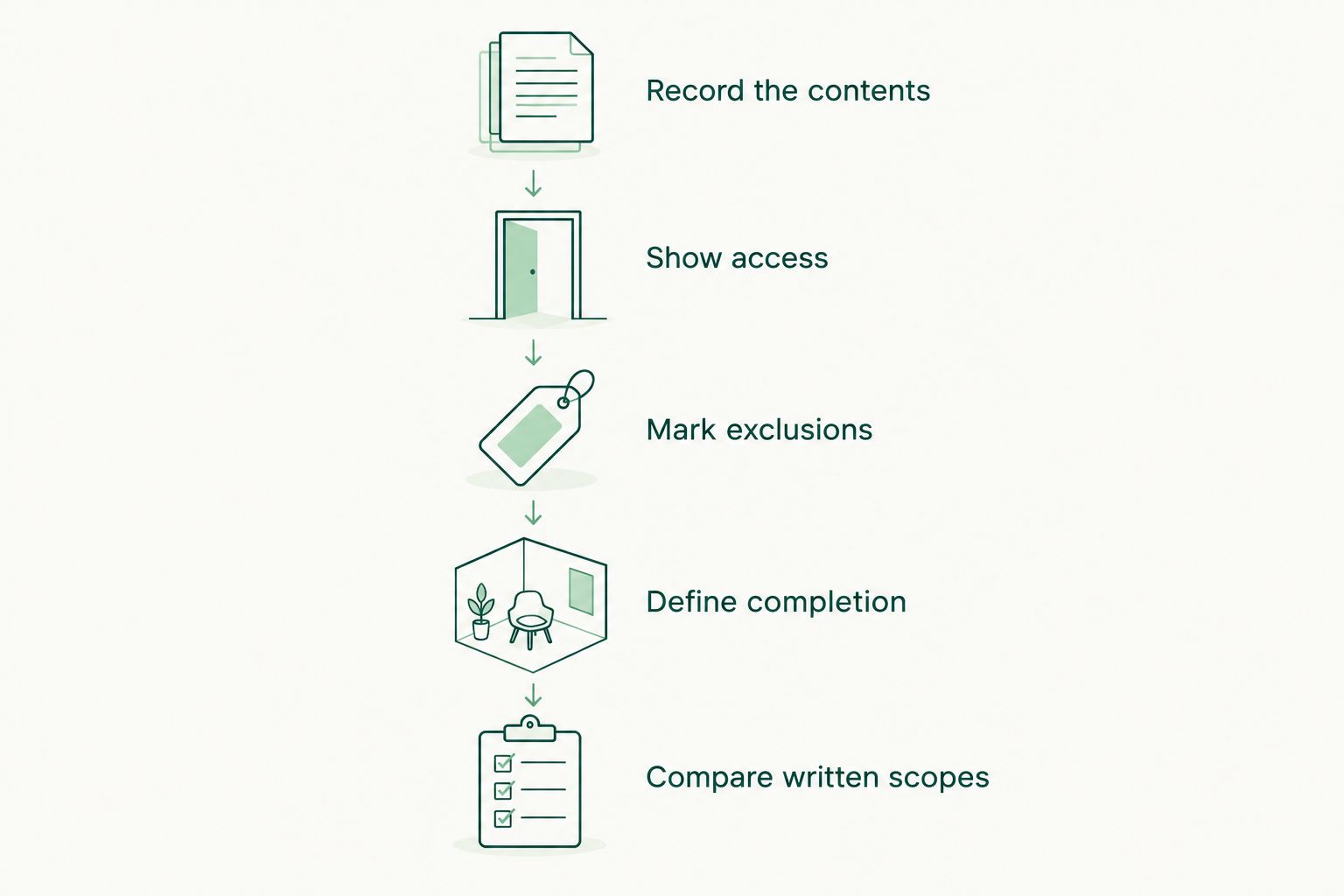
*Use the same job description when you compare independent providers.*
What should you ask before accepting a cleanout quote?
For a 2026 cleanout, keep the questions tied to your property rather than a generic promise of full service. A useful answer identifies an included task, an exclusion, or a responsibility you must handle yourself.
Ask the provider:
- Does the quote cover every room and item in the written inventory?
- Who handles sorting, loading, hauling, and disposal?
- Which materials or conditions fall outside the proposed work?
- What preparation must be completed before removal starts?
- How are changes to the scope documented and approved?
- What condition will the included spaces be left in?
Request documentation relevant to your property or building requirements, including insurance information where required. Confirm who will attend the property and who has authority to approve changes. Do not assume that a marketplace connection answers these provider-specific questions.
Expelled connects users with independent providers; it does not perform the cleanout itself. Use that distinction when deciding whom to ask about accepted materials, job terms, and the removal plan.
Connect with independent providers
Prepare your inventory and access details before discussing a property cleanout.
[Explore Expelled](https://expelled.online/)
Can preparing the property reduce the cleanout work?
Preparing the property can reduce the tasks you ask a provider to perform, but a smaller task list does not establish a particular reduction in the quote. Ask the provider to reassess the scope after preparation rather than assuming the original proposal changes automatically.
Start with decisions, not heavy lifting. Identify retained belongings, resolve uncertain ownership, and remove personal information from the removal inventory. Clear a safe access route only where you can do so without handling unsafe materials or moving items beyond your ability.
If you want donations or recycling handled separately, ask what the provider agrees to do and what documentation, if any, it supplies. Do not assume that every reusable-looking item will be accepted by a receiving organization.
Ask about preparation before moving contents. A provider needs an accurate description of the final removal locations, not photographs that no longer match the property.
Does a whole-house cleanout include cleaning?
A whole-house cleanout includes cleaning only when the provider’s written scope includes it. Removing contents, sweeping floors, and detailed cleaning are separate tasks, so name the condition you need rather than relying on the word cleanout.
If the property needs work after removal, identify that separately. Do not assume that hauling includes repairs, odor treatment, pest treatment, or remediation of damaged materials.
Is a site visit better than photographs for a quote?
A site visit lets a provider inspect conditions that photographs do not fully show, including access routes and concealed areas that can be viewed safely. Ask whether the provider needs a visit before confirming the scope.
Photographs remain useful when they show all included spaces and relevant access conditions. If anything changes after the assessment, update the provider before work begins.
FAQ
How much does a whole-house cleanout cost in 2026?
A whole-house cleanout cost in 2026 depends on the contents, access, handling requirements, and agreed work. Request a written provider quote that identifies included rooms, disposal responsibilities, and exclusions.
Can I get a whole-house cleanout quote from photographs?
Ask the provider whether photographs are sufficient for your property. Show every included space and the carrying route, and disclose conditions that the images do not show.
Does a whole-house cleanout include the garage and basement?
A whole-house cleanout includes the garage and basement only when those areas are part of the agreed scope. List each space explicitly in your request and check that it appears in the proposal.
Should I sort belongings before contacting a cleanout provider?
Identify what must stay before removal begins, and ask whether the provider offers any requested sorting work. You can contact a provider before sorting is complete if you clearly describe the decisions still outstanding.
Does Expelled perform whole-house cleanouts?
Expelled is a property cleanout marketplace that connects homeowners, property professionals, and businesses with independent providers. Confirm the work, terms, and accepted materials directly with the provider.
What happens if I add items after accepting a quote?
Adding items changes the requested scope, so ask the provider to document the revision before removing them. Confirm any effect on the proposal and approve the updated terms before additional work begins.
One last thing
Before your 2026 cleanout begins, photograph the items that must stay as carefully as the items that must leave. Give the provider a written keep list and identify who can resolve questions at the property.
The most useful final check is simple: read the scope while walking through each included room. Resolve any mismatch before loading starts, when you can still correct the instructions without trying to trace an item after removal.