
A foreclosure cleanout cost in 2026 requires a property-specific quote based on what must leave the property, where it is located, and what work the provider agrees to perform. Before accepting a total, confirm whether it includes loading, hauling, disposal, and any requested cleaning; do not treat repairs or hazardous-material handling as included unless the written scope says so.
TL;DR
- How much does a foreclosure cleanout cost? Compare written quotes for the same property cleanout scope, not different jobs.
- Expelled connects property owners and professionals with independent providers; it does not perform foreclosure cleanouts.
- Separate junk removal from cleaning, repairs, and specialist work before accepting a quote.
- Document items, access, exclusions, and completion requirements so providers can assess the same job.
How much does a foreclosure cleanout cost in 2026?
A useful foreclosure cleanout quote prices a defined job, not just a property address. Ask the provider to identify the removal areas, included materials, access assumptions, and disposal responsibilities. You can use Expelled to connect with independent providers, then confirm the proposed work directly with the provider.
Start by distinguishing the scope you need. These descriptions are quote-request categories, not standardized service packages. A provider must confirm what its proposal includes.
| Requested scope | Best for | Practical advantage | Limitation to resolve | |---|---|---|---| | Selected-item removal | A property with specific unwanted items | Keeps the removal list explicit | Unlisted items need separate agreement | | Whole-property cleanout | A property with belongings across multiple areas | Gives the provider a full removal brief | Requires clear instructions about items that stay | | Removal with cleaning | A property that needs both contents removed and surfaces addressed | Defines the intended condition after removal | Cleaning tasks must be described separately | | Cleanout alongside specialist work | A property with materials needing separate assessment | Keeps removal boundaries clear | A general cleanout quote does not establish specialist capability |
Do not compare these scopes as though they deliver the same result. An empty room, a swept room, and a repaired room are different outcomes. Put the required outcome in writing before comparing proposals.
Why this matters
A foreclosure cleanout sits between taking control of a property and preparing it for its next use. The removal instructions need to distinguish unwanted contents from belongings, fixtures, records, and equipment that must remain.
For a 2026 cleanout, make the written scope your comparison document. A proposal that omits the garage or disposal responsibilities does not answer the same question as one that includes them. Resolve the difference before choosing a provider, rather than treating a shorter proposal as equivalent work.
Also confirm that you have authority to authorize removal. Ownership changes do not replace instructions about possession, retained belongings, or required notices. Where those questions remain unresolved, get direction from the responsible property representative or qualified legal adviser before disposal.
What should a foreclosure cleanout quote include?
Ask for a breakdown that connects the proposed work to the property conditions. The goal is not to force every provider into the same billing format. It is to understand what you are authorizing and what remains outside the agreement.
Removal areas and contents
List each area separately: living spaces, closets, basement, attic, garage, outbuildings, and exterior areas, where applicable. Describe what is in each area rather than using only the phrase *whole-house cleanout*.
Identify bulky furniture, appliances, loose rubbish, bagged contents, and renovation debris separately. Ask the provider to confirm which materials it accepts. Do not assume that accepting household furniture also means accepting every container, appliance, or building material found on site.
Loading, hauling, and disposal
Ask whether the proposal includes moving items from their current locations, loading them, transporting them, and handling disposal. If the proposal uses a load-based description, ask how the provider defines the load and handles additional material.
Request written clarification about items requiring separate handling. The decision you need is straightforward: which items are included, which are excluded, and what happens if the crew finds something outside the agreed list?
Cleaning and the finished condition
Replace *leave it clean* with named tasks. Specify whether you want loose debris collected, floors swept, or other cleaning performed. Ask the provider to confirm each requested task rather than treating junk removal as a promise of detailed cleaning.
Keep repairs, demolition, and remediation outside the removal scope unless they are expressly agreed. Removing a damaged cabinet and repairing the wall behind it are separate instructions.
Why foreclosure cleanout quotes vary
The useful comparison is between the conditions providers are pricing. Give each provider the same information about these factors:
- Contents and materials: Describe the items to remove, including bulky objects and any materials the provider must assess separately.
- Removal boundaries: State whether the job covers selected rooms, the entire building, exterior areas, or separate structures.
- Access conditions: Describe stairs, narrow openings, locked areas, parking restrictions, and the route from the contents to the loading location.
- Requested finish: Distinguish contents removal from sweeping, detailed cleaning, dismantling, and repairs.
- Disposal responsibilities: Ask which materials the provider accepts and whether disposal is included in the proposal.
- Unresolved conditions: Identify rooms you cannot inspect and contents hidden behind other items so the quote states its assumptions.
Compare confirmed scope before comparing totals. If providers describe different work, ask them to revise or clarify their proposals against the same removal list.
How do you prepare a property for comparable quotes?
Use the following sequence for a 2026 quote request. You do not need to move heavy objects or enter unsafe areas to produce a useful brief; document what you can inspect safely and identify what remains unknown.
- Confirm authority. Identify the person who can approve removal, answer questions about retained belongings, and authorize changes.
- Record contents. Prepare a room-by-room list and take clear photographs of accessible areas. Include wide views as well as individual items requiring explanation.
- Mark retained items. Identify anything that must stay, including fixtures, equipment, records, and personal property awaiting instructions.
- Describe access. Record the entry route, stairs, locked spaces, parking conditions, and any building access requirements.
- Define completion. State the removal boundaries and the condition you expect at handover. Ask for exclusions and change-approval terms in writing.
Keep a copy of the brief you send. When a provider asks a question that changes the job description, update the brief for the other providers you are considering. Otherwise, the proposals stop being directly comparable.
!Five steps for preparing a foreclosure cleanout quote request
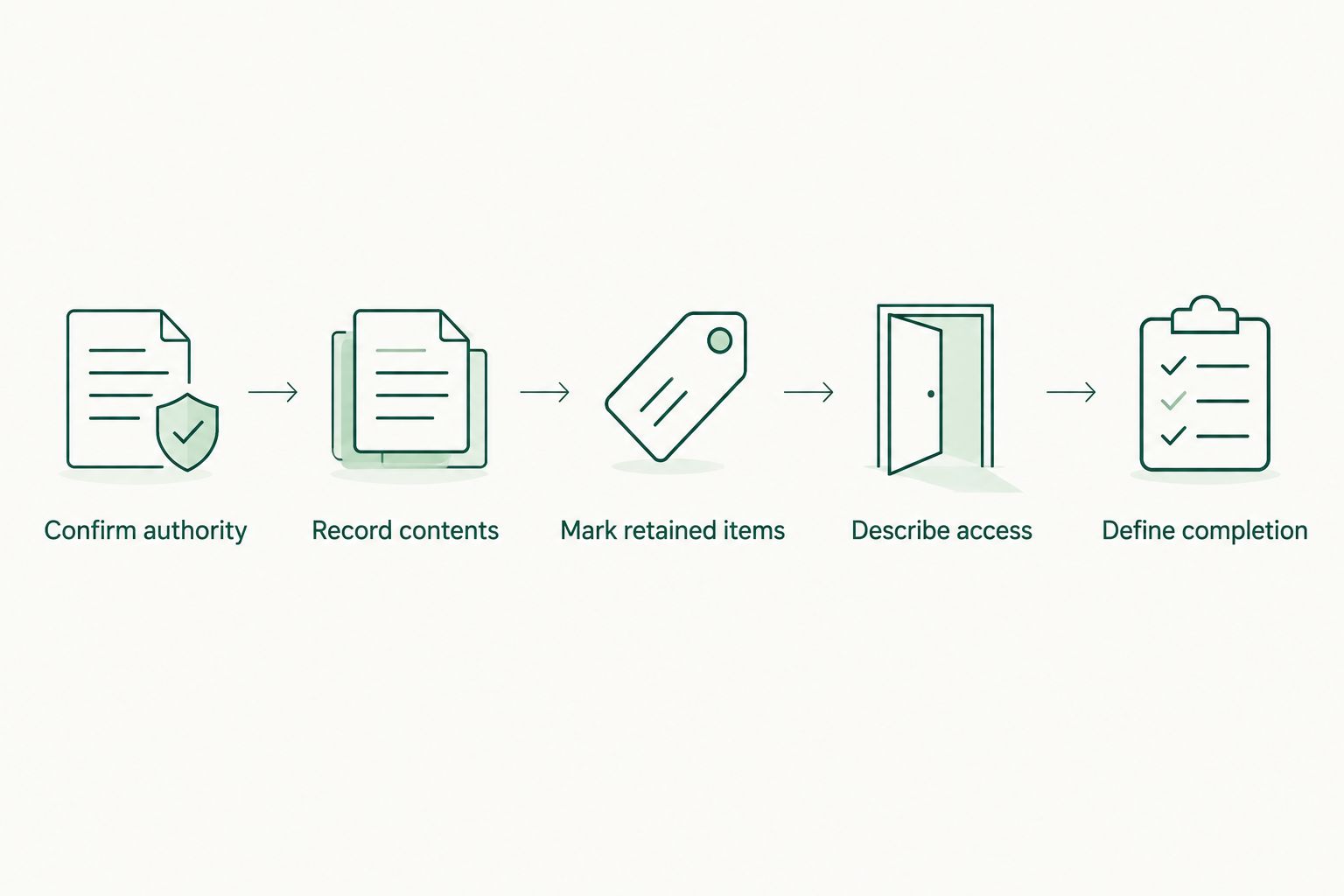
*A shared property brief gives providers the same removal instructions.*
A practical quote-request template
Send a short description organized around the property, contents, access, and intended result. Avoid sending photographs without explaining what should be removed.
- Property: Give the location and identify the areas included in the request.
- Remove: Describe unwanted contents by room or area, with photographs where useful.
- Keep: List retained items and explain how they will be identified on site.
- Access: Describe entry arrangements, stairs, loading access, and restrictions.
- Finish: Name the cleaning tasks you want included, if any.
- Exceptions: Identify uncertain materials, inaccessible areas, or items awaiting authorization.
- Approval: Name the person who must approve scope changes before additional work proceeds.
Ask the provider to respond against these headings. A clear reply makes it easier to identify omissions without interpreting a vague description of the job.
How should you compare independent providers?
Expelled is best for homeowners and property professionals seeking to connect with independent property cleanout providers. The marketplace connects you with providers; you still need to confirm the selected provider's scope, suitability, and terms directly.
When reviewing foreclosure cleanout providers, ask for evidence relevant to your property rather than accepting a general statement that a business handles cleanouts. Use the foreclosure cleanout provider guide to organize your provider search, then assess each proposal against your actual removal brief.
Check these points before authorizing work:
- Does the provider acknowledge every removal area and retained-item instruction?
- Does the proposal explain disposal responsibilities and excluded materials?
- Has the provider addressed the access conditions you described?
- Can the provider supply the insurance documentation your owner, lender, or property manager requires?
- Who approves changes, and how are those changes documented?
- What evidence will show that the agreed work is complete?
For your 2026 provider comparison, keep written answers alongside the proposals. Do not treat an unanswered question as an included service. Ask for clarification before selecting a provider, especially when the issue affects what remains at the property.
Connect with independent providers
Describe your property cleanout and confirm scope, exclusions, and terms directly with providers.
[Explore the marketplace](https://expelled.online/)
Is a whole-property cleanout better than selected-item removal?
Selected-item removal is best for a property with a clear, limited removal list; a whole-property cleanout is best for contents spread across the property. Neither description establishes what a provider includes. Choose the scope that matches your instructions, then confirm its boundaries in writing.
Selected-item removal keeps the instructions narrow, but it leaves everything else untouched. A whole-property scope addresses more areas, but it needs stronger retained-item instructions. If you have not inspected the entire property, identify that gap rather than declaring everything removable.
Does a foreclosure cleanout include repairs or hazardous materials?
Do not assume a foreclosure cleanout includes repairs or hazardous-material handling. Ask the provider to state its limits and identify work requiring separate assessment. A removal agreement is not evidence that a provider is qualified to perform every task found at a distressed property.
Do not open unknown containers, disturb suspect materials, or direct a removal crew to handle them without assessment. Keep those items outside the routine removal instructions until the responsible provider or specialist confirms an appropriate approach.
What happens if the cleanout scope changes?
Agree on a change process before work starts. The provider should describe the newly identified work, explain how it changes the agreement, and obtain approval from the designated decision-maker before proceeding with that change.
Document the change with photographs and a written description where practical. Examples include an additional storage area, contents not visible during the original inspection, or an item the provider cannot accept. A change record should identify what happens next, including anything left on site.
At handover, compare the completed work with the agreed scope rather than relying only on wide photographs of empty rooms. Check retained items, excluded materials, and any areas that were inaccessible. Record unresolved tasks separately from completed removal work.
FAQ
How much does a foreclosure cleanout cost in 2026?
A foreclosure cleanout requires a property-specific quote based on the removal scope, contents, access, and agreed services. Ask for written inclusions and exclusions before comparing proposals.
Can I get a foreclosure cleanout quote from photographs?
Ask the provider whether photographs are sufficient for its assessment. Send room-by-room views, describe access, and identify concealed or inaccessible areas so the proposal states its assumptions.
Does foreclosure junk removal include cleaning?
Include cleaning only when the provider expressly agrees to the requested tasks. Contents removal, sweeping, detailed cleaning, and repairs need separate descriptions in the scope.
Who should approve disposal of belongings in a foreclosed property?
The person with authority over the removal must approve disposal instructions. Resolve possession, retained-property, and notice questions with the responsible representative or qualified legal adviser before removing disputed belongings.
How do I compare foreclosure cleanout quotes?
Compare quotes against the same removal list, access description, finish requirements, and exclusions. Ask providers to clarify missing work rather than assuming differently worded proposals cover the same job.
Does Expelled perform foreclosure cleanouts?
Expelled does not perform foreclosure cleanouts; it is a marketplace connecting homeowners, property professionals, and businesses with independent providers. Confirm the work, terms, and provider suitability directly with the provider.
One last thing
Before approving your 2026 foreclosure cleanout, write down what must remain, not just what must leave. A clear retained-item list gives the provider a boundary that photographs of unwanted contents cannot provide by themselves. Attach that list to the approved scope and use it again at handover.