
Commercial junk removal for an office move takes the time required to clear your agreed item list within the building’s access rules; there is no reliable universal duration. For a 2026 move, get a provider-confirmed work window based on your inventory, loading route, and removal scope. That window must distinguish on-site removal from booking lead time, building approvals, and any separate handling arrangements.
TL;DR
- How long does commercial junk removal take for an office move? Get a scope-based work window, not a generic estimate.
- Separate booking lead time, on-site removal, and final handover when planning an office cleanout.
- Confirm furniture dismantling, elevator access, loading arrangements, and excluded materials before accepting a schedule.
- Expelled connects businesses with independent providers; confirm the office cleanout schedule directly with the provider.
Why this matters
Plan around the cleared-space deadline, not just the truck’s arrival. An appointment does not establish when your office will be ready for movers, cleaners, or a landlord inspection. Define the required condition of the space before asking anyone to estimate the work.
For your 2026 office relocation, make one written plan that separates items being moved from items being removed. The commercial junk removal for office relocations guide provides a related planning reference. Keep your actual inventory and building instructions together so each provider receives the same scope.
How long does commercial junk removal take for an office move?
Use the independent provider’s written work window for your specific office, not an estimate based only on floor area. A useful schedule identifies when loading starts, what must happen before loading, and what counts as completion. It also states which changes require the provider to revise the estimate.
Follow this sequence before committing the removal to your move calendar:
- List the items. Record furniture, loose materials, equipment, and items requiring separate assessment. Mark everything that stays or moves to the new office.
- Document access. Describe the floor, stairs, elevator, loading entrance, parking restrictions, and route from the office to the vehicle.
- Confirm preparation. Ask who handles dismantling, disconnecting, packing loose contents, and obtaining building approval.
- Request the window. Ask for booking lead time, expected on-site working time, and any conditions attached to the estimate.
- Define completion. Agree whether completion means loading the listed items, checking all rooms, or another clearly described handover condition.
A useful answer names the assumptions behind the schedule. If a provider has not reviewed the item list or access details, ask what information is still needed before treating the estimate as a planning commitment.
!Office removal planning sequence from listing items to defining completion
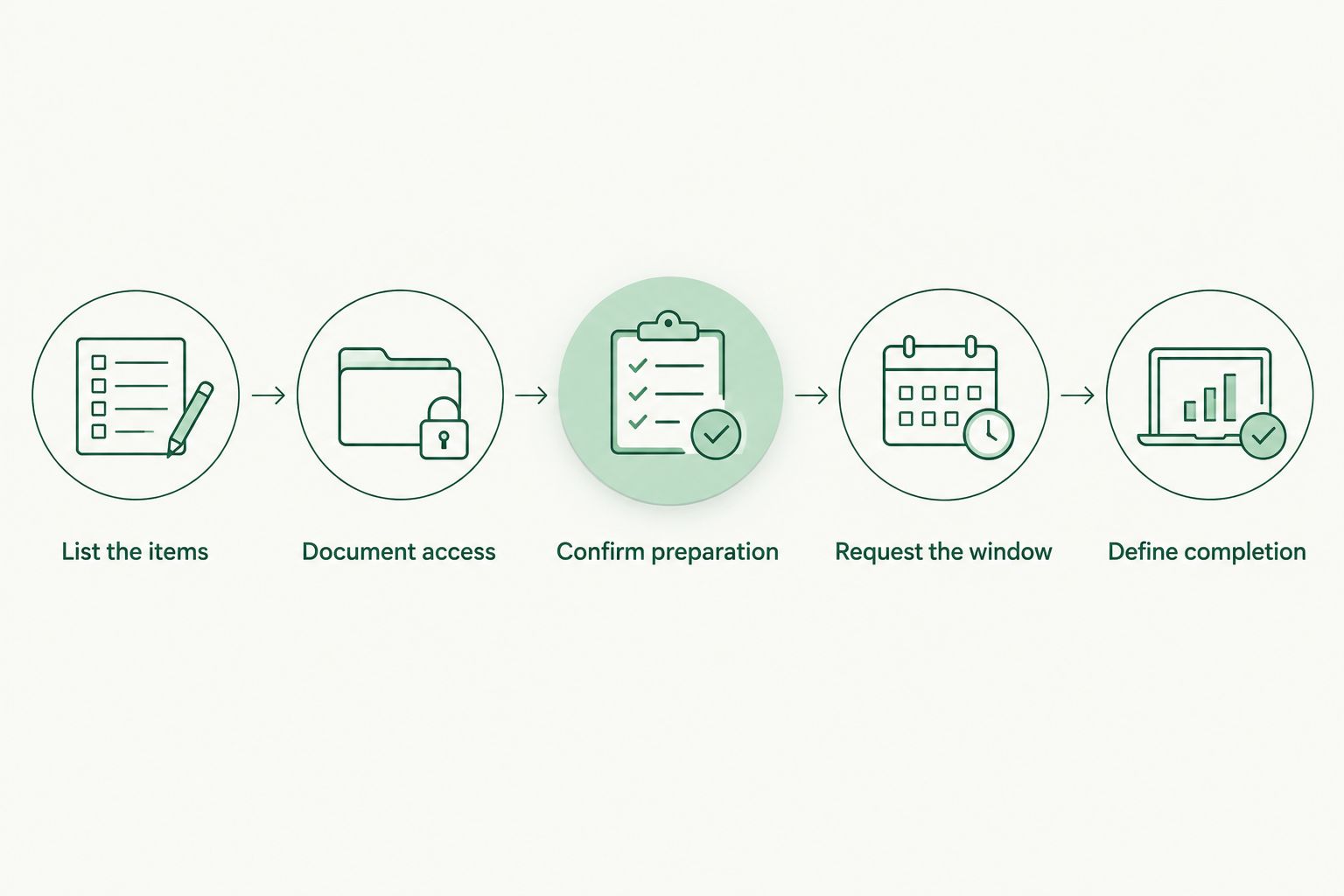
*Confirm the scope and access before relying on a removal window.*
Separate the different parts of the schedule
Do not use one appointment time to represent the entire office cleanout. For a 2026 move plan, record the following parts separately and ask who controls each one. These are planning categories, not promised service durations.
| Schedule component | What to confirm | What it does not establish | |---|---|---| | Booking lead time | When the provider can accept and schedule the job | How long removal will take on-site | | Building preparation | Required access permissions and approved work periods | Whether the provider has accepted those conditions | | On-site removal | The work window for the agreed inventory and route | Completion of work excluded from the scope | | Final handover | Who checks the space and accepts completion | Completion of repairs, cleaning, or other separate services |
Ask whether the proposed window covers all agreed activity at the property, including setup and the final walkthrough. Also ask whether any vehicle movements during the job affect that window. Do not assume these details from an arrival time alone.
Keep the provider’s estimate attached to the inventory version it covers. If staff add furniture after the estimate, send the revised list and request confirmation before leaving the original schedule unchanged.
Why office junk removal timing varies
The useful question is not simply how large the office is. It is what the provider must remove and how that material reaches the loading point. Give each provider the same details about these factors:
- Item volume and type. List furniture separately from loose contents. Describe bulky or awkward pieces rather than using only a room count.
- Dismantling requirements. Identify desks, shelving, partitions, or other items that need assessment before they can pass through the route. Confirm who handles that work.
- Internal access. Describe stairs, doorways, corridors, and the distance between the items and the loading entrance. Include any shared areas that must remain clear.
- Building restrictions. Obtain the actual elevator, loading, parking, and work-hour instructions from building management. Send those instructions before the provider confirms the schedule.
- Material acceptance. Identify electronics, batteries, liquids, documents, and other items needing explicit handling instructions. Ask what the provider accepts and what needs another arrangement.
- Scope changes. Resolve unclear ownership and removal decisions before work begins. Ask how newly added items affect the agreed plan.
Compare providers against the same inventory and access conditions. Different assumptions produce estimates that are not directly comparable, even when each answer sounds definite.
Prepare a job description a provider can schedule
A request that says only “office furniture removal” leaves important decisions unresolved. Give the provider enough information to assess the work without guessing what is behind a closed door or inside a cabinet. Use plain descriptions rather than trying to estimate vehicle capacity yourself.
Inventory and boundaries
List items by room or zone, with quantities wherever you can count them. Distinguish an empty cabinet from a cabinet still holding files, and a cleared desk from a workstation containing equipment. Mark attached fixtures separately and confirm permission before including them in removal.
Name what must remain. A clear exclusion list protects retained furniture, landlord-owned items, and equipment assigned to the moving company. Keep the removal list separate from the moving inventory, even when both teams work in the same office.
Photos and access details
Start with 3 photo views per removal area: an overview, the largest items, and the route out. This is a suggested briefing format, not a guarantee that photos replace an inspection. Add detail wherever the route, condition, or contents need explanation.
Describe the loading entrance in words as well. Tell the provider who arranges access, whether an elevator reservation is required, and which building instructions still need confirmation. Do not present an unapproved loading arrangement as settled.
Work windows and decisions
Offer 2 candidate work windows if your move plan allows flexibility. Ask the provider to confirm which window fits the job and whether the expected work can finish before the building’s access period ends. Candidate windows are requests, not confirmed bookings.
Assign 1 on-site approver who can identify the items and resolve questions. Give that person the agreed inventory and exclusions. This avoids asking the removal crew to decide whether an unmarked item belongs in the vehicle.
Should removal happen before or during the office move?
Choose the sequence according to which items must remain in use and whether the teams share access. Do not assume simultaneous work saves time. For your 2026 schedule, ask the mover, removal provider, and building contact to confirm any overlapping use of elevators or loading areas.
| Removal sequence | Best for | Practical advantage | Limitation to resolve | |---|---|---|---| | Before the move | Items already approved for disposal | Separates removal from the moving inventory | Staff must release those items before moving day | | During the move | Jobs with clearly separate work areas | Allows coordination within the same move plan | Requires agreement on shared routes and loading access | | After the move | Items identified only after retained goods leave | Makes the remaining removal scope easier to identify | Needs its own access window before handover |
Ask each provider to explain how the proposed sequence affects their work, rather than selecting the earliest arrival offered. Keep retained items physically separate wherever practical and label exceptions clearly. The best sequence is the one the parties can carry out under the building’s actual rules.
How do you compare provider timing estimates?
Compare the scope behind the estimate before comparing the proposed finish. A shorter stated window is useful only when it covers the items, access conditions, and tasks you actually need. Ask providers to identify exclusions in writing.
Use these questions when reviewing responses:
- Does the estimate cover the exact inventory you supplied?
- Does it include any agreed dismantling or preparation?
- Has the provider accepted the building’s loading and elevator rules?
- Does completion include a walkthrough of every removal area?
- What happens if the inventory or access conditions change?
Expelled is best for businesses seeking a marketplace to connect with independent office cleanout providers. Expelled does not perform the removal; you need to confirm scope, timing, and responsibilities directly with the independent provider. A marketplace connection is not a confirmed work window.
You can use Expelled to connect with independent providers for property cleanouts, junk removal, and hauling services. Present the same written brief to each provider you consider, then compare their answers against your move requirements.
Can an office junk removal provider finish before the movers arrive?
An office junk removal provider must confirm whether the agreed work fits before your movers’ arrival. Give both parties the same access restrictions and explain which items or routes overlap. Do not treat separate appointment confirmations as proof that the combined schedule works.
If removal must finish first, state that dependency explicitly. Ask what happens if access is delayed or the inventory changes, and agree who makes the scheduling decision. Leave any unconfirmed dependency out of the final move instructions until it is resolved.
Does same-day service mean the office will be cleared that day?
Same-day scheduling does not establish a completion deadline for your office cleanout. Ask what the provider means by the term and whether the agreed inventory can be removed within the available building access period. An arrival commitment and a completed-clearance commitment are different statements.
Keep the handover requirement explicit even when the appointment is urgent. If the provider cannot confirm completion against the documented scope, do not write the move plan as though that deadline has been accepted.
FAQ
How long does commercial junk removal take for an office move?
Commercial junk removal timing depends on the agreed inventory, preparation, and building access. Ask the independent provider for a written on-site work window tied to those details, separate from booking lead time.
Can you estimate office removal time from square footage?
Square footage alone does not describe the items or the loading route. Supply an inventory, photos, and access instructions before relying on a schedule.
Should office furniture be dismantled before junk removal?
Confirm dismantling responsibilities with the provider before doing the work yourself. Identify furniture that needs assessment and ask whether dismantling is included in the agreed scope.
Can junk removal happen while the moving company works?
Concurrent work needs agreement on shared loading areas, elevators, and item boundaries. Confirm the sequence with both providers and building management before scheduling overlapping activity.
What should I send for an office cleanout estimate?
Send an itemized inventory, photos, the removal route, building restrictions, and your required handover condition. Identify items that stay and materials requiring separate acceptance.
Does Expelled perform commercial junk removal?
Expelled is an online marketplace that connects businesses, homeowners, and property professionals with independent providers. Confirm the commercial junk removal scope and schedule directly with the provider.
What should I do if more junk is added before moving day?
Send the revised inventory to the provider and request confirmation of the work window. Do not assume the earlier estimate covers added items or changed access conditions.
One last thing
Define “finished” before you define the deadline. For your 2026 handover, specify whether you need the listed items loaded, every designated area checked, or additional work arranged separately. A provider’s completed removal and your landlord’s acceptance of the premises are not interchangeable milestones.
Walk the space against the agreed inventory before releasing your on-site approver. Check storage rooms, items marked to remain, and any materials excluded from removal. Record unresolved tasks with the person responsible rather than treating an empty main office as the end of the job.