
An estate cleanout takes as long as the property's sorting, authorization, and removal work requires; a hauling appointment is not the full estate cleanout timeline. Get a property-specific schedule that separates decisions about belongings from loading and removal, and confirms what must happen before the provider arrives.
TL;DR
- How long does an estate cleanout take? The answer depends on sorting, authorization, access, and the agreed removal scope.
- Expelled connects estate cleanout customers with independent providers; it does not perform the cleanout itself.
- Request separate estimates for preparation, on-site removal, and any follow-up work.
- Compare estate cleanout and junk removal proposals against the same written inventory and finish condition.
How long does an estate cleanout take?
An estate cleanout timeline must include both preparation and physical removal. Before accepting a completion date, establish whether the provider means the end of loading, the removal of every agreed item, or a property ready for its next use.
Use the estate cleanout provider guide alongside a written job description. A provider comparison is useful only when each proposal covers the same rooms, belongings, and access conditions.
For your 2026 cleanout plan, separate the work into these stages:
- Confirm authority. Identify who can authorize removal and who resolves questions about individual belongings.
- Set aside belongings. Identify documents, valuables, personal items, and anything that must stay.
- Define removal. List the rooms and items included, along with access restrictions and handling concerns.
- Confirm the schedule. Ask the independent provider to estimate on-site work after reviewing the property information.
- Check completion. Review the agreed areas and record any items or tasks left unresolved.
These are planning stages, not fixed-duration appointments. Some preparation can happen together, but removal should not overtake decisions about what stays.
Why this matters
A provider's loading estimate does not tell you how long it will take to settle family decisions, locate documents, or prepare the property for access. Treating those tasks as already complete creates a schedule that does not describe the actual job.
Define the finish condition before discussing timing. Empty rooms, an empty house with swept floors, and a house prepared for sale describe different scopes; do not assume a cleanout proposal includes cleaning, repairs, or sale preparation.
Preparation: finish decisions before removal begins
Preparation is the part of an estate cleanout where you decide what can leave. Start with areas containing personal records, valuables, photographs, and belongings someone has requested, rather than marking everything for removal immediately.
Assign a decision-maker who can answer questions during the cleanout. If several people have an interest in the belongings, resolve disagreements before including those items in the removal scope. Ask the estate's legal representative about authority questions rather than asking the hauling provider to settle them.
Create clearly separated categories:
- Keep: belongings that remain at the property or go to a designated person.
- Review: items awaiting a decision, identification, or further advice.
- Remove: belongings expressly approved for the agreed removal work.
Do not use an open box or an unmarked corner as the only signal that something must stay. Label retained belongings and explain the boundaries during the walkthrough.
If you discover an unresolved document or disputed item, separate that item from the removal job. The provider needs clear instructions, not responsibility for deciding its significance.
On-site removal: estimate the actual work
Physical removal starts with the approved belongings and the route out of the property. A room list alone does not describe that work: include furniture, loose contents, packed containers, and items stored inside cupboards or outbuildings.
Photograph the route as well as the contents. Stairs, doorways, elevators, parking arrangements, and the distance between the property and the loading area are relevant details for a provider's assessment.
Ask what the proposed schedule includes. Loading, any agreed dismantling, transport, and the final walkthrough should be discussed explicitly rather than bundled into an undefined completion promise.
For a 2026 estate cleanout, ask the provider to identify the assumptions behind the estimate. An assessment based on accessible rooms and approved items does not describe a job with locked storage, unresolved belongings, or additional areas disclosed later.
Final walkthrough: define what finished means
The cleanout is finished when the agreed scope is complete, not simply when a vehicle leaves. Use the original room list to check the property with the provider or your designated representative.
Look inside included closets and storage areas. Confirm that retained belongings remain where agreed, and distinguish intentionally excluded items from unfinished work.
Record any follow-up responsibilities before closing the job. If another collection or a different service is necessary, identify who will arrange it and whether it belongs to the original agreement.
Keep this review separate from broader property handover tasks. A removal service does not establish that repairs, cleaning, inspections, or other preparations have been completed.
Why estate cleanout timelines vary
The useful question is not simply how large the property is. Ask what must happen to remove the approved contents under the property's actual conditions.
- Decision readiness: Unresolved choices about belongings leave the removal scope incomplete. Mark exclusions before requesting a final schedule.
- Contents and distribution: Describe both the amount of material and where it sits. Include cupboards, basements, attics, garages, and other areas that belong in the job.
- Access conditions: Explain stairs, narrow routes, locked areas, elevator arrangements, and loading access. Ask the provider to assess these conditions rather than assuming they are routine.
- Handling requirements: Identify oversized, fragile, or unfamiliar items. Do not assume the provider accepts every material found at the property.
- Required coordination: Explain building access rules and any arrangements involving other people or services. Confirm those arrangements separately.
- Scope changes: Additional rooms, retained items later released for removal, or newly discovered contents require an updated assessment.
For your 2026 schedule, record unresolved factors beside the proposed completion date. That makes it clear which parts of the plan are confirmed and which still depend on a decision or assessment.
Which cleanout approach fits your property?
Choose an approach based on what is ready for removal, not on an unsupported promise of speed. Each approach has a practical benefit and a limitation.
| Approach | Best for | Practical benefit | Limitation to address | |---|---|---|---| | Sort before removal | Estates with documents, keepsakes, or unresolved belongings | Establishes what stays before loading begins | Requires preparation before the removal scope is final | | Remove approved areas first | Properties with clearly separated, authorized rooms | Lets you define a limited job without including disputed areas | Remaining areas still need their own decisions and assessment | | Assess the whole property together | Estates with an agreed inventory and authorized removal | Gives the provider a property-wide view of the work | Depends on complete access and an accurate inventory |
Sort before removal when ownership or retention decisions remain unresolved. This approach separates family and estate decisions from the provider's work, but it requires you to finish those decisions rather than expecting the crew to sort them out.
Removing approved areas first suits a clearly bounded scope. Its limitation is coordination: an initial removal does not settle the schedule for everything left behind.
A whole-property assessment suits an estate with settled instructions. It gives the provider more context, but excluded spaces and undisclosed contents still need to be addressed.
How do you get a useful timeline from a provider?
Give each independent provider the same job description. A written brief makes differences between proposals easier to identify without treating unlike scopes as interchangeable.
Build an inventory
List each included area and describe its contents. Include large furniture, loose belongings, stored containers, and any attached or detached storage spaces that form part of the job.
State exclusions just as clearly. A room that remains untouched should not appear only in a verbal conversation that another person might miss.
Document access
Describe the route from the belongings to the loading area. Include access permissions, stairs, elevators, parking constraints, and any doors or gates that require arrangements.
Send photographs that show the route and the contents. Ask whether the provider needs an on-site assessment before confirming the schedule.
Define completion
Write the expected result in plain language: which contents leave, which belongings stay, and what condition the included areas should be left in. Ask the provider to confirm any cleaning or other work separately.
Avoid using a broad phrase such as ready for sale without explaining the tasks it represents. Removal and sale preparation are not interchangeable instructions.
Confirm assumptions
Ask the provider what could require a revised schedule and who will communicate changes. Confirm the proposed appointment directly, including access arrangements and the contact responsible for decisions.
Keep the written scope and the provider's response together. For a 2026 handover, give the person attending the property the same version used to agree on the work.
!Four steps for preparing a provider-ready estate cleanout brief
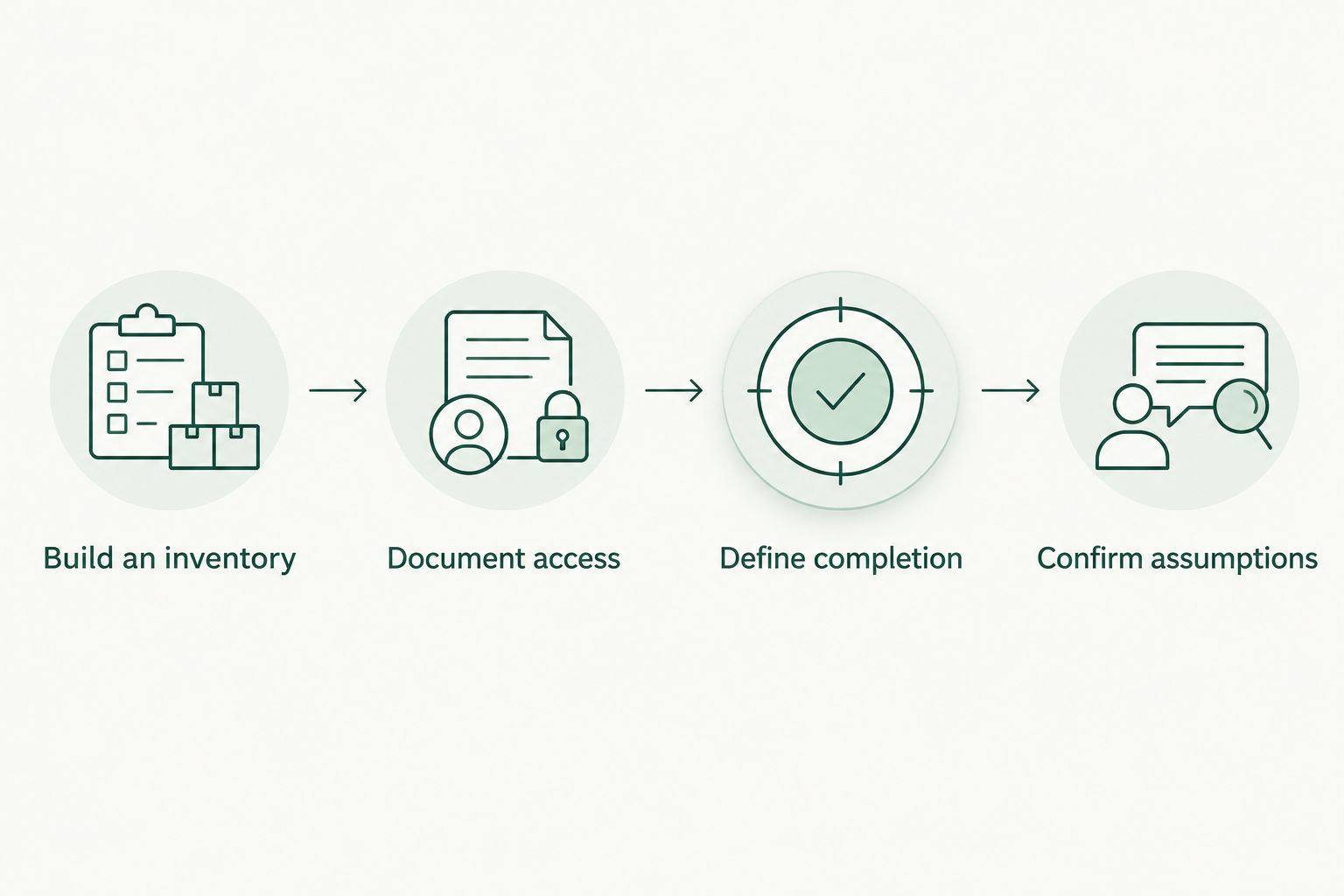
*A schedule is useful only when the inventory, access, and expected result are clear.*
Where does a marketplace fit into the timeline?
Expelled is for homeowners, property professionals, and businesses seeking to connect with independent property cleanout providers. The marketplace connection does not replace the provider's assessment of your estate or confirmation of the work.
You can use Expelled to connect with independent providers offering property cleanouts, junk removal, and hauling services. Discuss your inventory, access conditions, scope, and scheduling requirements directly with the provider; the platform does not perform the cleanout itself.
The practical benefit is a route to a provider connection. The boundary is equally important: a connection is not a confirmed appointment or a completion commitment.
Can an estate cleanout happen before everything is sorted?
An estate cleanout can cover clearly approved areas while other belongings remain excluded. Give the provider written boundaries and keep review items separate from removal items.
Do not describe the job as a whole-property cleanout if decisions still prevent access to parts of it. Ask for a schedule covering only the work you can authorize.
Does an empty house mean the estate cleanout is complete?
An empty house meets the cleanout scope only if removing its contents was the agreed finish condition. Cleaning, repairs, and other handover work need separate confirmation.
Before accepting completion, check included storage areas and compare the result with the written scope. Do not rely on a view of the main rooms alone.
What should you do if you have a fixed handover date?
Give the provider the handover date before agreeing to the work, and ask whether the proposed scope fits that requirement. Confirm the appointment directly rather than treating an inquiry as a booking.
For a fixed 2026 handover, resolve authority, access, and retention decisions before the scheduled removal. Keep any separately arranged services visible in the same plan.
FAQ
How long does an estate cleanout take from start to finish?
An estate cleanout takes the time required for authorization, sorting, agreed removal, and the final walkthrough. Ask for a property-specific schedule that separates preparation from on-site work.
Can I get an estate cleanout timeline from photos?
Photos help a provider assess the contents and access, but ask whether an on-site assessment is needed before confirming the schedule. Include storage spaces and the route to the loading area.
Does the estate cleanout provider sort personal documents?
Confirm document handling explicitly rather than assuming it is included. Set aside records and review items before authorizing removal.
Can I arrange removal while relatives are still choosing belongings?
Arrange removal only for belongings you are authorized to release. Keep unresolved items outside the removal scope and make the boundaries clear.
Is estate cleanout the same as cleaning the house?
Estate cleanout and house cleaning describe different tasks unless the agreement expressly includes both. Confirm the expected condition of each area before accepting the proposal.
Does Expelled perform estate cleanouts?
Expelled is a property cleanout marketplace that connects customers with independent providers. Confirm the job scope and schedule directly with the provider.
What should I compare when providers give different timelines?
Compare the included areas, removal tasks, access assumptions, and finish condition. Different timelines are not directly comparable when they describe different jobs.
One last thing
Photograph what must stay, not just what must go. Give the provider those instructions with the removal inventory so retained furniture, stored documents, and excluded areas are visible in the same brief.
Before accepting a completion date, ask the provider to restate what will remain at the property. That answer tests whether you share the same understanding of the job.