
A hoarder cleanup takes as long as the property's sorting, removal, and any separate cleaning or remediation require; there is no fixed duration that applies to every home. For a 2026 project, request a property-specific schedule that distinguishes time on site from the full calendar timeline, including preparation and any follow-up work.
TL;DR
- How long does a hoarder cleanup take? Get a property-specific schedule covering sorting, junk removal, and separate cleaning.
- Expelled connects property cleanout customers with independent providers; confirm each provider's scope and schedule directly.
- A removal appointment does not establish when cleaning, repairs, or the entire property cleanout will be finished.
- Compare written schedules against the same inventory, access conditions, and definition of completion.
How long does a hoarder cleanup take?
The useful answer is a schedule for your property, not a generic number of hours or days. A provider needs to understand what must leave, what must stay, how items will reach the vehicle, and whether anything requires separate handling. A schedule based only on the home's room count leaves those questions unanswered.
Start with the following sequence when requesting an estimate. The guide to junk removal companies for hoarder cleanups provides a related starting point for evaluating providers.
- Document the property. Describe the affected rooms, storage areas, exterior spaces, and access restrictions. Share photographs only with the appropriate permission.
- Identify retained belongings. Explain who decides what stays and how unresolved items will be handled.
- Define the removal scope. Separate ordinary belongings from materials that need assessment or a different service.
- Request a work sequence. Ask which tasks happen before removal, during the visit, and afterward.
- Confirm the finish point. State whether completion means belongings removed, surfaces cleaned, or a property prepared for another contractor.
- Get scheduling assumptions in writing. Ask what would change the estimate and when the provider will reassess it.
A usable answer explains both the expected work and its boundaries. If a provider estimates removal only, do not treat that estimate as the duration of the entire cleanup.
Why this matters
A cleanup deadline often connects to another decision: a move, a property inspection, a handover, or work by another contractor. Booking the next activity against an undefined finish point creates avoidable uncertainty. You need to know what the property will look like when the booked service ends.
For your 2026 plan, separate active work time from elapsed calendar time. Active work covers the tasks being performed; elapsed time also includes gaps between appointments, decisions, and separate services. Ask the provider to distinguish them rather than quoting a single unexplained duration.
Use neutral descriptions when discussing the property. Describe blocked routes, retained belongings, and visible conditions instead of relying on a label to communicate the job. That gives providers information they can assess and keeps the conversation focused on the work.
Sorting before removal: define who makes decisions
Sorting has a different purpose from hauling. Before belongings leave, establish who has authority to approve disposal and which categories require review. Do not assume the person arranging the appointment can authorize every item's removal.
Best for protecting retained belongings: identify items to keep before the removal appointment whenever practical. This gives the provider a clearer scope. The limitation is that advance sorting requires decisions and a safe place for retained items; do not enter an unsafe area just to prepare photographs or an inventory.
Create a written instruction for unresolved belongings. For example, tell the provider to leave uncertain items for the authorized decision-maker rather than treating an unclear pile as disposable. Ask whether sorting assistance is included or requires a different arrangement.
Keep the instructions practical. A list of documents, photographs, medications, keys, and other belongings to preserve is more useful than a general request to save anything important. Explain where those items should go if found, without assuming the provider offers document handling or secure storage.
Removal versus full cleanup: compare the finish points
Removal, cleaning, and remediation describe different scopes. Confirm which services an individual provider offers rather than treating those terms as interchangeable. A cleared room is not automatically a cleaned, repaired, or ready-to-occupy room.
| Scope | Best for | What to confirm | Limitation | |---|---|---|---| | Sorting | Deciding what stays and leaves | Decision-maker, retained items, and unresolved belongings | Does not establish that removal or cleaning is included | | Junk removal and hauling | Taking agreed items off the property | Included materials, access, loading, and disposal arrangements | Does not establish that surfaces will be cleaned | | Cleaning | Addressing surfaces after access is cleared | Rooms, surfaces, methods, and exclusions | Does not establish that hazardous conditions or repairs are covered | | Specialist assessment or remediation | Evaluating conditions outside ordinary removal | Qualifications, assessment scope, and required follow-up | Requires its own scope and scheduling discussion |
Compare equivalent scopes before comparing completion dates. An earlier removal appointment and a later combined service proposal do not necessarily describe the same outcome.
For a 2026 handover, write the required condition in plain language. Specify the rooms to be cleared, items to remain, areas excluded, and any separate cleaning requirements. Ask each provider to identify the parts of that description they accept.
Why hoarder cleanup timelines vary
The duration depends on the work and its constraints. Give each provider the same information about these factors so the resulting schedules are comparable.
- Amount and distribution of belongings. Describe where items are located, not just how many rooms exist. Include closets, garages, storage areas, and outside spaces if they are part of the job.
- Sorting and approval. Explain whether disposal decisions are complete or must happen during the visit. Identify who can answer questions when uncertain items appear.
- Property access. Report stairs, elevators, narrow passages, parking restrictions, and the route from the property to the loading area. Ask what access the provider requires.
- Materials and visible conditions. Disclose suspected sharps, chemicals, contamination, pests, or structural concerns without attempting to diagnose them. Ask what the provider excludes and what needs separate assessment.
- Work arrangements. Ask about the proposed crew, equipment, loading plan, and any anticipated return visits. Confirm which arrangements underpin the schedule.
- Separate services and permissions. Identify cleaning, remediation, repairs, building access, or disposal authorization that another person must arrange. Ask which tasks depend on those arrangements being complete.
These details are scheduling inputs, not reasons to promise a particular turnaround. If conditions change after an assessment, request an updated scope and timeline before approving additional work.
How do you get a useful cleanup time estimate?
Send a job brief that lets providers assess the same work. For your 2026 inquiry, include the property location, affected spaces, access conditions, retained belongings, known concerns, and desired finish point. State your preferred date as a request, not an assumed booking.
Organize the brief under the following headings. Keep each description factual, and distinguish what you know from areas that have not been inspected.
- Property overview: the property type and spaces included in the request.
- Item decisions: what stays, what leaves, and who approves uncertain items.
- Access details: stairs, entry restrictions, parking, and the loading route.
- Safety concerns: visible conditions or reported concerns requiring provider review.
- Finish point: the condition you expect at the end of the agreed service.
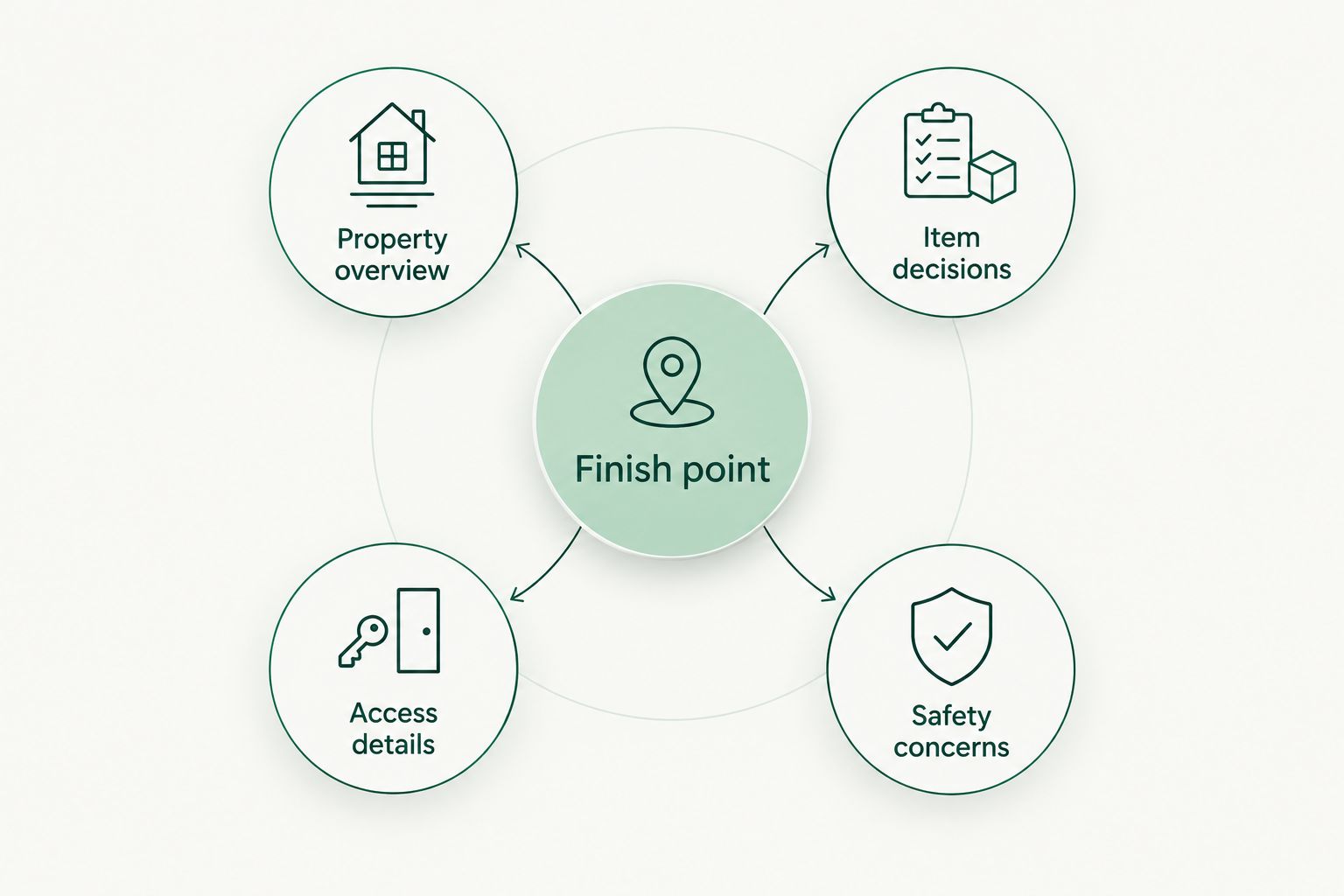
*A clear finish point helps providers assess the same job.*
Ask whether photographs are sufficient for an initial assessment or whether the provider requires a walkthrough. Photographs should show room context and access routes, not just close views of individual objects. Avoid sharing personal documents, faces, or other sensitive information unnecessarily.
Request a written response identifying the proposed scope, exclusions, expected work sequence, and scheduling assumptions. Then ask what happens if the crew finds additional material or a condition outside that scope. Resolve the approval process before work begins.
Can you stay in the property during a hoarder cleanup?
Whether you can remain in the property depends on safe access, the work area, and the conditions being addressed. Do not assume occupancy is safe because a removal appointment is booked. Ask the provider which areas need to remain clear and whether separate professional advice is required.
Tell the provider if anyone needs ongoing access to medication, mobility equipment, sleeping areas, bathrooms, or exits. Plan how essential belongings will remain accessible without interfering with the agreed work area. If safe access cannot be maintained, resolve that issue before proceeding.
A homeowner, tenant, property manager, and authorized representative can have different responsibilities. Establish who communicates instructions and who approves changes. The removal crew should not have to resolve conflicting disposal directions during the appointment.
How can you avoid unnecessary cleanup delays?
Resolve decisions and access arrangements before the scheduled work. Confirm entry instructions, building requirements, the authorized contact, and the location of retained belongings. Give the provider updated information if the property's condition changes after assessment.
Avoid preparing the property in ways that conceal uncertainty. Do not mix items to keep with items approved for removal, and do not move unidentified substances simply to make a room easier to photograph. Tell the provider what still needs assessment.
Before accepting a 2026 schedule, ask for the point at which you will receive a progress update and how changes will be approved. A clear update process does not guarantee a finish date. It tells you when to reconsider dependent appointments instead of assuming the original plan still applies.
Where does Expelled fit into a property cleanout?
Expelled is best for homeowners, property professionals, and businesses seeking to connect with independent property cleanout providers. The marketplace connects customers with independent providers offering property cleanouts, junk removal, and hauling; it does not perform the cleanout itself.
Use Expelled to connect with independent providers, then discuss the specific property, accepted materials, service boundaries, and schedule directly. The convenience is finding a connection point; the limitation is that a marketplace connection does not establish a provider's timing or suitability for your job.
Confirm location coverage directly. Provider coverage is confirmed in Pittsburgh and Los Angeles, but that does not establish availability for a particular appointment or acceptance of every cleanup condition.
FAQ
How long does a hoarder cleanup take from start to finish?
A hoarder cleanup requires a property-specific schedule covering sorting, removal, and any separate cleaning or remediation. Ask for both active work time and the full calendar timeline, with a written definition of completion.
Can a hoarder cleanup be completed in a single visit?
A single-visit plan requires the provider to assess and accept the full scope. Do not assume a removal visit includes sorting, cleaning, remediation, or repairs; confirm any separate appointments.
Does junk removal include cleaning a hoarded home?
Junk removal does not establish that cleaning is included. Ask the provider to list the rooms, surfaces, and tasks covered, along with anything requiring another service.
What should I send a provider before asking how long cleanup will take?
Send the property location, affected spaces, access details, retained-item instructions, known concerns, and desired finish point. Ask whether photographs are sufficient or a walkthrough is required.
Should I sort belongings before booking a cleanup?
Identify retained belongings and the authorized decision-maker before removal whenever practical and safe. Ask whether the provider includes sorting assistance rather than assuming those decisions will be handled during loading.
Can Expelled guarantee when my property cleanout will finish?
Expelled connects customers with independent providers and does not perform property cleanouts itself. Confirm the scope, scheduling assumptions, and any proposed completion date directly with the provider.
What happens if the provider finds hazardous materials?
Ask the provider to explain its exclusions and the process for handling newly identified concerns before work begins. Conditions outside the agreed scope require reassessment and, where appropriate, a separately qualified service.
One last thing
Ask what will still be unfinished when the provider leaves. That question exposes the gap between removing belongings and completing the whole property project. Record the answer alongside the schedule, especially if cleaning, repairs, an inspection, or a handover follows.
A useful completion plan names both the work being done and the work someone else must arrange. Keep that distinction visible when comparing providers and coordinating the next appointment.