
A foreclosure cleanout takes as long as the agreed removal work requires; get a property-specific duration from the independent provider rather than treating a general estimate as a deadline. Separate time spent clearing the property from the wait to start, disposal arrangements, and any cleaning or repairs outside the removal scope.
TL;DR
- How long does a foreclosure cleanout take? Get an independent provider’s estimate for the documented property cleanout scope.
- Separate scheduling, junk removal, disposal, and final inspection when agreeing on a completion date.
- Expelled connects property owners and professionals with independent providers; it does not perform foreclosure cleanouts.
- Define what stays, what goes, and what completion means before authorizing removal.
How long does a foreclosure cleanout take?
Use a written, scope-based schedule—not an assumed whole-house duration. Ask the provider to identify when work can begin, how long the specified removal should take, and what must happen before the job counts as complete.
For a foreclosure cleanout planned in 2026, follow this sequence before placing other work on the calendar:
- Confirm authority. Establish who can authorize entry and removal, and resolve instructions for belongings before work begins.
- Document contents. Describe every included room, storage area, and exterior area. Identify items that must remain.
- Describe access. Explain entry arrangements, stairs, parking, loading access, and any restrictions the provider needs to assess.
- Confirm scope. Ask the provider to state which removal, hauling, disposal, and cleanup tasks the estimate covers.
- Agree on timing. Request the proposed start, estimated completion, and circumstances that require a revised schedule.
- Check completion. Name the person who will inspect the property and approve the finished work.
Expelled is a property cleanout marketplace for homeowners, property professionals, and businesses seeking independent providers. You can use Expelled to connect with providers, then discuss the property, scope, and timing directly; the marketplace does not perform the cleanout itself.
Why this matters
An empty property and a property ready for its next use are different deliverables. Removing unwanted contents does not establish that repairs, detailed cleaning, or other property work are complete.
When arranging a foreclosure cleanout in 2026, define the handoff before discussing the deadline. A contractor waiting for an empty room needs a different completion condition from an agent preparing the entire property for photographs.
Write the deadline alongside the required condition: which spaces must be cleared, what must remain, and who accepts the result. That gives the provider something specific to assess and gives you a clear basis for comparing responses.
Separate the schedule into distinct parts
Ask the provider to distinguish the start date from the work duration. A statement about time on site does not answer when a crew can begin or when every agreed task will be finished.
Use this comparison to check what each scheduling statement actually covers. These are parts of a proposed schedule, not promised service times.
| Schedule component | Best for understanding | What to confirm | Limitation | |---|---|---|---| | Pre-work preparation | Whether the property is ready for removal | Authorization, access, and keep-or-remove instructions | Does not describe the removal work itself | | Scheduling window | When work is proposed to begin | Provider confirmation and entry arrangements | A proposed start is not a completion commitment | | On-site removal | The physical clearing work | Included spaces, contents, and loading tasks | Does not automatically include every disposal or cleaning task | | Disposal arrangements | Where removed materials will go | Accepted materials and any separate handling | Must be discussed alongside the removal scope | | Completion review | Whether the agreed work is finished | Inspection, photographs, and unresolved items | Does not certify unrelated repairs or property condition |
Compare equivalent completion points. If one proposal ends when loading finishes and another includes a final walkthrough, the schedules describe different deliverables. Ask each provider to explain its endpoint before choosing between them.
Build a job description the provider can assess
A request that says only “foreclosure cleanout” leaves the actual work undefined. Give the provider a description that connects the contents, access, and required finish.
For your 2026 cleanout request, organize the information in this order. Keep the same description when contacting different independent providers so their responses address the same job.
Property areas
List the spaces included in the request rather than relying on the property address alone. Include storage and exterior areas when they are part of the proposed work, and explicitly exclude any spaces that are not.
A room-by-room list gives the provider a way to ask focused questions. It also gives you a practical checklist for the completion review.
Contents
Describe furniture, loose belongings, appliances, and other materials you want assessed for removal. State which items are staying, which are approved for removal, and which still need a decision.
Photograph the contents without treating photographs as a complete substitute for discussion. Ask whether the provider needs additional views or an on-site assessment before confirming the schedule.
Access
Explain how the provider would enter the property and reach the included spaces. Describe stairs, locked areas, parking arrangements, and the proposed loading location.
Do not assume access is clear because you can enter the front door. Ask the provider to assess the actual route from the contents to the loading area.
Completion condition
State what you want to see at the handoff: agreed contents removed, specified areas cleared, or additional cleaning expressly included in the scope. Avoid using “ready” without explaining ready for what.
Identify any areas or materials that require separate instructions. Ask the provider to record exclusions rather than leaving them implied.
Review contact
Name the person authorized to answer questions during the work and approve changes. Give the provider a clear route for resolving an item that does not match the original instructions.
Also identify who will accept completion. If that person will not attend, agree beforehand on the photographs or other documentation they need.
!Five parts of a cleanout brief, from property areas through the completion review contact.
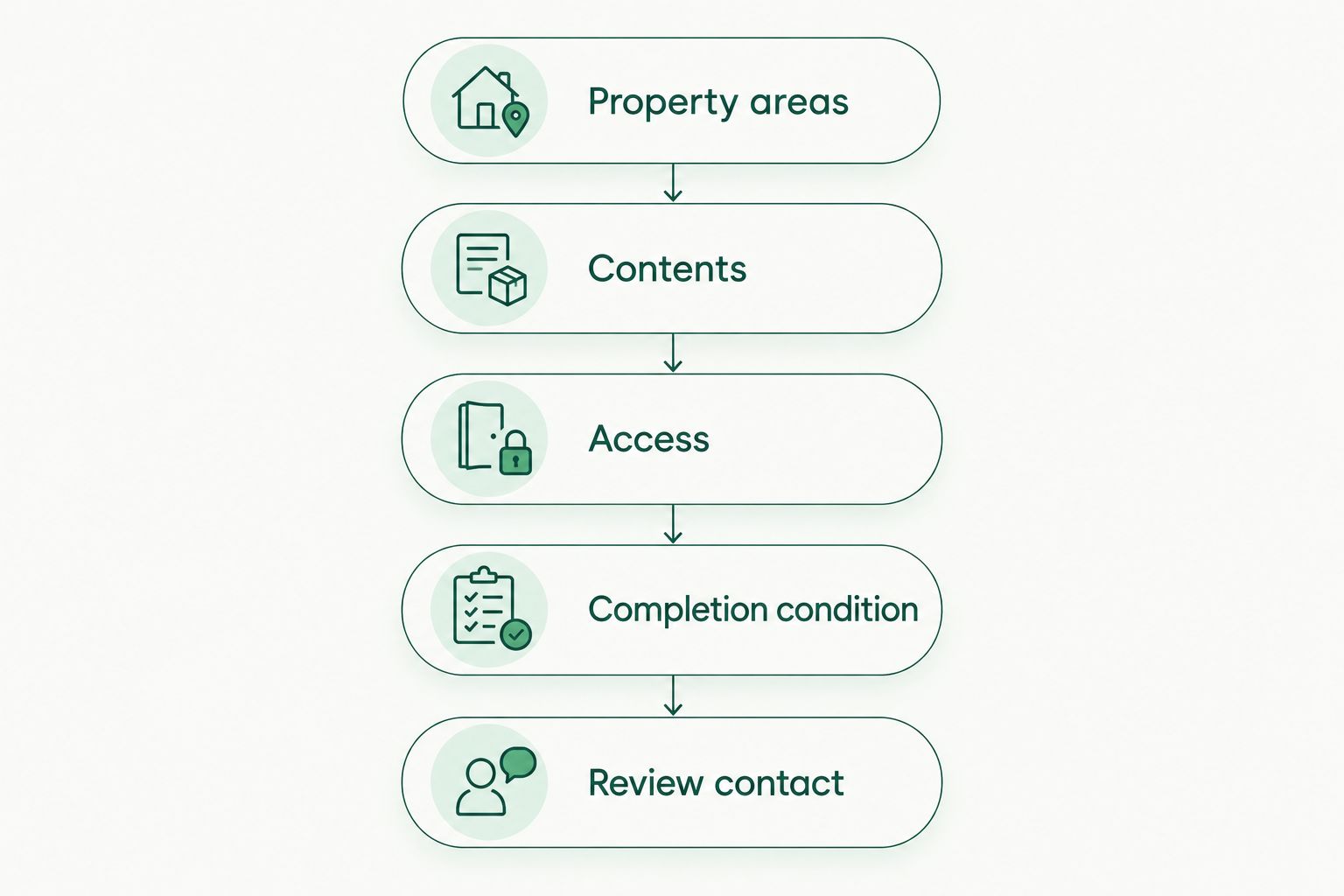
*Give each provider the same job description before comparing proposed schedules.*
Why foreclosure cleanout timing varies
A useful estimate explains its assumptions. Ask the provider how each of these factors affects the proposed schedule instead of requesting a duration disconnected from the property.
- Removal scope: Identify the included areas and contents. Ask what changes if additional spaces or belongings are added after assessment.
- Access arrangements: Describe entry, stairs, parking, and loading access. Have the provider identify any arrangements you must make before work starts.
- Sorting decisions: Resolve what stays and what goes. Establish who decides when an item is uncertain rather than leaving that decision to the removal crew.
- Material handling: Describe materials that need assessment, and ask what the provider accepts. Do not treat every item at the property as ordinary junk.
- Work boundaries: Separate hauling from cleaning, repairs, and other property services. Confirm whether another provider must finish a task before the cleanout can proceed.
- Scheduling and approval: Confirm the proposed start and the process for approving changes. Do not interpret an initial discussion as a reserved appointment.
These questions turn a general timing discussion into a job-specific plan. Keep the provider’s answers with the scope so you can see which assumptions support the proposed completion date.
Compare provider schedules without guessing
For a 2026 provider comparison, send the same photographs, area list, and completion requirements to each provider. Ask each to identify what it has assessed and what still requires confirmation.
A photograph-based discussion is useful for sharing visible contents before arranging access, but it does not show every condition. An on-site assessment allows the provider to inspect the property directly, but you still need written agreement on what the resulting schedule includes.
| Assessment approach | Best for | Practical benefit | Limitation to address | |---|---|---|---| | Written description and photographs | Starting a discussion before site access | Shares the proposed scope in a repeatable format | Hidden areas and unclear images still need clarification | | On-site walkthrough | Reviewing contents and access at the property | Lets the provider examine the proposed work directly | Verbal observations still need to become an agreed scope | | Updated assessment after changes | Revising a job when instructions change | Connects the revised schedule to the revised work | The original completion estimate needs reconfirmation |
Expelled connects you with independent property cleanout providers; confirm each provider’s scope and schedule directly. Do not treat a marketplace connection as approval of a particular completion date.
Ask these questions before authorizing the job:
- Does the proposed finish include all the areas in the written scope?
- What work or material is excluded?
- What must be ready before the provider starts?
- Who approves a change, and how will the provider explain its scheduling effect?
- How will the provider report that the agreed work is complete?
Choose a schedule you can verify against the scope. A short answer without assumptions gives you less to manage than a clear estimate tied to specific work.
Can a foreclosure cleanout be completed in one visit?
Treat a single-visit cleanout as a proposal the independent provider must confirm after assessing the property—not as a default. Ask whether that visit includes every agreed area, removal task, and completion check.
If the provider proposes separate visits, request the purpose and completion condition for each. Do not assume that one visit covers cleaning or repairs simply because it covers hauling.
Does a foreclosure cleanout include cleaning and repairs?
A foreclosure cleanout includes only the work agreed with the provider. Put removal, hauling, cleaning, and repairs on separate lines so you can see exactly which tasks are accepted and which need another arrangement.
For a 2026 handoff plan, define the property condition required by the next person entering the site. Confirm whether the proposed cleanout actually delivers that condition before scheduling the next task.
Keep changes from becoming unclear deadlines
An agreed scope needs an agreed change process. If you add a room, change the removal instructions, or discover an unassessed area, ask the provider to confirm the effect before treating the original schedule as unchanged.
Keep a written record of the revised work, who approved it, and the updated completion expectation. Separate a newly requested task from an unfinished original task; they are different issues and need different decisions.
At handoff, review the original area list alongside approved changes. Document unresolved items and agree on the next action rather than describing the entire property as complete or incomplete without detail.
FAQ
How long does a foreclosure cleanout take from booking to completion?
The full schedule needs to include the wait to start, the agreed removal work, and the completion review. Ask the independent provider to confirm each part for the property rather than treating on-site work duration as the entire timeline.
Can I get a foreclosure cleanout estimate from photographs?
Ask the provider whether photographs are enough for an initial assessment or whether a walkthrough is needed. Share every included area, describe access, and identify anything the images do not show.
Does a foreclosure cleanout include everything left in the house?
Only include belongings that you are authorized to have removed and that the provider accepts within the agreed scope. Identify items that must remain and resolve uncertain instructions before removal begins.
Can I schedule repairs immediately after the cleanout?
Confirm the cleanout completion point before committing to the repair handoff. Tell the provider which spaces must be clear and ask how any change to the removal schedule will be communicated.
What should I ask when comparing foreclosure cleanout providers?
Ask each provider to assess the same areas, contents, access arrangements, and completion requirements. Compare exclusions and scheduling assumptions alongside the proposed finish.
Does Expelled perform foreclosure cleanouts?
Expelled does not perform foreclosure cleanouts; it connects homeowners, property professionals, and businesses with independent providers. Discuss the work, accepted materials, and proposed schedule directly with the provider.
One last thing
Write the acceptance checklist before the cleanout starts. Use the same area names in your request, the provider’s scope, and the final walkthrough so everyone is discussing the same work.
The most useful scheduling question is not just when the crew leaves. Ask what will be finished, what will remain, and who confirms the handoff.