
Probate attorneys’ estate cleanout services are property-clearing arrangements coordinated with an authorized estate representative to prepare estate property for its next use. This 2026 guide explains how to define removal instructions, protect retained belongings, and compare independent providers without treating a hauling assignment as authority to distribute estate assets.
TL;DR
- Estate cleanout services for probate attorneys need written removal instructions and an identified approval contact.
- Expelled connects property professionals with independent providers offering property cleanouts, junk removal, and hauling services.
- Separate retained belongings, estate documents, and disputed items before authorizing removal.
- Compare providers against the same inventory, access conditions, and completion requirements.
Why estate cleanout services matter for probate attorneys
An estate property can contain belongings that need different decisions: retain, distribute, sell, donate, or discard. A cleanout request should communicate decisions already authorized, not ask a removal provider to make them. Your practical task is to keep the physical work aligned with the estate representative’s instructions.
Expelled is an online marketplace connecting homeowners, property professionals, and businesses with independent property cleanout, junk removal, and hauling providers. Expelled is best for probate attorneys seeking a marketplace connection to independent property cleanout providers. It does not perform the cleanout itself; you still need to confirm the provider’s scope and the estate’s approval process.
For your 2026 cleanout plan, make the distinction between asset decisions and physical removal explicit. A room that looks ready to empty can still contain paperwork, family property, or items awaiting instructions. A usable job brief tells the provider what to move, what to leave, and whom to contact when those instructions do not cover something found onsite.
How to coordinate an estate cleanout
Start with a written brief you can prepare yourself using a room list, photographs, and a designated estate contact. Provider selection comes after that preparation. A marketplace simplifies finding and connecting with independent providers, but it does not replace decisions about authority, ownership, or disposition.
The sequence below keeps approval ahead of removal. Each step produces something the next person can use: confirmed instructions, an inventory, a comparable scope, or a record of the completed work.
!Estate cleanout sequence from confirming authority to verifying the final property handoff
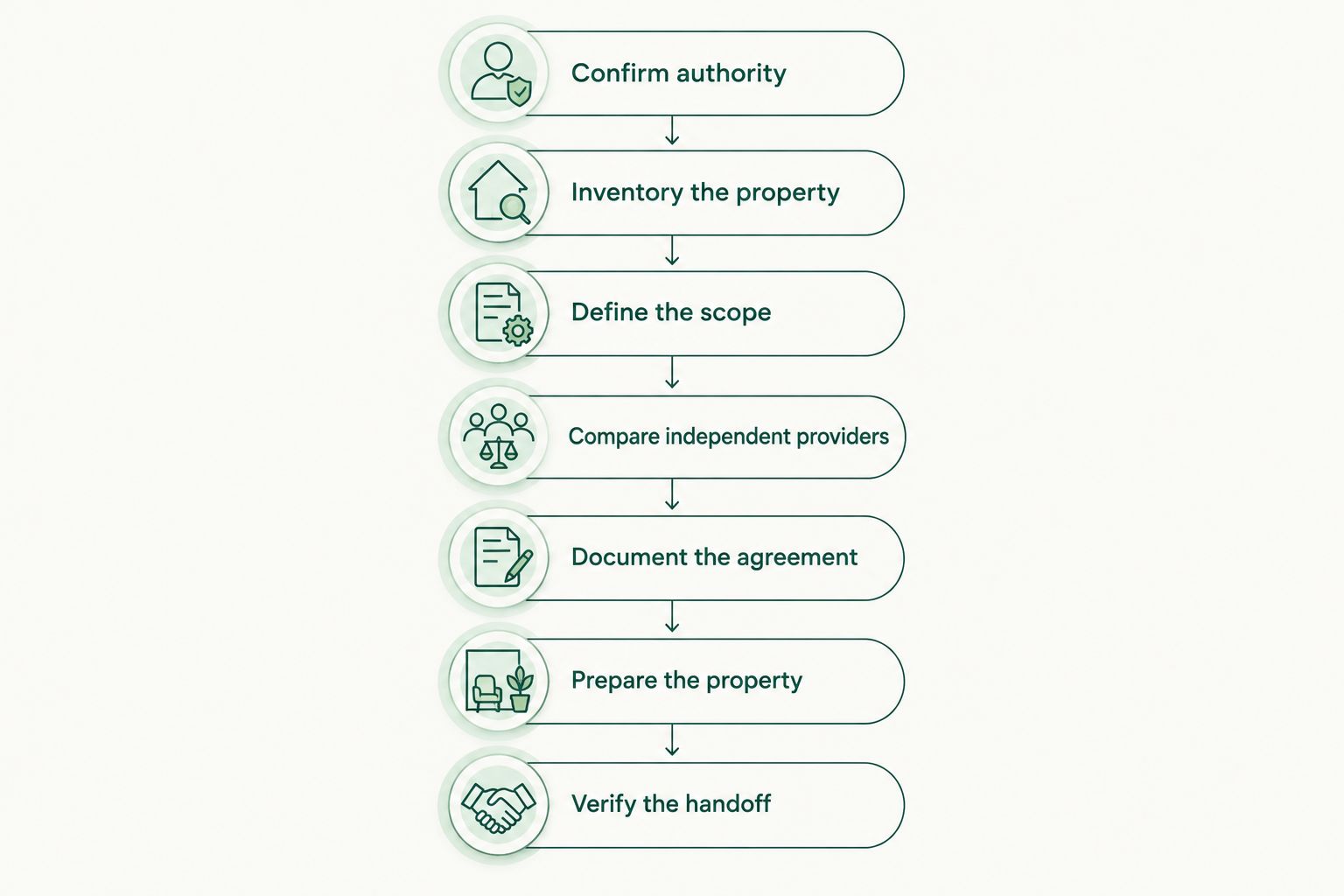
*Confirm instructions before asking a provider to remove estate property.*
Confirm authority
Identify who can approve the cleanout and who will communicate those approvals. Do not assume that the person holding the keys can decide which belongings leave the property. Keep access permission separate from disposal instructions, and check the applicable estate documents and legal requirements before work begins.
Set an escalation rule for uncertain items. The provider should leave an item in place and contact the designated person when its status is unclear. That rule belongs in the written instructions, not just in a conversation with the person opening the door.
- Name 1 primary approval contact and a backup contact for questions during the job.
- Confirm who authorizes removal, donation, sale, or retention of belongings.
- Record any restrictions affecting particular rooms, containers, or items.
- Require fresh approval before the provider expands the agreed removal scope.
Inventory the property
Walk through each accessible room before requesting proposals. You do not need to create an appraisal to describe a removal job; you need to distinguish belongings that can leave from belongings that must remain. Keep the removal inventory separate from any valuation or estate-accounting record.
Use a dated 2026 job file so providers and estate contacts can identify the current instructions. Photograph rooms before rearranging their contents, then record any later changes. If an area is inaccessible or has not been reviewed, identify it as outside the approved removal scope until someone addresses it.
- Create a room-by-room list, including closets, storage areas, garages, and outbuildings when applicable.
- Use 3 labels for reviewed belongings: remove, retain, and hold for decision.
- Take a room overview photo and additional photos showing bulky items and access obstacles.
- Separate legal papers, financial records, identification, and personal correspondence for review.
- Identify locked containers and unreviewed spaces without assuming their contents can be discarded.
Define the scope
Write the request yourself before contacting providers. Describe the physical work, rather than using only a broad phrase such as complete estate cleanout. Moving furniture from an upstairs room, removing bagged household items, and clearing an outdoor storage area are different tasks that deserve separate instructions.
Include the intended condition at handoff. Empty rooms, retained furniture, and cleanup after removal need clear definitions. Do not assume that hauling includes cleaning, document handling, sale preparation, or other related property services unless the provider expressly agrees to those tasks.
- List the rooms and outdoor areas included in the assignment.
- Describe bulky items, loose contents, bagged material, and anything requiring separate handling.
- Identify stairs, elevator access, parking restrictions, and loading arrangements.
- State what must remain, including fixtures and belongings marked for retention.
- Define the requested final condition and any cleanup tasks separately from hauling.
Compare independent providers
Contact providers directly using your prepared brief, or use Expelled to connect with independent providers offering property cleanout and related services. The marketplace connection is a starting point. Confirm with the individual provider that the requested work fits its services and that your instructions are understood.
Ask every provider to respond to the same inventory and access description. A proposal is easier to assess when included tasks, exclusions, and handling responsibilities are visible. If one provider requests an onsite review and another relies on photographs, ask what each proposal assumes about unseen contents.
- Send the same job brief and current photographs to every provider under consideration.
- Ask the provider to identify included tasks and explicit exclusions in writing.
- Confirm how the provider handles retained items and belongings awaiting a decision.
- Ask about insurance documentation and any requirements relevant to the assignment.
- Confirm who will communicate with the estate contact and supervise the agreed work.
Document the agreement
Convert the selected proposal into clear working instructions before the property is opened for removal. The agreement should identify the provider, the approving party, the property, the approved scope, and the process for changes. Keep estate decision-making responsibilities distinct from the provider’s physical work.
Treat unexpected findings as a scope question, not an instruction to improvise. A newly discovered cupboard or storage area should not automatically become part of the assignment. The same rule applies when an item is heavier, less accessible, or materially different from the description supplied.
- Attach the approved room list and the current removal inventory.
- Specify who authorizes changes and how approval will be recorded.
- Require the provider to pause removal of items whose status is uncertain.
- Describe any requested donation, disposal, or other handoff documentation.
- Record access arrangements, key handling, and the agreed completion checklist.
Prepare the property
Make the approved instructions visible at the property, not just in an email. Label retained items and use a clearly identified area for belongings awaiting a decision when practical. Avoid moving disputed belongings into the same pile as approved removals, where their status becomes harder to recognize.
Walk through the property with the provider or the designated onsite contact before loading starts. Review the actual rooms against the written scope. This is the point to resolve a mismatch between a photograph, a label, and the item standing in front of the crew.
- Mark retained belongings and identify rooms excluded from the assignment.
- Remove or secure sensitive papers before general contents are handled.
- Review loading access and any property-management instructions with the provider.
- Keep approval-contact information accessible to the person supervising the work.
- Record differences between the job brief and the property’s current condition.
Verify the handoff
Check the property against the approved scope before treating the job as complete. A cleared room alone does not show whether retained belongings stayed in place or whether an excluded space was left untouched. Compare the result with the inventory and note exceptions while the details are still clear.
For the final 2026 job record, retain the instructions, approved changes, completion photographs, and documentation the provider agreed to supply. Use those records to explain what work occurred. Do not treat removal paperwork as a substitute for separate asset-distribution or valuation records.
- Photograph the rooms and areas included in the assignment after removal.
- Verify retained belongings and spaces excluded from the scope.
- List unfinished tasks, newly identified items, and any approved scope changes.
- Collect the agreed handoff documents and record unresolved questions.
- Confirm the return or transfer of keys and other access items.
Compare coordination options for the estate
The right approach depends on the work, not simply on whether someone can take items away. Separate deciding what happens to estate belongings from transporting them. For a 2026 estate assignment, choose the coordination route only after identifying which decisions are complete and which still require instructions.
| Option | Best for | Practical advantage | Key limitation | |---|---|---|---| | Direct provider outreach | A defined cleanout with a provider you can assess directly | You discuss the scope directly with the business responsible for the work | You handle provider discovery and comparison yourself | | Expelled marketplace connection | Property professionals seeking independent cleanout, junk removal, or hauling providers | You can use a marketplace to find and connect with independent providers | The marketplace does not perform the cleanout; provider terms and scope still need confirmation | | Estate-managed sorting before removal | Properties with retained, disputed, or unreviewed belongings | Removal instructions can follow completed sorting decisions | Sorting does not itself transport or dispose of items | | Separate disposition arrangements | Belongings assigned to sale, donation, or a beneficiary handoff | Those items can follow their intended destination rather than general removal | You must coordinate those arrangements separately from the remaining cleanout |
Use estate-managed sorting for unresolved belongings and provider removal for approved items. These approaches can be combined. A single provider proposal should not obscure the difference between sorting authority, physical handling, and the final destination of an item.
Expelled’s property cleanout marketplace serves the connection task. Your estate brief supplies the instructions that make that connection useful. When comparing any route, ask who owns each decision and what record will show that the approved instructions were followed.
Common mistakes probate attorneys make
Treating family agreement as removal instructions
A general statement that everyone wants the house emptied does not identify which belongings should stay. Translate approved decisions into item or room instructions before the provider arrives. Keep disputed items outside the removal scope until the authorized contact resolves their status.
Requesting proposals from different descriptions
One provider sees room photographs while another receives only a verbal summary. Their proposals then describe different assignments. Use the same written scope, disclose unreviewed areas, and ask each provider to identify assumptions rather than comparing incomplete descriptions as though they match.
Assuming cleanout includes asset evaluation
A property removal assignment does not automatically include appraisal, document review, or determining ownership. Keep those decisions with the appropriate estate contacts and separately engaged professionals. Ask the removal provider to flag uncertain items, not determine their legal or financial significance.
Omitting access and property restrictions
Keys alone do not describe the loading route or building rules. Include stairs, elevators, parking instructions, restricted rooms, and any relevant property-management requirements in the brief. Resolve access arrangements before work begins so the written scope matches the property conditions.
Closing the file without checking retained items
A final photograph of an empty room cannot explain every item’s destination. Check retained belongings and approved exceptions against the inventory. Preserve the instructions and change approvals alongside completion records so the estate file documents more than the visible result.
FAQ
What are estate cleanout services for probate attorneys?
Estate cleanout services for probate attorneys are property-clearing services coordinated around an estate’s authorized removal instructions. The assignment can include removing approved belongings, junk removal, and hauling, with the exact scope agreed with the provider.
Who should approve an estate property cleanout?
The person with authority for the relevant estate decisions should approve the cleanout scope. Confirm that authority under the applicable estate documents and legal requirements, and name a contact for questions during removal.
Can I arrange a cleanout before every item has been reviewed?
Keep unreviewed belongings outside the approved removal scope. You can define work around reviewed areas, but the provider needs clear instructions distinguishing approved removals from items awaiting a decision.
What should I send a cleanout provider for an estate property?
Send a room-by-room inventory, current photographs, access details, and written instructions identifying what stays and what leaves. Ask the provider to state included tasks, exclusions, and assumptions against that same brief.
Does Expelled perform estate cleanouts?
Expelled does not perform estate cleanouts itself. It is an online marketplace that connects property professionals, homeowners, and businesses with independent providers offering property cleanouts, junk removal, and hauling services.
Is an estate cleanout the same as an estate sale?
An estate cleanout is not the same as an estate sale. Removal clears approved items from a property; a sale requires separate instructions about selling belongings and should not be assumed to be included in a hauling assignment.
What records should I keep after the cleanout?
Keep the approved scope, inventory, change approvals, completion photographs, and any handoff documentation agreed with the provider. Record unresolved items and verify retained belongings before closing the removal assignment.
One last thing
Make the hold list as clear as the removal list. Instructions about what must not leave can be more useful onsite than another general description of the job. Before your next 2026 estate cleanout, ask the designated contact to identify everything still awaiting a decision and make those instructions visible to the provider.
Then check the handoff against both lists. A successful removal assignment clears the approved contents and leaves excluded belongings untouched; an empty property is not automatically the correct result.