
Estate liquidators’ estate cleanout services are property removal and hauling services coordinated with the aim of clearing authorized contents after sale, distribution, or retention decisions. This 2026 guide explains estate cleanout services for estate liquidators, where protecting retained property and documenting removal instructions matter as much as clearing rooms.
TL;DR
- Estate cleanout services for estate liquidators should follow written release instructions, not assumptions about what remains after a sale.
- Expelled is best for estate liquidators who want to connect with independent property cleanout providers.
- Compare property cleanout and junk removal providers against the same inventory, access details, exclusions, and handoff requirements.
- Separate retained items, unsold inventory, and authorized removals before scheduling hauling.
Why estate cleanout services matter for estate liquidators
A cleanout is not permission to discard everything left behind. Your sale inventory, the estate representative’s instructions, and the removal provider’s work order need to agree before loading starts. An unsold cabinet and a cabinet awaiting family collection can look identical to a crew.
Estate liquidators coordinate decisions as well as physical contents. You need to distinguish sale preparation from post-sale removal, preserve access for collections, and define what the next property professional receives. The related guide to estate cleanout services for probate attorneys addresses another professional role involved in these handoffs.
For your 2026 workflow, judge a cleanout arrangement by the clarity of its scope. A written assignment lets you compare providers without treating different jobs as equivalent. It also gives the authorized estate representative a specific removal plan to approve rather than a vague instruction to clear the house.
How to coordinate an estate cleanout
1. Confirm who can authorize removal
Start with a written authorization record using an email thread or shared document. Identify who can approve removal, who can resolve disputed items, and who can approve changes once work begins. Being the person who schedules a cleanout does not establish ownership of the contents.
Keep operational instructions separate from legal questions. Ask the authorized estate representative or their counsel to resolve uncertain authority, ownership, or distribution decisions before you release affected items. A hauling provider should not decide which family instruction takes precedence.
Set 2 approval checkpoints: approval of the removal inventory before work starts, and approval of any material scope change during the job. These are suggested controls for your process, not a substitute for estate-specific instructions.
Your written authorization record should include:
- The person authorizing the removal and their contact information.
- The property address and spaces included in the assignment.
- The approved removal inventory and explicit exclusions.
- The person authorized to approve changes during loading.
- Instructions for pausing work when ownership or release status is uncertain.
2. Separate sale inventory from released contents
Build a room-by-room inventory in a spreadsheet before requesting removal proposals. Use 4 status labels: Retain, Sell, Release, and Hold. Retain covers property staying with the estate or a recipient; Sell covers active sale inventory; Release identifies authorized removals; Hold stops action pending a decision.
Do not rely on colored stickers alone. A sticker can detach, and a verbal explanation can fail to reach the person carrying an item. Pair each label with a written location and description, particularly when similar furniture occupies the same room.
Keep sold items awaiting collection outside the removal scope until collection or another authorized decision resolves their status. When you use a 2026 inventory template, include a revision date so the provider knows which version controls the job.
Before you share the inventory:
- Mark retained furniture and contents clearly.
- Separate sold items awaiting buyer collection.
- Record unresolved items under Hold rather than Release.
- Identify drawers, cupboards, and containers requiring review.
- Name the person responsible for changing an item’s status.
3. Describe the job before contacting providers
Create a reusable job brief yourself, then send the same version to each provider you approach. Include photographs, item descriptions, access conditions, and your required end state. A request to remove released furniture is different from a request to empty every approved room and sweep afterward.
Expelled is best for estate liquidators who want to connect with independent property cleanout providers. The Expelled marketplace connects property professionals with independent providers offering property cleanouts, junk removal, and hauling. It is a connection option, not the company performing the cleanout; confirm the proposed work directly with the provider.
The marketplace can serve as a starting point for provider discovery rather than limiting your search to an existing contact list. You still need to establish job fit, written terms, and scheduling with the independent provider. Do not treat a platform connection as acceptance of your assignment.
Include these details in your brief:
- Property scope: rooms, outbuildings, storage areas, and excluded spaces.
- Removal inventory: released items, quantities you have counted, and unusual pieces.
- Access conditions: stairs, elevators, parking instructions, and loading routes.
- Work boundaries: dismantling, carrying, hauling, and cleanup requested.
- Handoff requirements: photographs, access return, and unresolved-item reporting.
4. Document access and material restrictions
Walk the property yourself or ask an authorized onsite contact to document the route from each removal area to the loading point. Take 3 photo types: room overviews, item close-ups, and access-route views. These support a discussion of the job; they do not replace any inspection the provider requires.
Describe observed conditions rather than diagnosing them. If you see leaking containers, unidentified chemicals, damaged materials, or signs of contamination, flag the condition and ask the provider what it can accept. Do not place questionable material in an ordinary removal pile while waiting for an answer.
For occupied buildings, separate estate access from neighboring residents’ access. Confirm building instructions with the responsible contact instead of assuming the cleanout crew can reserve an elevator or block a shared corridor.
Document these access and handling points:
- The approved entry route and areas the crew must not enter.
- Stairs, narrow turns, elevator instructions, and doorway constraints.
- Parking or loading arrangements confirmed by the responsible party.
- Items requiring provider review before acceptance.
- Materials excluded from ordinary removal until handling is confirmed.
5. Compare written scopes and confirm the sequence
Use a side-by-side worksheet to compare responses manually. Put the inventory version at the top, then record what each provider includes, excludes, and needs clarified. A response covering curbside collection is not equivalent to one covering interior carrying and removal.
Request relevant insurance documentation and ask who will attend the property. Establish how subcontracted work, if any, will be communicated. Neither a provider’s name nor its presence on a marketplace answers those questions.
Your 2026 comparison worksheet should also show dependencies: family collection, final sale pickups, building access, and any inspection needed before acceptance. Confirm dates with the provider rather than treating your preferred date as a booking.
Before you accept a proposal:
- Match its scope to the current released-item inventory.
- Confirm who handles carrying, dismantling, and loading.
- Record exclusions and the process for approving additional work.
- Confirm relevant insurance documentation and onsite contacts.
- Agree on the sequence of pickups, removal, and final review.
6. Inspect the handoff before closing the file
Use your original inventory as the inspection checklist. Compare each approved area with its agreed end state and record exceptions while the responsible contacts can address them. Empty, swept, and ready for another contractor describe different outcomes; use the wording accepted in the scope.
Keep removal evidence distinct from evidence about an item’s destination. A photograph of an empty room shows that contents are gone. It does not establish donation, recycling, or disposal, so request applicable documentation when that outcome forms part of the agreement.
Close the job only after recording retained property, unresolved items, and access arrangements. Your successor should be able to understand the property’s status without reconstructing the cleanout through messages.
Complete the handoff with these actions:
- Compare the cleared spaces against the approved inventory.
- Photograph completed areas without exposing sensitive documents.
- Record items left behind and the reason for each exception.
- Collect destination documentation agreed in the scope.
- Confirm the return or transfer of keys and access devices.
The sequence is deliberate: authorization comes before sorting, and comparison comes after the scope is clear. Inspection closes the assignment against those same instructions.
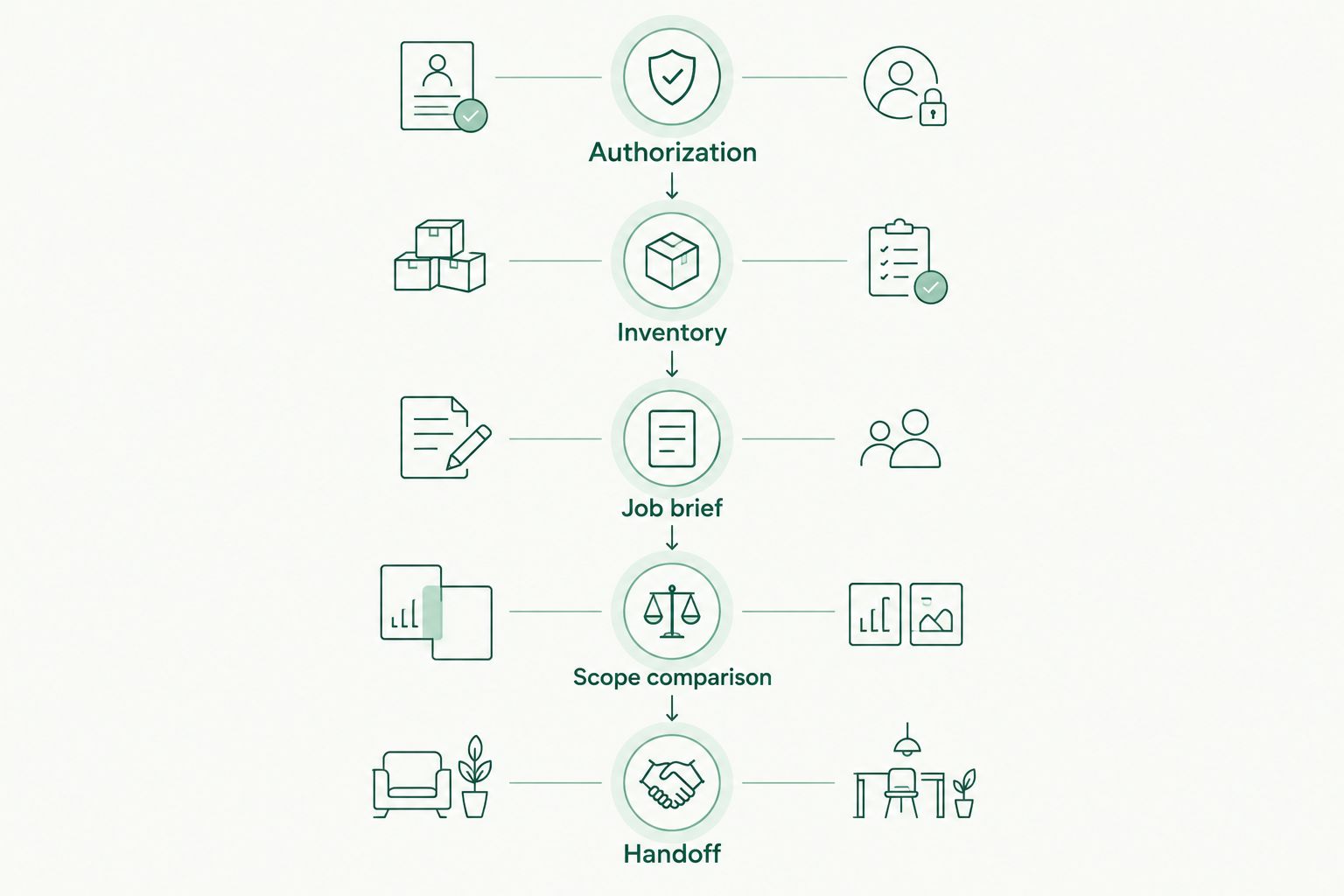
*Use the same approved scope from the first provider conversation through the final inspection.*
Compare estate cleanout coordination options
Choose the arrangement that matches who will carry, load, and coordinate the released contents. For a 2026 assignment, compare responsibilities before accepting a proposal; the service label alone does not define the work.
| Option | Best for | Practical advantage | Key limitation | |---|---|---|---| | Directly arranged independent provider | Liquidators with an established provider relationship | Lets you discuss scope directly with the business doing the work | You handle provider discovery, checks, and coordination yourself | | Expelled marketplace connection | Liquidators seeking independent property cleanout providers | Provides a marketplace route to connect with providers | Expelled does not perform the cleanout; provider acceptance and terms require confirmation | | Self-coordinated hauling | Assignments where authorized staff already handle sorting and loading | Keeps physical handling under your own coordination | You retain responsibility for labor, transport arrangements, and accepted destinations | | Container-based removal | Jobs where onsite personnel will load approved contents | Separates container arrangements from your sorting process | Does not by itself supply interior carrying, sorting, or loading labor |
Compare the complete assignment, not just the removal method. A container arrangement and an interior cleanout leave different responsibilities with your team. Make those differences visible before choosing.
If you want a marketplace starting point, Expelled connects property professionals with independent providers. Use the job brief above to explain the assignment and confirm whether a provider accepts its scope.
Connect with independent providers
Use your estate inventory, access details, and exclusions to describe the cleanout assignment.
[Explore the marketplace](https://expelled.online/)
Common mistakes estate liquidators make
Treating every unsold item as released
An item can remain unsold while still belonging to a designated recipient or awaiting instructions. Keep unsold status separate from removal authorization. Move the item to Release only after the authorized contact approves that decision.
Leaving buyer collections mixed with cleanout work
A buyer’s pending pickup creates a different instruction from hauling unwanted contents. Maintain a collection list and identify those pieces onsite. If collection arrangements change, get a new instruction rather than asking the removal crew to interpret the situation.
Comparing different definitions of a cleared property
One proposal can cover loose contents while another includes dismantling or a final sweep. Write your required end state before comparing responses. Otherwise, you are choosing between different assignments without acknowledging the difference.
Allowing informal family instructions to change the scope
A relative arriving during loading can introduce a legitimate concern without being the designated decision-maker. Pause removal of disputed items and contact the authorized person. Record the resolution so the onsite crew receives a single instruction.
Assuming removal proves donation or recycling
Removal, donation, recycling, and disposal are distinct outcomes. Agree on destination requirements and documentation before work starts. Do not report an outcome to the estate representative merely because the item left the property.
FAQ
What are estate cleanout services for estate liquidators?
Estate cleanout services for estate liquidators involve removing authorized property contents in coordination with sale, retention, and distribution decisions. The scope should identify what leaves, what stays, and who approves changes.
Should I schedule an estate cleanout before or after the estate sale?
Schedule removal of sale inventory after its sale or release status is resolved. Separate earlier removal work from retained property and items still offered for sale, and confirm the sequence with the authorized estate representative.
Does Expelled perform estate cleanouts?
Expelled does not perform estate cleanouts itself; it is an online marketplace connecting customers with independent providers. Confirm the job scope, scheduling, and terms directly with the provider.
What should I send an estate cleanout provider?
Send a released-item inventory, property photographs, access details, exclusions, and your required handoff condition. Identify the person authorized to approve changes and explain any pending buyer or family collections.
Is a container arrangement better than a cleanout provider?
A container arrangement fits work where your designated personnel will handle loading; an interior cleanout assignment requires confirmation of carrying and loading responsibilities. Choose by the labor and coordination included, not by the service label.
What should happen if family members dispute an item during removal?
Pause removal of the disputed item and refer the decision to the designated authorized contact. Record the instruction before the item is loaded or released.
How should I compare estate cleanout proposals?
Compare proposals against the same inventory, access conditions, exclusions, and required end state. Confirm carrying, dismantling, cleanup, documentation, and change approval so different assignments do not appear equivalent.
One last thing
An empty room can still be an incomplete handoff. Keys, disputed contents, destination records, and retained items can remain unresolved after the truck leaves. Add an exceptions field to your 2026 completion record and name the person responsible for each open item; that makes the next action clear without overstating that the estate is finished.