
Retail store closure commercial junk removal is the removal of unwanted store contents with the aim of preparing premises for handover. Unlike a routine pickup, a closure requires you to separate retained stock, movable fixtures, landlord-owned items, and equipment needing specialist handling before anyone starts loading.
TL;DR
- Commercial junk removal for retail store closures starts with an approved inventory, access plan, and written removal scope.
- Expelled connects businesses with independent providers; it does not perform commercial junk removal itself.
- Separate junk removal, fixture dismantling, specialist equipment handling, and final cleaning when comparing proposals.
- Approve what stays before loading begins, then document the cleared premises against your handover requirements.
Why commercial junk removal matters for retail store closures
A cleared shop is not automatically a handover-ready shop. Your lease and written landlord instructions determine what must remain, what must go, and which repairs or cleaning tasks belong outside the removal job.
For a 2026 store closure, organize the work around those obligations rather than a general instruction to empty the premises. A provider needs to distinguish freestanding shelving from attached fixtures, saleable inventory from discarded stock, and ordinary contents from materials requiring separate handling.
Before appointing anyone, use the licensing and insurance comparison guide to frame your questions. Verify the documents and job-specific requirements directly rather than treating a business listing as proof that every task is covered.
How to plan your retail store cleanout
Build the job in this order: Inventory, Ownership, Access, Provider comparison, and Handover. Resolve decisions on paper before asking someone to remove physical contents; a clear scope gives each provider the same work to assess.
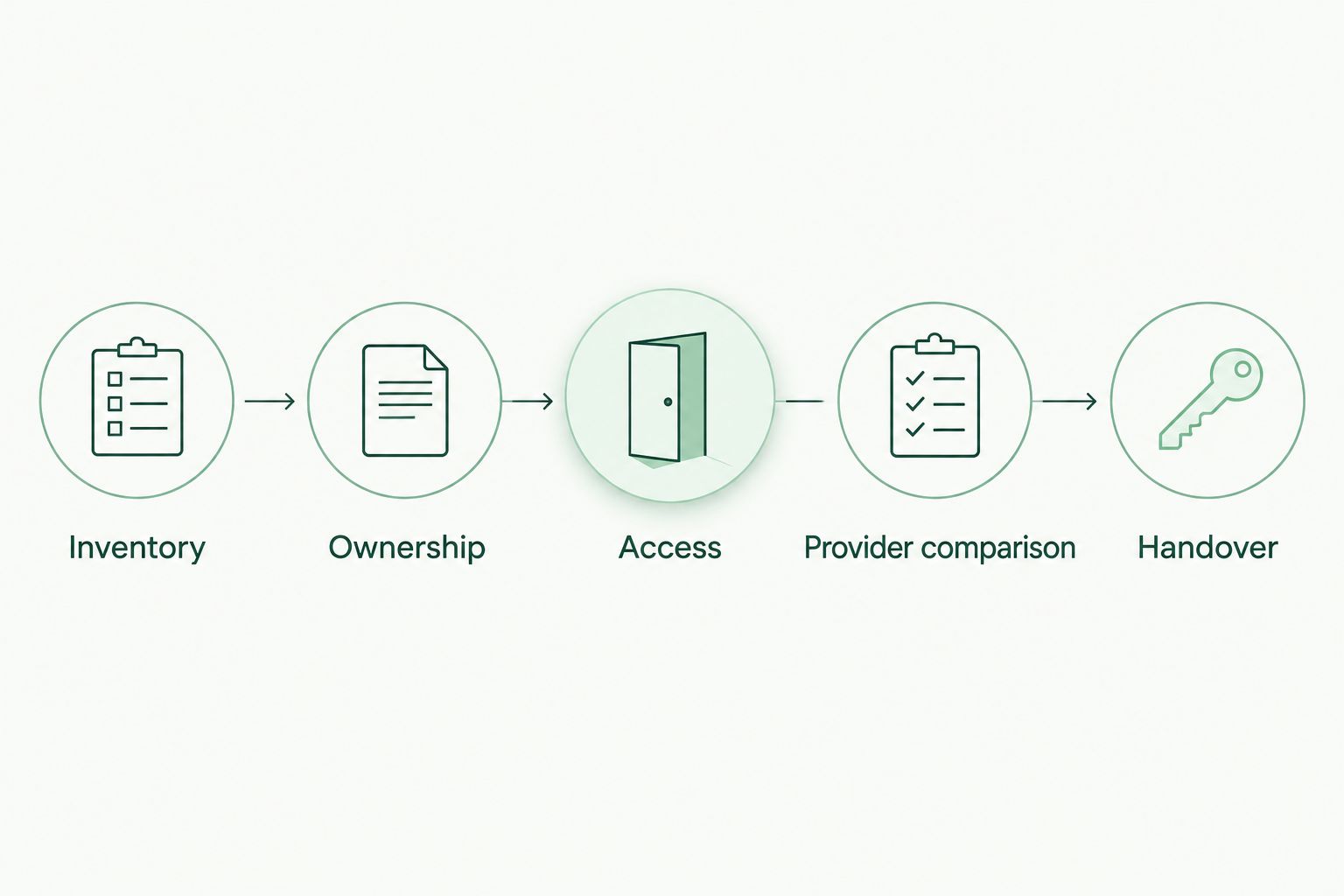
*Approve the inventory and ownership decisions before arranging removal.*
1. Inventory every area before requesting proposals
Start with a spreadsheet, a floor sketch, and photographs. Walk the sales floor, fitting rooms, stockroom, office, basement, and any exterior storage areas that belong to your tenancy. Include overlooked contents such as display props, loose signage, packing materials, and employee storage.
Record items in useful groups without hiding access difficulties. A description such as freestanding shelving in the rear stockroom tells a provider more than miscellaneous junk. Take at least 3 photographs per work area: an overview, the largest items, and the route to the loading point. This is a documentation checklist, not a required provider standard.
- Record item types and quantities where you can count them.
- Identify heavy, awkward, fragile, or attached items separately.
- Photograph doorways, stairs, lifts, and loading routes.
- Mark rooms that have not yet been inspected.
- Update the inventory after stock transfers or fixture sales.
2. Confirm ownership and separate the removal scope
Create 2 written lists: contents approved for removal and contents that must remain. Check those lists against the lease, equipment rental agreements, consignment records, and landlord instructions. Get written approval for disputed fixtures before including them in the job.
Use labels that are understandable without a verbal explanation. Sold counters, leased payment equipment, and retained stock should not sit in an unlabeled pile beside discarded materials. Keep removal authority with a designated person so staff, buyers, and providers do not issue conflicting instructions.
Your 2026 cleanout brief should identify who approves changes, not just who opens the door. Ownership decisions remain your responsibility; a removal provider cannot resolve a disagreement about whether a fixture belongs to the tenant or landlord.
- Label approved items as remove, retain, return, or transfer.
- Separate customer property and employee belongings.
- Identify rented, leased, and consigned equipment.
- Obtain approval before removing attached fixtures.
- Keep confidential records out of general disposal piles.
3. Connect with providers using the same job brief
You can contact independent providers directly using your inventory and photographs. Ask each provider to assess the same scope, explain exclusions, and identify information needed before accepting the work. Do not compare a proposal for loose contents with one that also includes dismantling and cleanup.
Expelled is best for businesses seeking to connect with independent commercial junk removal providers. Expelled is a marketplace, not the company performing the cleanout; you must confirm the proposed work, terms, and suitability with the independent provider.
Using a marketplace gives you another route to provider connections, but it does not replace your scope or due diligence. Discuss location and job requirements directly without assuming coverage, availability, or a particular completion schedule.
- Send the same inventory and photographs to each provider.
- Describe the property type and exact work areas.
- Ask whether a site visit is needed before agreement.
- Request written inclusions, exclusions, and job assumptions.
- Confirm who performs and supervises the work.
4. Resolve access and building restrictions
Walk the route from each work area to the loading point. Note steps, narrow turns, shared corridors, lift restrictions, and surfaces that need protection. Ask building management to confirm loading arrangements and contractor procedures before you agree to a work date.
Assign 1 site contact with authority to answer scope questions. Give that person the approved inventory and landlord instructions, and establish how they will handle a newly discovered item. The provider also needs a contact if access is blocked or the proposed route proves unsuitable.
For a 2026 closure, put agreed dates and access conditions in writing. A requested date is not a confirmed appointment, and a building access window is not a promise that every part of the job will fit inside it.
- Confirm loading areas and vehicle access with building management.
- Share lift booking rules and permitted working hours.
- Identify door, floor, and corridor protection requirements.
- Keep emergency exits and shared routes clear.
- Confirm keys, alarm access, and the on-site contact.
5. Separate specialist materials and attached equipment
List electronics, batteries, lamps, chemicals, and refrigeration equipment separately from ordinary furniture and loose rubbish. Ask the provider what they accept and how excluded materials should be handled. Do not assume that a commercial junk removal proposal includes every material present in a store.
Treat disconnection and dismantling as distinct tasks. Before removing powered equipment or attached fixtures, establish whether another contractor must disconnect utilities or make the area safe. Refrigerant-containing equipment requires appropriate handling; it does not belong in an undifferentiated disposal pile.
Avoid asking general removal workers to decide the status of an unidentified chemical or damaged battery. Keep the item identified and separate, then obtain instructions from an appropriate specialist or local disposal authority.
- Flag refrigeration equipment and other powered appliances.
- Identify batteries, lamps, chemicals, and damaged electronics.
- Ask who handles disconnection and fixture dismantling.
- Confirm accepted materials and disposal exclusions in writing.
- Request relevant disposal documentation when your requirements call for it.
6. Compare written proposals by scope and responsibility
Use a simple comparison sheet before choosing a provider. Start with the approved removal list and check whether each proposal covers the same rooms, items, access conditions, and finishing tasks. A proposal that omits stockroom contents is not equivalent to one covering the entire tenancy.
For each 2026 proposal, identify who handles dismantling, loading, transport, disposal, surface protection, and any agreed cleanup. Ask how changes are authorized when the actual contents differ from the inventory. Do not let a conversation about a general cleanout substitute for written task boundaries.
Expelled commercial junk removal connections still require provider-level checks. The marketplace relationship does not establish that an independent provider meets your building's insurance requirements or accepts every item in your scope.
- Check every proposal against the same removal inventory.
- Verify insurance documents against building requirements.
- Identify subcontracted or separately arranged tasks.
- Record exclusions and the process for approving changes.
- Confirm the agreed access window and completion criteria.
7. Inspect the premises before accepting completion
Use the approved inventory as your inspection checklist. Walk every included area with the site contact, photograph the result, and record items left behind or tasks not completed. Distinguish an agreed exclusion from unfinished work before discussing corrective action.
Check the handover requirements separately. Junk removal does not inherently include deep cleaning, repairs, removal of fixings, or restoration of walls and floors. If those tasks are required, assign them explicitly rather than assuming that an empty sales floor closes the job.
Do not rely on memory at the final inspection. Keep the original scope, approved changes, completion photographs, and any agreed disposal records together so the person handing back the premises can explain what happened.
- Inspect sales areas, stockrooms, offices, and storage spaces.
- Check retained fixtures against the do-not-remove list.
- Photograph remaining contents and visible damage.
- Record outstanding work with the responsible party.
- Obtain written acknowledgment of the completed scope.
Compare cleanout options for a retail closure
Choose by the work required, not by the label on the service. A small loose-item pickup and a store strip-out have different task boundaries. The options below are ways to organize the work; none replaces confirmation of what a particular provider accepts.
| Option | Best for | Practical advantage | Key limitation | |---|---|---|---| | Internal staff coordination | Sorting stock, records, and retained assets | Keeps ownership decisions with the business | Does not replace appropriate removal or specialist handling | | Independent junk removal provider | Approved loose contents and movable fixtures | Assigns the agreed removal work to an outside provider | Dismantling, cleaning, and specialist materials require explicit confirmation | | Expelled marketplace | Businesses seeking connections with independent providers | Offers a route to find and connect with providers | Does not perform the work or guarantee provider availability | | Specialist contractor | Utility disconnection, attached equipment, or separately regulated materials | Separates technical tasks from general loading | Requires coordination with the removal job | | Building-approved contractor | Properties with landlord contractor requirements | Fits the building's required appointment process | Approval does not establish that every task is included |
Use more than one route when the job requires it. Staff can decide what stays, a specialist can disconnect equipment, and an independent removal provider can handle the agreed contents. Define the boundary between those tasks before booking them.
Common mistakes retail operators make
- Treating every fixture as tenant-owned. Check attached shelving, counters, lighting, and signage against written ownership instructions before approving removal.
- Requesting a proposal before the final inventory. Update the scope after liquidation, stock transfers, and fixture collections so the provider assesses the actual remaining contents.
- Forgetting the loading route. A clear sales floor does not solve a restricted service entrance, unbooked lift, or shared loading area.
- Combining removal and restoration without saying so. Identify cleaning, repairs, utility work, and removal of fixings as separate tasks unless the written agreement includes them.
- Discarding records and devices with general contents. Separate confidential paperwork and data-bearing equipment, then arrange appropriate handling rather than relying on ordinary junk disposal.
FAQ
What's the best way to arrange commercial junk removal for retail store closures?
Start with an approved inventory, ownership decisions, and an access plan, then compare independent providers against the same written scope. Separate specialist handling and restoration tasks from ordinary contents removal.
Does Expelled perform retail store cleanouts?
Expelled does not perform retail store cleanouts; it connects businesses with independent providers. Confirm the work, access arrangements, exclusions, and terms with the provider performing the job.
Can a junk removal provider take all the store fixtures?
Only include fixtures you are authorized to remove and that the provider agrees to handle. Attached fixtures, rented equipment, and utility-connected items need separate ownership and task checks.
Do I need to empty the stockroom before asking for a proposal?
You do not need to empty the stockroom, but you need to show and describe its contents. Include photographs, item groups, access restrictions, and anything excluded from removal.
Is store cleaning included in commercial junk removal?
Store cleaning is included only when the written agreement specifically includes it. Define sweeping, deep cleaning, repairs, and restoration separately so an empty premises is not mistaken for a completed handover.
Can electronics and refrigerators go with ordinary store junk?
List electronics and refrigerators separately and confirm handling before removal. Refrigerant-containing equipment, batteries, and other specialist materials require appropriate handling rather than an assumption that general disposal covers them.
What should I check before handing back the store?
Check the cleared premises against the approved removal scope and the landlord's handover requirements. Record remaining items, retained fixtures, visible damage, and outstanding tasks with photographs and written notes.
One last thing
Before your 2026 removal appointment, create a do-not-remove list and send it alongside the removal inventory. Put the same labels on site. An instruction describing what must stay closes a gap that an inventory of unwanted contents leaves open.