
General contractors’ commercial junk removal is the collection and hauling of unwanted jobsite materials with the aim of clearing work areas for the next construction phase. This 2026 guide explains how to define debris, document access, and compare independent providers without confusing hauling with demolition or hazardous-material handling.
TL;DR
- Commercial junk removal for general contractors starts with a written debris inventory and site-access plan.
- Expelled connects businesses with independent providers; confirm each provider’s acceptance of your construction debris.
- Compare hauling, container rental, and self-hauling against your project’s loading needs and removal schedule.
- Keep demolition, hazardous materials, and final cleaning outside the hauling scope unless explicitly agreed.
Why commercial junk removal matters for general contractors
A contractor’s removal request needs more detail than a list of unwanted furniture. Your debris comes from specific trades, work areas, and construction phases, while loading takes place around deliveries, occupied spaces, and active work.
The distinction matters when you assign responsibility. Removing material already stacked near a loading area is different from carrying it downstairs, dismantling fixtures, or collecting scattered debris throughout a building. Put those tasks in writing before comparing providers.
Expelled is an online marketplace connecting businesses with independent providers offering property cleanouts, junk removal, and hauling services. It does not perform the cleanout itself; the independent provider must confirm whether your particular materials and site conditions fit its service.
For a 2026 project, make removal part of your work plan rather than an unspecified task at the end. Identify the trade responsible for gathering debris, the person authorized to approve removal, and the work area that must be clear afterward.
How to plan your contractor junk removal
Use this sequence whether you contact providers directly or use a marketplace. Start with information you can collect yourself: a material list, site photographs, an access description, and a written boundary between removal work and other construction tasks.
The sequence separates preparation from provider selection. Choose a removal method only after you know what must leave the site and who must load it. Otherwise, you are comparing different services under the same job description.
!Seven steps from defining contractor debris to verifying removal closeout
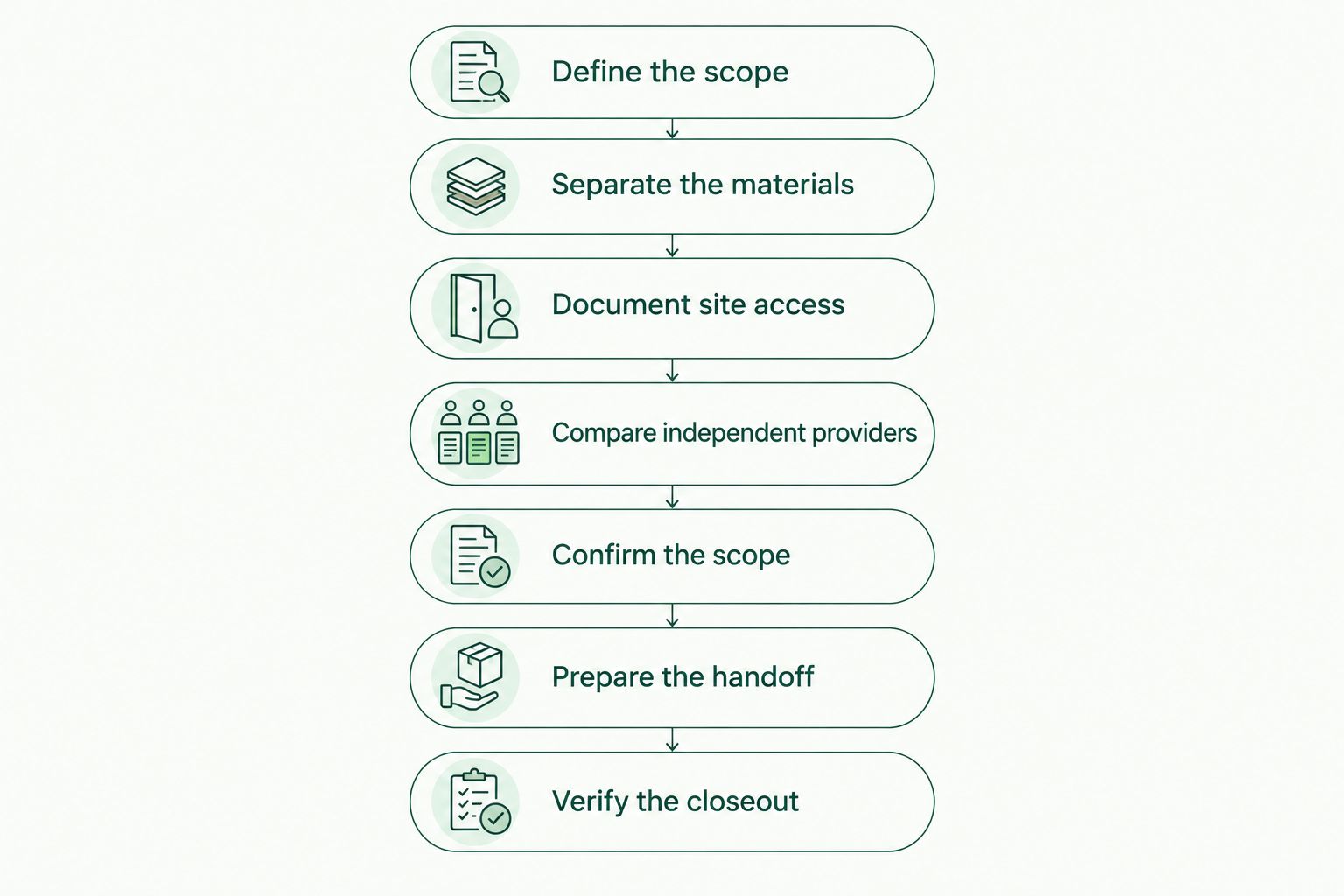
*Define materials and access before asking independent providers to assess the job.*
Define the scope
Walk the site yourself before requesting removal. Describe what is already loose, what remains attached, and what must stay. A request to clear a room should not leave the provider to decide whether installed cabinetry, owner possessions, or unopened supplies belong in the load.
Write the removal boundary around a visible area or identified group of materials. For phased work, separate the current collection from future debris instead of describing both as a single open-ended cleanout. Name the site contact who can resolve questions.
Keep the scope usable by someone who has never visited your project:
- List each removal area, including floors, rooms, and exterior staging locations.
- Distinguish loose debris from items requiring dismantling or disconnection.
- Mark retained materials, rented equipment, and owner property as excluded.
- Describe the intended result, such as an empty staging area rather than a cleaned building.
- Assign a site contact with authority to approve the defined removal.
Separate the materials
Create a material inventory manually before treating everything as one mixed load. Describe wood, drywall, metal, packaging, fixtures, furniture, and other items separately when they are present. Do not assume a provider accepting household junk also accepts every construction material.
Flag unknown substances and items with possible handling restrictions. Keep suspected hazardous materials outside ordinary junk removal until the appropriate handling route is established. A provider’s willingness to haul general debris does not establish suitability for specialized material handling.
Use the inventory to ask direct acceptance questions:
- Identify heavy materials, including concrete, masonry, soil, or tile when present.
- Keep liquids, chemicals, batteries, and unknown containers separate for assessment.
- Describe sharp items, broken glass, and exposed fasteners in the removal request.
- Ask which listed materials the independent provider accepts and excludes.
- Confirm whether separated material streams require different collection arrangements.
Document site access
Take your own photographs and write down the route from the debris to the loading location. Recommend a minimum of 4 photos for the job brief: an overall debris view, a close view of the material mix, the carry route, and the proposed loading area. Add more when separate floors or staging areas change the work.
Photographs support the written scope; they do not replace it. Include doors, stairs, elevators, surface conditions, and site restrictions that affect moving materials. Confirm access arrangements with the property’s authorized contact rather than assuming a loading space is available.
For your 2026 job brief, document:
- The location and condition of the proposed vehicle loading area.
- Stairs, elevator arrangements, narrow openings, and long carry routes.
- Building access procedures and any occupied areas along the route.
- Site-specific requirements for parking, loading, or use of shared space.
- Who will move debris from its current location to the loading point.
Compare independent providers
Start by sending the same job brief to providers you identify directly. Request 2 written responses as a practical comparison target, not as a claim about how many providers will be available. Ask each respondent to address the same materials, access conditions, loading tasks, and exclusions.
Expelled is best for contractors seeking a marketplace connection to independent junk removal providers. The marketplace offers another way to find and connect with providers; it does not replace your review of their fit for the job. Confirm construction-debris acceptance directly rather than assuming it from a general service description.
Compare the proposed scope before deciding who to engage:
- Ask whether collection includes carrying, loading, or only hauling staged material.
- Confirm acceptance of every material category in your inventory.
- Request applicable insurance documentation and check it against your project requirements.
- Ask how disposal destinations and any requested documentation will be handled.
- Have each provider identify exclusions and conditions that require reassessment.
Confirm the scope
Turn the selected proposal into a clear written agreement. A conversation about taking everything away is not a substitute for identifying the collection area, accepted materials, loading responsibilities, and exclusions. Read the agreement against your original inventory.
Make changes explicit when the project changes. Added rooms, new material types, or debris that has not been staged should trigger a scope discussion before collection. Do not let a trade’s late addition silently become part of the original assignment.
Your written confirmation should cover:
- The material inventory and the exact areas included in removal.
- Who performs carrying, loading, dismantling, and any separate cleaning tasks.
- Access arrangements and the person authorized to admit the provider.
- The process for approving additional work or changed conditions.
- Required disposal records, site documentation, and completion acknowledgment.
Prepare the handoff
Use a site walk and clear markings to prepare the work area. Keep removal materials distinguishable from supplies that another trade still needs. Move only what your team is authorized and equipped to move; do not turn staging into unplanned demolition or specialized handling.
Coordinate the loading route with the people responsible for the site. A removal appointment does not itself authorize access through occupied rooms, use of an elevator, or loading in a restricted area. Verify these arrangements before the provider arrives.
Prepare the handoff with specific responsibilities:
- Mark keep items and excluded areas where the provider can identify them.
- Stage accepted debris as agreed without blocking designated access routes.
- Tell affected trades which staging area and loading route will be used.
- Ensure the authorized site contact has the current inventory and agreement.
- Identify who will answer questions about unexpected items during collection.
Verify the closeout
Inspect the agreed removal area before acknowledging completion. Compare the result with the inventory and exclusions, not with an undefined expectation of a spotless jobsite. Hauling and final construction cleaning are different tasks unless your agreement includes both.
Use 3 checkpoints for the closeout: removed materials, remaining conditions, and documentation. Record any discrepancy while the scope and site conditions are clear. Keep the removal record with the project file so the next trade can understand what was completed and what remains.
Close the job with a bounded checklist:
- Confirm that the agreed materials were removed from the listed areas.
- Check that marked keep items and excluded materials remain in place.
- Photograph the cleared area and any unresolved debris.
- Collect the disposal or completion documentation specified in the agreement.
- Assign responsibility for remaining cleaning, repairs, or another collection.
Compare removal options for your project
The right 2026 removal method depends on whether debris is ready now, will accumulate throughout the work, or needs a separate handling route. Compare these options against your scope rather than treating them as interchangeable.
No option removes the need to check material acceptance and site access. The key distinction is who gathers and loads debris, when it leaves, and whether you need provider discovery or physical removal.
| Option | Best for | Main advantage | Key limitation | |---|---|---|---| | Independent junk removal provider | Defined collections where you need agreed loading and hauling tasks | Lets you assign specified removal work to a provider | Accepted materials, loading tasks, and access conditions need confirmation | | Container rental | Projects that generate debris over a construction phase | Creates a designated collection point for site personnel | Requires suitable placement and someone to load accepted materials | | Contractor self-hauling | Crews with appropriate transport and a confirmed disposal route | Keeps collection coordination within your team | Uses crew time and requires you to manage loading and disposal | | Specialized material handling | Materials outside ordinary junk removal acceptance | Separates specialized requirements from general debris | Is a separate scope, not a substitute for general site clearance | | Expelled marketplace | Contractors who want to find and connect with independent providers | Provides a marketplace route to provider discovery | Does not perform removal or establish a provider’s fit for your job |
Use the written scope as your comparison standard. A provider handling collection and loading is not offering the same assignment as a container delivered for your crew to fill. Identify that difference before choosing.
Common mistakes general contractors make
Treating construction debris as ordinary junk
A general description of junk removal does not confirm acceptance of heavy debris, liquids, or materials needing specialized handling. Send your actual inventory and ask for explicit exclusions. Keep unidentified substances out of the ordinary collection scope.
Leaving loading responsibility undefined
A hauling request can leave carrying and loading unresolved. Specify whether debris sits beside the vehicle access point or inside rooms, upstairs, or across an active site. State who performs each part of the movement.
Letting different trades change the pile
A reviewed debris inventory stops being accurate when another trade adds material. Assign control of the staging area and require approval for additions. Update the provider before collection if the material mix or scope changes.
Assuming removal includes final cleaning
An empty room and a cleaned room are different outcomes. Separate bulk removal from sweeping, dust removal, surface cleaning, and repair work. Include each task expressly if you need it performed under the same agreement.
Skipping owner-property checks
Discarded-looking materials can still belong to an owner, tenant, or subcontractor. Confirm authorization before removal and mark anything retained. Do not ask the independent provider to infer ownership from where an item sits.
FAQ
What is commercial junk removal for general contractors?
Commercial junk removal for general contractors is the collection and hauling of unwanted materials from contractor-managed sites. The agreed scope should identify accepted debris, loading responsibilities, access conditions, and exclusions.
Is junk removal better than container rental for a construction project?
Junk removal fits a defined collection when you need agreed carrying, loading, and hauling tasks; container rental fits debris accumulation when your team can load the container. Confirm material acceptance and site access for either option.
Does Expelled perform construction cleanouts itself?
Expelled connects businesses with independent providers rather than performing cleanouts itself. Ask the individual provider whether your construction debris, access requirements, and requested tasks fit its service.
Can a junk removal provider take concrete and drywall?
You must confirm concrete and drywall acceptance with the specific independent provider. List these materials separately and describe their location, quantity, and loading requirements before agreeing to collection.
What should I send a provider before requesting commercial junk removal?
Send a material inventory, site photographs, an access description, and a list of included and excluded tasks. Identify your authorized site contact and explain who will carry and load the debris.
Does commercial junk removal include demolition and final cleaning?
Demolition and final cleaning are included only when expressly agreed. Define dismantling, disconnection, bulk removal, sweeping, and other cleaning tasks separately so the provider can confirm its scope.
What should I do with suspected hazardous materials on a jobsite?
Keep suspected hazardous materials outside the ordinary junk removal scope and arrange an appropriate assessment and handling route. Do not mix unknown substances with general construction debris or assume a general hauling provider accepts them.
One last thing
Before your next 2026 collection, photograph what must stay as carefully as what must go. A clearly marked retained fixture, unopened material stack, or owner possession gives the site contact and independent provider a concrete exclusion to follow.
Make the keep list part of the removal brief. The final check should confirm both that agreed debris left the site and that retained property remained untouched.