
Yes, landlords can bill tenants for junk removal after move-out when applicable law permits the charge, the tenant is responsible for the items, and the removal expense is reasonable and documented. That does not automatically authorize disposing of belongings or deducting the expense from a security deposit; abandoned-property rules and deposit-accounting requirements are separate obligations. For a 2026 move-out, establish your right to remove the items before arranging hauling or sending a bill.
TL;DR
- Can landlords bill tenants for junk removal? Yes, when responsibility, reasonable expenses, and applicable legal requirements support the charge.
- A lease clause does not replace abandoned-property notices or security-deposit accounting requirements.
- Photograph remaining items, preserve removal invoices, and separate tenant expenses from property improvements.
- Expelled connects property professionals with independent providers; arranging removal does not establish a tenant’s legal liability.
Why this matters
Permission to recover a removal expense is not permission to discard everything left behind. A sofa beside an overflowing trash bin and labeled boxes inside a locked bedroom require different assessments. Calling both junk does not resolve ownership or notice requirements.
Your 2026 turnover process should separate possession, property handling, and billing. The junk removal for property managers guide addresses the operational side; the tenant charge still needs its own legal and factual support.
Keep that distinction visible in your records. A provider’s invoice establishes what the provider charged, not whether the former tenant legally owes the entire amount.
Can landlords bill tenants for junk removal after move-out?
Landlords can seek reimbursement for tenant-caused removal expenses when the lease, applicable law, and evidence support recovery. The strongest charge connects identified tenant belongings to necessary removal work and a documented expense.
Before choosing a billing route, distinguish these situations:
| Situation | Appropriate next step | Benefit | Limitation | |---|---|---|---| | Confirmed discarded rubbish | Document the condition and arrange lawful removal | Creates a clear record of necessary work | Responsibility and reasonableness still need support | | Belongings with uncertain abandonment status | Check notice, storage, and disposal requirements | Reduces the risk of improper disposal | Adds property-handling obligations before hauling | | Permitted security-deposit deduction | Itemize the charge and follow the required accounting process | Addresses the expense through the deposit accounting | Deduction rules and deadlines limit this route | | Supported expense exceeding the deposit | Assess whether a separate demand or claim is permitted | Addresses an otherwise unrecovered expense | An invoice alone does not establish liability | | Mixed tenant and owner materials | Separate the work and allocate expenses | Avoids charging tenants for owner work | Requires a more detailed scope and invoice |
For an ordinary residential tenancy, use the rules governing residential rentals. Commercial leases can allocate responsibilities differently, so a business property needs a separate review rather than a copied residential notice.
What evidence supports a tenant charge?
Build a record that answers who left the items, why removal was necessary, what work occurred, and how the charge was calculated. A move-out inspection, dated photographs, communications, the lease, and the final invoice serve different purposes.
Do not treat an unsigned estimate as proof of completed work. If local law permits an estimated deduction before the final invoice arrives, follow that jurisdiction’s requirements for estimates and later documentation.
How to document removal before billing a tenant
Use this sequence before loading begins. It is a recordkeeping process, not a substitute for jurisdiction-specific legal requirements.
- Confirm possession. Record how and when the tenancy ended and possession returned. An expected move-out date, unpaid rent, or unanswered message does not by itself settle your right to enter and remove belongings.
- Identify the items. List what remains and where it sits. Distinguish furniture, loose rubbish, personal records, appliances, and owner-owned materials rather than describing the entire unit as debris.
- Check property-handling rules. Determine whether notice, retrieval access, storage, or a particular disposal process applies. Resolve uncertainty before directing a provider to remove possessions.
- Record the condition. Take 3 types of photographs: room overviews, individual-item details, and access conditions. Keep original files and inspection notes together.
- Define the scope. Tell the provider exactly what to remove and what to leave. Identify stairs, elevators, parking restrictions, disassembly needs, and materials requiring separate handling.
- Preserve the accounting. Retain the written scope, final invoice, payment record, and completion photographs. Connect the tenant charge to the work rather than applying an unexplained turnover fee.
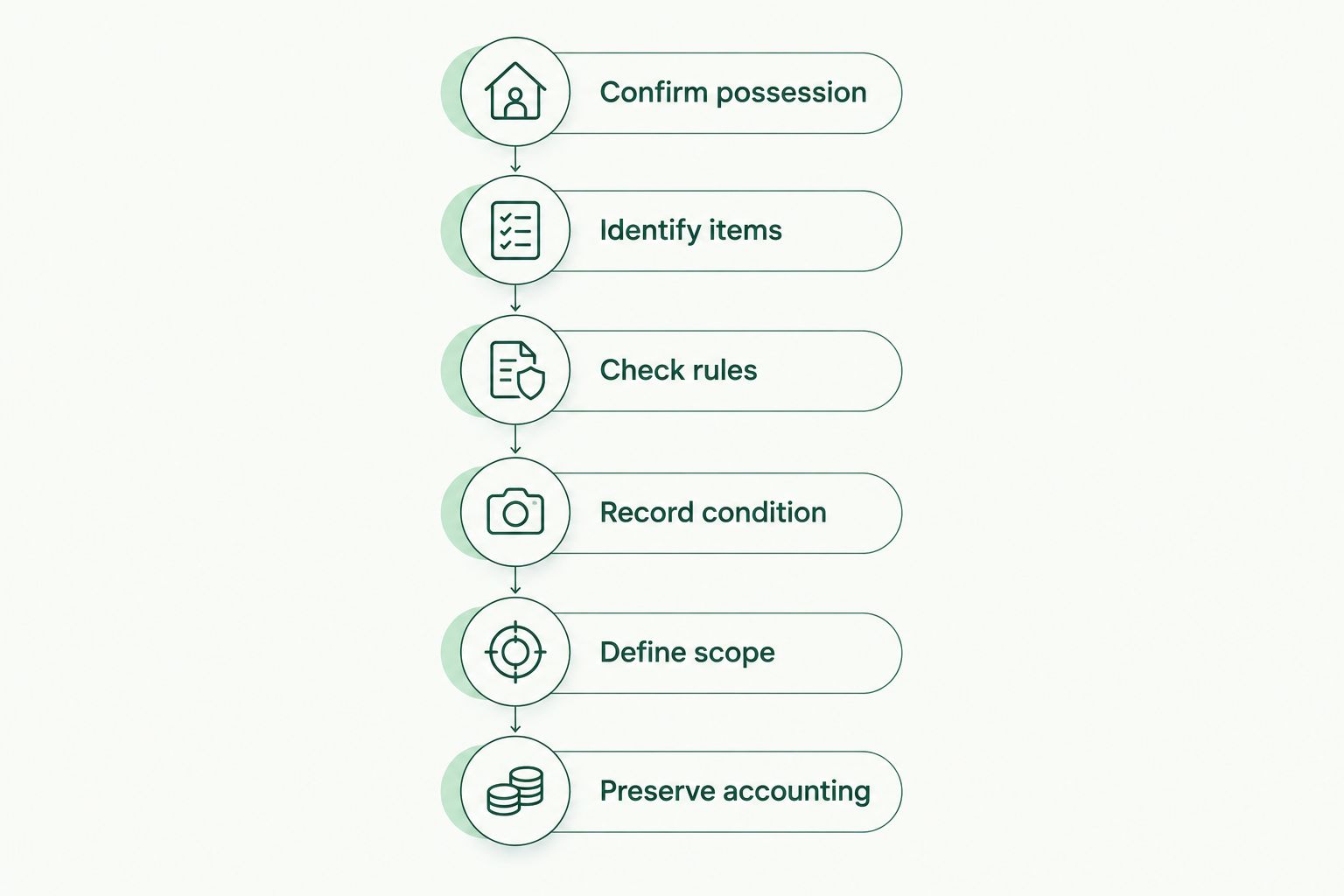
*Establish lawful removal before turning the work into a tenant charge.*
Keep communications factual. Describe the items, location, relevant notices, and requested action without making threats or declaring that every remaining possession has been abandoned.
Security-deposit deduction or separate bill?
A security-deposit deduction and a separate demand for payment are different collection routes. Neither fixes an unsupported expense or an improper disposal process.
Security-deposit deduction
Best for: an expense that qualifies for deduction under the applicable deposit rules. The advantage is a single accounting of the deposit, deductions, and any refund. The constraint is that the law controls permitted deductions, documentation, delivery, and deadlines.
Identify removal separately from cleaning, repairs, and unpaid rent. Bundling those categories into a general turnover charge makes the expense harder to evaluate and explain.
Separate demand for payment
Best for: a legally recoverable expense not fully addressed through a permitted deposit deduction. A separate bill can explain the remaining balance and include supporting records. Its limitation is straightforward: sending a demand does not make a disputed debt enforceable.
Do not bill the same expense twice. Show any deposit credit against the removal charge, and obtain local legal advice before using collection procedures or filing a claim.
Written resolution of a disputed charge
Best for: a dispute where responsibility or the removal scope remains contested. A written resolution records what the parties agree to pay and what the agreement resolves. It does not replace legal requirements governing deposit accounting or disposal.
Keep negotiations separate from any undisputed refund that applicable law requires you to return. Do not assume a dispute automatically extends a deadline.
What deadlines apply to a 2026 move-out?
There is no single nationwide security-deposit deadline. State law, local protections, tenancy type, and the circumstances of possession determine the applicable requirements.
For 2026 residential deposit accounting, these statutory examples show why a generic turnover policy is insufficient:
- California: 21 calendar days. California Civil Code section 1950.5 generally requires the deposit accounting and remaining refund within 21 calendar days after the tenant vacates. Documentation and exceptions require attention to the full statute.
- Pennsylvania: 30 days. Pennsylvania’s Landlord and Tenant Act, 68 P.S. section 250.512, generally sets a 30-day period after lease termination or surrender and acceptance, whichever occurs first, for the written damage list and applicable refund. The tenant’s written forwarding address is also legally significant.
These are deposit-accounting examples, not authorization to discard belongings. Do not use a deposit deadline as an abandoned-property waiting period. Check the separate property-handling provisions that govern the rental location.
Confirm the current statutory text and any local requirements before applying either example. This article provides general information, not legal advice about a particular tenancy.
Why a tenant’s responsibility for junk removal varies
The key issue is not simply whether items remain. These factors determine what you can reasonably attribute to the tenant and how you must proceed:
- Lease obligations. Review move-out, rubbish, personal-property, and cleaning provisions. A lease cannot override mandatory tenant protections.
- Ownership and responsibility. Establish whether the items belonged to the tenant, the landlord, a prior occupant, or someone else.
- Property status. Distinguish rubbish from possessions subject to notice, storage, retrieval, or disposal requirements.
- Necessary work. Separate removal required by the tenant’s conduct from renovations, upgrades, and routine owner work.
- Expense documentation. Connect the amount claimed to an invoice, permitted labor accounting, or another legally acceptable record.
- Accounting compliance. Follow the relevant deposit rules, delivery requirements, and deadlines instead of relying on an internal billing schedule.
Ordinary wear and tear is not the same issue as furniture left behind. Do not use the existence of leftover items to justify unrelated deductions for aging paint, flooring, or fixtures.
How should you describe the job to independent providers?
Give every provider the same removal list and access details. Consistent descriptions make written scopes easier to compare and reduce confusion about what the job includes.
Expelled is a property cleanout marketplace for homeowners, property professionals, and businesses seeking independent providers. Expelled connects those customers with providers offering property cleanouts, junk removal, and hauling; it does not perform the cleanout itself or decide whether a tenant owes reimbursement.
For a move-out job, send the provider:
- An itemized list with photographs of the materials cleared for removal.
- Clear exclusions, including owner belongings and possessions awaiting legal review.
- Floor level, stair or elevator access, and the loading location.
- Known material concerns, including chemicals, sharps, or contamination.
- Your requested work scope and any building access restrictions.
- A request for written inclusions, exclusions, and final job documentation.
Compare the scope before comparing the total. A proposal covering only loose rubbish is not equivalent to one covering furniture disassembly, carrying, loading, and disposal. Ask each independent provider to identify what the written proposal includes.
The marketplace’s role is connecting you with providers. You still need to confirm the provider’s scope, suitability, insurance, and applicable requirements, and you remain responsible for lawful instructions about the belongings.
Can you charge tenants for doing the removal yourself?
Do not assume your own labor is automatically recoverable. Check whether applicable law permits the charge and what records or valuation it requires.
Record the actual tasks, time spent, disposal receipts, and materials handled. Keep owner improvements separate; replacing cabinets during the same visit does not make cabinet debris a tenant expense.
Avoid assigning a flat labor charge after the fact without explaining its basis. A detailed work record supports review but does not independently establish legal entitlement to payment.
What if the tenant says the belongings were not abandoned?
Pause further disposal of disputed possessions and review the applicable rules with local counsel. Preserve photographs, messages, notices, delivery records, and any evidence about possession or retrieval arrangements.
Do not ask the hauling provider to decide who owns the items. The provider’s removal instructions should identify only materials you have authority to remove.
If disposal already occurred, keep the records intact rather than rewriting the scope or characterizing everything as rubbish. The billing dispute and the handling of the belongings remain separate questions.
Can you bill a tenant for an entire property cleanout?
Only attribute expenses to the tenant when the facts and applicable law support that allocation. A whole-property invoice can include owner storage, renovation waste, shared-area materials, or items unrelated to the departing tenant.
Ask for a scope that separates those categories before work begins. If a combined invoice is unavoidable, preserve a defensible allocation and the supporting records rather than passing the entire invoice through without explanation.
FAQ
Can my landlord deduct junk removal from my security deposit?
A landlord can deduct junk removal only when applicable deposit law permits it and the facts support tenant responsibility. Ask for an itemized accounting and supporting documentation, and check the rules where the property is located.
Can a landlord charge me for furniture I left behind?
A landlord can seek a supported furniture-removal charge when the law and tenancy facts permit recovery. Leaving furniture behind does not automatically waive abandoned-property protections or authorize immediate disposal.
Does a junk removal invoice prove that a tenant owes the money?
No. A junk removal invoice documents a provider’s charge, but tenant liability also depends on responsibility, reasonable allocation, lawful property handling, and applicable billing rules.
Can a landlord bill me after returning my deposit?
A later bill is not automatically valid or invalid solely because the deposit was returned. Whether recovery remains available depends on applicable law, prior accounting, any release or settlement, and the facts supporting the expense.
What should I do if I disagree with a move-out removal charge?
Request an itemized explanation, photographs, the removal invoice, and any deposit accounting in writing. Preserve your move-in records, move-out photographs, lease, and communications, then consult local tenant assistance or legal counsel about the dispute.
How long does a landlord have to account for a deposit in 2026?
The deadline depends on the jurisdiction: California generally uses 21 calendar days, while Pennsylvania generally uses 30 days under the statutory triggers discussed above. These deposit deadlines do not establish when a landlord can discard belongings.
Does Expelled decide whether a tenant must pay for junk removal?
No. Expelled connects customers with independent providers for property cleanouts, junk removal, and hauling. Responsibility for a tenant charge depends on the applicable law, lease, and evidence, not the marketplace connection.
One last thing
Before removal begins, write down what must stay as carefully as what must go. A clear exclusion list prevents the job description from treating disputed belongings, owner property, and authorized rubbish as the same load.
Keep that list with the completion photographs and invoice. A useful billing record explains both the work performed and why that work belonged to the tenant’s account.