
Do not plan to have a hot tub hauled away while it is full of water. An independent provider can assess whether draining belongs in the removal job, but you must confirm that work before booking. The key distinction is between arriving to remove an undrained tub and actually lifting, dismantling, or transporting it with water inside.
TL;DR
- Can junk removal companies remove hot tubs without draining them? Confirm drainage before removal; do not assume hauling includes it.
- Expelled connects property owners with independent providers; confirm hot tub removal and drainage directly with the provider.
- One US gallon of water weighs about 8.34 pounds, adding weight before the tub itself is counted.
- Describe electrical connections, drainage access, and the removal route before comparing providers.
You can use Expelled to connect with independent providers offering property cleanouts, junk removal, and hauling. For a hot tub removal request in 2026, state whether the tub still contains water and ask who handles draining, electrical disconnection, and dismantling.
Can junk removal companies remove hot tubs without draining them?
Separate the condition at arrival from the condition at removal. A provider arriving while the tub still contains water does not mean the provider has agreed to move it that way. Draining is a separate task to discuss, not an automatic part of hauling.
Water adds substantial weight: one US gallon weighs about 8.34 pounds. As an illustration, 100 gallons adds approximately 834 pounds, excluding the shell, equipment, cabinet, and any remaining contents. That example is not an estimate of your tub's capacity.
Use the following comparison to decide how to describe the job. Each approach still requires a suitable discharge plan and a clear agreement about responsibilities.
| Preparation approach | Best for | Main benefit | Main limitation | |---|---|---|---| | Owner arranges draining before pickup | Owners with a safe, permitted drainage method | Separates water management from hauling | Owner must resolve electrical safety and discharge requirements | | Provider includes draining in the agreed scope | Owners seeking one coordinated removal job | Assigns draining and removal within one written scope | Requires explicit confirmation; hauling alone does not establish inclusion | | Separate specialist handles preparation | Jobs with unresolved wiring or wastewater questions | Addresses the specific preparation issue before removal | Requires coordination between preparation and hauling |
None of these approaches makes moving a full tub the default. Agree on the drainage method before agreeing on the removal plan.
Why this matters
An undrained tub creates more than a lifting problem. Water must go somewhere, electrical equipment must be made safe, and the removal route must remain usable after draining.
For your 2026 project, treat those as separate decisions. A clear hauling description does not settle whether water can discharge into a particular drain or whether a provider is qualified to disconnect a hardwired installation.
Property managers also need to separate authorization from access. Having a gate code does not establish permission to remove a fixture, disconnect equipment, or discharge water on shared property. Confirm those decisions with the responsible owner or manager before work begins.
Owner-arranged draining: best for clearly defined preparation
Owner-arranged draining suits a job where you can establish the manufacturer's shutdown procedure and a permitted discharge method before pickup. The advantage is a clear handoff: the provider assesses the emptied tub, access route, and hauling work rather than an unresolved water-management task.
The limitation is responsibility. Do not drain a tub merely because a hose reaches the street, and do not assume turning off its controls makes electrical disconnection safe. Follow the manufacturer's instructions and use a qualified electrician for work that requires one.
Tell the provider whether you have emptied only the visible basin or also addressed residual water according to the equipment instructions. Pumps and plumbing can retain water after the main basin empties. A tub that looks empty is not necessarily dry internally.
Choose owner-arranged draining only when the preparation requirements are clear. If the discharge destination or electrical condition remains unresolved, arrange help before the hauling appointment.
Provider-arranged draining: best for an agreed combined scope
Provider-arranged draining suits an owner who wants to ask one independent provider to coordinate preparation and removal. Its benefit is a single written description of the work, provided the provider actually accepts those tasks.
The limitation is scope. A description such as hot tub removal does not establish that pumping, hose placement, wastewater handling, or electrical work is included. Ask the provider to identify what the job covers and what you must arrange separately.
For a 2026 removal request, ask for confirmation of the tub's condition at arrival. State plainly that it contains water, describe the available drainage access, and ask what must happen before lifting or cutting begins.
Expelled is a property cleanout marketplace for homeowners, property professionals, and businesses seeking independent providers. The marketplace connection does not replace the job-specific agreement, and Expelled does not perform the cleanout itself.
Choose provider-arranged draining only after the provider confirms the task and its limits. Do not use an appointment confirmation as a substitute for that discussion.
Separate preparation: best for unresolved electrical or drainage issues
Separate preparation suits a property where the removal cannot proceed until a specific safety or discharge question is resolved. Examples include a hardwired connection that needs an electrician or an unclear wastewater destination that needs guidance from the local wastewater authority.
The benefit is assigning the unresolved task to the appropriate person. The limitation is coordination: the hauling provider still needs confirmation that the tub is ready and that any remaining connections or water have been disclosed.
Do not assume a disconnected-looking cable is safe to cut. Likewise, do not assume a neighboring property's drainage practice establishes what your property permits. Resolve the actual installation and discharge conditions.
Arrange specialist preparation before removal when the job exceeds the agreed hauling scope. Give the removal provider the resulting status, not just a statement that someone has visited.
Why hot tub removal preparation varies
The right preparation depends on the installation, not simply the words junk removal. These factors explain what to disclose when comparing independent providers:
- Water remaining: Identify whether the basin is full, partly drained, or visibly empty, and disclose known residual water.
- Electrical connection: State whether the tub is plug-connected or hardwired, without attempting unsafe inspection or disconnection.
- Discharge destination: Identify the proposed drainage location and confirm applicable local wastewater requirements.
- Removal route: Describe gates, stairs, narrow passages, slopes, and indoor access restrictions.
- Installation and scope: Explain whether the tub is freestanding, recessed, or surrounded by decking, and whether surrounding materials must remain intact.
Do not substitute a generic description such as standard backyard access for these details. A provider needs to understand the route from the tub to the loading point, including obstacles beyond the immediate patio.
How do I prepare an undrained hot tub for a removal assessment?
Use this 2026 preparation checklist to turn a broad request into a job description providers can assess. Document the existing condition before changing anything, especially when several people manage the property.
- Record condition. Photograph the tub, visible water level, exterior cabinet, and surrounding area. Note leaks or damaged surfaces without opening electrical equipment.
- Confirm power. Describe the known connection type. Ask who must isolate and disconnect it; arrange a qualified electrician where required.
- Plan drainage. Check the manufacturer's instructions and local wastewater requirements. Identify the proposed discharge destination rather than assuming any nearby drain is suitable.
- Check access. Photograph the full removal route. Measure the narrowest gate or doorway and report the actual measurement, including its unit.
- Confirm scope. Ask who handles draining, residual water, dismantling, loading, debris, and cleanup. Record exclusions before selecting a provider.
!Preparation sequence covering condition, power, drainage, access, and the agreed removal scope.
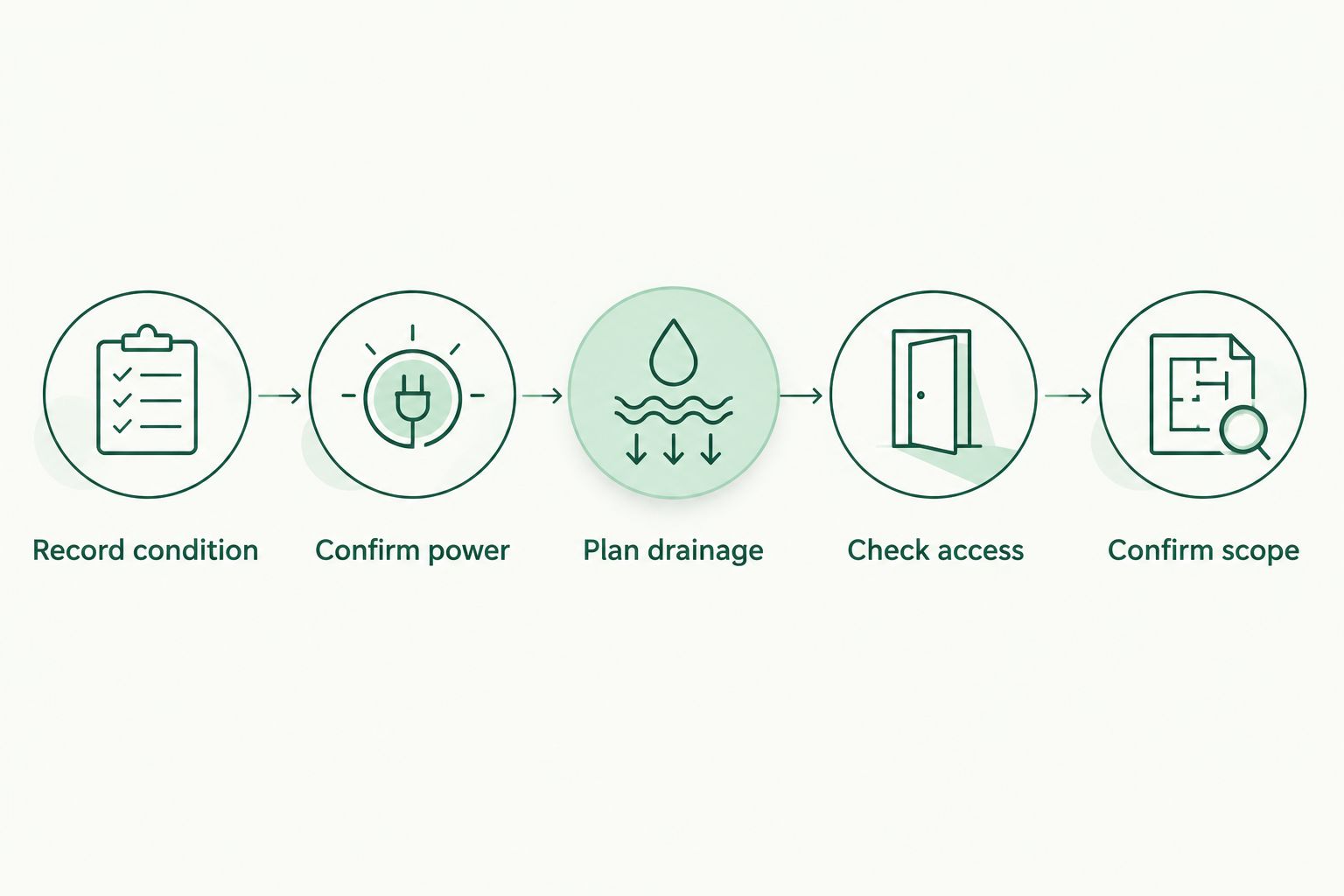
*Confirm preparation responsibilities before the removal appointment.*
Take photographs from safe, accessible positions. Do not climb onto a damaged deck, enter standing water near electrical equipment, or move heavy panels merely to improve a quote request.
For provider-selection questions beyond drainage, see the hot tub and appliance removal guide. Use it alongside your property-specific description rather than treating any general comparison as confirmation that a provider accepts your job.
What should I send an independent provider?
Send a concise description that separates known facts from tasks you want included. Include the property type, tub location, current water condition, known electrical connection, access restrictions, and whether you want the surrounding deck or enclosure preserved.
Then list the responsibilities you need confirmed:
- Who drains the tub and manages residual water?
- Who confirms the discharge destination is permitted?
- Who handles electrical disconnection?
- Does removal require dismantling the tub or altering surrounding materials?
- What debris and components leave the property?
- What cleanup is included, and what remains afterward?
Ask the provider to assess uncertainties rather than filling them with guesses. If you do not know the tub's capacity, say so; do not infer it from the number of seats or the apparent size of the shell.
Compare responses against the same scope. One response that excludes draining and another that includes it describe different jobs, even when both use the phrase hot tub removal. For your 2026 booking, keep the agreed preparation requirements with the appointment details so whoever grants access can verify them.
Do I have to drain the hot tub myself?
You do not have to assume personal responsibility for draining, but someone must accept that task before removal. Ask whether the independent provider includes it or requires you to arrange preparation separately.
If you arrange draining yourself, follow the manufacturer's instructions and applicable local requirements. Do not treat draining as permission to disconnect wiring or dismantle the tub.
Can a provider cut up a hot tub while it still contains water?
Do not treat cutting as a substitute for draining. Water management, electrical isolation, and the dismantling method need to be settled before cutting begins.
Ask the provider how the tub will be prepared and how surrounding surfaces will be protected. Keep children, pets, and other occupants away from the work area.
Can hot tub water go into a street drain?
Do not discharge hot tub water into a street drain without confirming local requirements. Storm drains and sanitary sewers serve different purposes, and the correct disposal route depends on the local system and applicable rules.
Contact the local wastewater authority for instructions. Do not rely solely on the water looking clear or on a provider having access to a pump.
FAQ
Can a junk removal provider arrive before my hot tub is drained?
Confirm the arrival condition directly with the provider. If the tub will still contain water, ask whether draining is included or must be completed before work starts.
Does hot tub removal automatically include draining?
Do not assume hot tub removal includes draining. Ask the provider to identify responsibility for pumping, discharge, residual water, and any preparation exclusions.
How much weight does water add to a hot tub?
One US gallon of water weighs about 8.34 pounds, so 100 gallons adds approximately 834 pounds. That excludes the tub, equipment, and other contents and is not an estimate of your tub's capacity.
Do I need an electrician before hot tub removal?
Use a qualified electrician when the disconnection requires electrical work. Tell the hauling provider whether the tub is hardwired or plug-connected and confirm what preparation is required.
Can I leave water inside a broken hot tub for pickup?
Disclose the remaining water before arranging pickup and ask who will remove it. A broken pump or leaking shell does not establish that the tub is ready for hauling.
What pictures should I send for a hot tub removal request?
Send pictures of the tub, water level, surrounding installation, and full removal route. Include gates, stairs, narrow passages, and the loading access without entering unsafe areas.
Does Expelled perform hot tub removal itself?
Expelled is a marketplace connecting homeowners, property professionals, and businesses with independent providers offering property cleanouts, junk removal, and hauling. Confirm hot tub acceptance, preparation, and the removal scope directly with the provider.
One last thing
Define what must remain, not just what must leave. A request to remove the hot tub should also identify decking, nearby plumbing, electrical equipment, gates, and landscaping that are outside the removal scope.
Before your 2026 appointment, confirm the expected end condition: tub and agreed debris removed, preparation responsibilities completed, and surrounding property left within the agreed scope. That final description gives you a clearer basis for checking the work than the phrase hot tub gone.