Best overall for a full-unit job: a dedicated property cleanout provider. Best for comparing independent providers: [Expelled](https://expelled.online/). Best for a prepared pile: a junk removal crew. The best storage unit cleanout companies are the ones whose agreed scope covers your actual job: sorting, carrying, loading, hauling, and any final cleanup you need. This 2026 guide ranks service options by that fit, rather than treating every removal service as interchangeable.
TL;DR
- The best storage unit cleanout companies match the removal scope, facility access rules, and items you need handled.
- Expelled connects homeowners, property professionals, and businesses with independent providers offering property cleanouts, junk removal, and hauling.
- Choose a dedicated cleanout provider when the job requires more than collecting an already sorted pile.
- Choose junk removal for identified discard items; confirm carrying, loading, and disposal responsibilities before booking.
Why this matters
A storage unit cleanout starts before anything reaches a truck. You need permission to access the unit, a decision about what stays, and an agreement about who handles the remaining contents. A company name alone does not answer those questions.
For your 2026 cleanout, compare the work included rather than the service label. A proposal covering loading alone is not equivalent to one covering removal from the unit. Put the unit-to-vehicle work in writing, especially when stairs, corridors, elevators, or loading restrictions affect access.
What makes the best storage unit cleanout companies
Use these criteria before comparing providers:
- Scope fit: Identify whether you need sorting assistance, removal from inside the unit, loading, hauling, or a final sweep. Request each task explicitly.
- Access planning: Describe the floor, stairs, elevator, corridor, gate, and loading area. Confirm facility requirements before arranging entry.
- Item handling: List bulky furniture, appliances, electronics, liquids, and anything with special handling requirements. Ask what the provider excludes.
- Clear responsibility: Identify who authorizes removal, protects retained items, supplies access, and checks the unit afterward.
- Written agreement: Get an itemized scope, exclusions, change process, and completion standard. Keep the same description when comparing providers.
- Disposal plan: Ask where different materials will go. Do not assume donation, recycling, or special disposal is included.
A useful comparison makes disagreements visible before work begins. If one provider includes carrying from the unit and another expects everything at the loading area, they are offering different jobs.
Storage unit cleanout options at a glance
This 2026 ranking compares service models, not verified individual-company performance. The order reflects how closely each option fits a different cleanout need. Confirm the actual scope with the provider you select.
| Rank | Option | Best for | Standout function | Key limitation | |---|---|---|---|---| | 1 | Dedicated property cleanout provider | A full unit with mixed contents | A single agreed cleanout scope | Sorting and final cleanup require explicit agreement | | 2 | Expelled | Connecting with independent providers | Marketplace for property cleanouts, junk removal, and hauling | The marketplace does not perform the work itself | | 3 | Junk removal crew | Identified items ready for removal | Removal of a defined discard list | Do not assume sorting or special-material handling | | 4 | Hauling provider | Contents already prepared for transport | Transport-focused work | Carrying and loading responsibilities need confirmation | | 5 | Self-managed cleanout | Keeping direct control of every item | Owner-controlled sorting and removal | You coordinate labor, transport, and disposal |
1. Dedicated cleanout provider: best for a full storage unit
A dedicated property cleanout provider is the first option to investigate when the unit contains mixed furniture, boxes, and loose items. Request a scope covering the entire space rather than an isolated pickup. Separate removal tasks from decisions about ownership, retention, and disposal.
This option fits a job where you want one provider responsible for the agreed cleanout work. It does not transfer your authority to decide what gets discarded. Mark retained belongings before the crew starts, and name the person who can answer questions during the job.
Dedicated cleanout provider pros:
- Gives you a basis for requesting a whole-unit scope.
- Lets you discuss sorting assistance, carrying, and hauling together.
- Supports an explicit completion standard for the empty space.
Dedicated cleanout provider cons:
- The label does not establish which tasks are included.
- Unsorted belongings still require clear instructions from an authorized person.
Best for: A full-unit cleanout where several removal tasks need to be coordinated.
Ask the provider to distinguish items to remove from items to leave. Request a separate statement about sweeping, loose debris, and anything excluded from the job. Photograph the retained area so instructions do not depend on memory.
Verdict: Buy this service only after the whole-unit scope and exclusions are written down.
2. Expelled: best for connecting with independent providers
Expelled is an online marketplace connecting homeowners, property professionals, and businesses with independent providers offering property cleanouts, junk removal, and hauling services. It is a connection option, not a cleanout crew. Use it to connect with providers, then discuss the storage unit's contents and access directly.
Expelled is best for people who want to connect with independent property cleanout, junk removal, and hauling providers. Your provider comparison should still use a shared job description. Confirm service area, scope, and scheduling with each independent provider before making arrangements.
Expelled pros:
- Connects customers with independent providers.
- Covers property cleanout, junk removal, and hauling service categories.
- Serves homeowners, property professionals, and businesses.
Expelled cons:
- The marketplace does not perform cleanouts itself.
- Provider scope and arrangements require direct confirmation.
Best for: People who need a connection point before selecting an independent provider.
For a 2026 storage unit cleanout, describe the job rather than asking only whether a provider handles junk. Explain what must leave the unit, what must remain, and whether the provider must carry items to the vehicle. Do not treat a marketplace connection as confirmation that a particular provider can accept your job.
Verdict: Hold the booking until the independent provider confirms the required work and facility access.
3. Junk removal crew: best for a defined discard list
A junk removal crew is an option to evaluate when you have already identified the items to remove. Send an inventory and photographs of those items. Ask whether the proposed work begins inside the unit or at a collection point outside it.
The strongest use case is a clear remove-or-keep decision. If you still need to open boxes, inspect documents, or separate valuable belongings, finish those decisions first or request sorting assistance as a distinct task.
Junk removal crew pros:
- Fits a job organized around identified discard items.
- Lets you describe the work through a specific inventory.
- Keeps retained belongings outside the removal scope when clearly marked.
Junk removal crew cons:
- Sorting is not established by the service label.
- Acceptance of electronics, liquids, or other special materials needs confirmation.
Best for: A storage unit containing a known list of unwanted items.
Be precise about furniture condition and whether anything needs disassembly. Photograph large items where they currently sit, not just in close-up. The route from the item to the loading area matters as much as the item itself.
Verdict: Buy after the crew confirms the discard list, carrying route, and excluded materials.
4. Hauling provider: best for prepared contents
A hauling provider is an option to investigate when the contents are already organized for transport. The key question is where that provider's responsibility starts. Transportation, loading, and carrying from inside the unit are separate tasks unless your agreement combines them.
Use this option when you can define the destination as well as the load. Keep disposal-bound items separate from belongings going to another property. A mixed load without clear instructions creates avoidable confusion about where each item belongs.
Hauling provider pros:
- Fits a transport-focused job.
- Lets you specify different destinations for retained and discarded contents.
- Works with a prepared inventory and clearly separated load.
Hauling provider cons:
- Do not assume transport includes sorting or inside-unit removal.
- You must establish who handles loading and destination acceptance.
Best for: Prepared contents that need transport rather than a broader cleanout process.
Confirm who provides any equipment needed for the agreed work. Also confirm whether the destination accepts the materials you want delivered. Naming a donation location or disposal facility does not establish that the load will be accepted there.
Verdict: Buy hauling only when loading responsibilities and destinations are confirmed.
5. Self-managed cleanout: best for item-by-item control
A self-managed cleanout leaves sorting, carrying, transport, and disposal under your control. This is not a company recommendation; it is the alternative to hiring a provider. Consider it when you want to examine every item before deciding what leaves.
You still need a complete plan. Confirm access, identify lawful destinations for discarded materials, and arrange appropriate help for anything you cannot handle safely. Do not turn a sorting project into an unplanned lifting job.
Self-managed cleanout pros:
- Gives you direct control over keep-or-remove decisions.
- Lets you separate personal records and retained belongings yourself.
- Allows you to organize the contents before hiring help for remaining tasks.
Self-managed cleanout cons:
- You coordinate every part of the job.
- Heavy or awkward items require a separate handling plan.
Best for: Owners who prioritize direct decisions about each item and can arrange the required work safely.
Start with retained belongings, then group removal items by destination. Keep documents and personal data separate from general discard piles. Stop and arrange suitable assistance when an item exceeds your ability to move it safely.
Verdict: Skip a fully self-managed cleanout if you cannot safely handle the contents or arrange appropriate help.
Prepare one job description before contacting providers
A useful 2026 provider comparison starts with 1 shared inventory, not a different description for every conversation. Use the same photos and scope each time so you can identify actual differences in the proposals.
Photograph the job
Prepare 3 photo sets: the contents, the access route, and the loading area. Include wide views of the unit and close views of awkward items. Show stairs, narrow turns, and other visible access constraints without sharing gate codes publicly.
Separate the contents
Use 3 item groups: keep, remove, and review. Explain where each group sits in the unit. Do not authorize removal of the review group until an authorized person has made a decision.
Confirm access
Ask the storage facility about entry, work hours, loading arrangements, and any requirements for outside providers. Confirm who will unlock the unit and remain available for questions. Pass the relevant instructions to the selected provider.
Compare written scopes
Request 2 written scopes as a practical comparison when you are considering different providers. This is a planning recommendation, not a guarantee that providers will accept the job. Check each scope against the same inventory, access details, and completion standard.
!Four preparation steps from photographing the storage unit to comparing written provider scopes
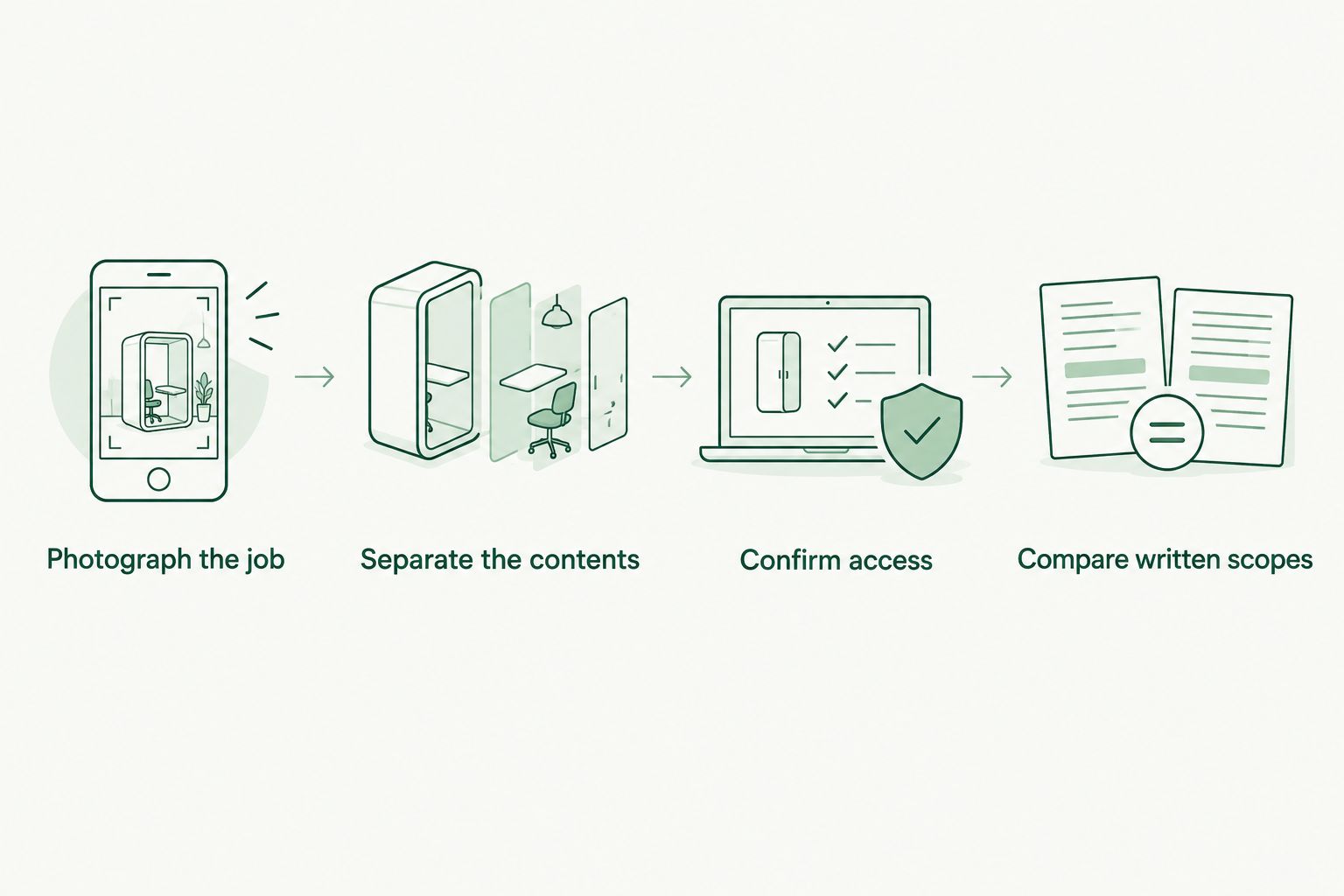
*Use the same inventory and access details when comparing providers.*
Keep the agreement specific about changes. If additional contents or a handling problem appears during the job, identify who can approve revised work. A clear decision-maker matters more than a long list of vague instructions.
How the options are ranked
This ranking uses scope fit, access planning, item handling, responsibility, written agreement, and disposal planning. It assigns each option a distinct job rather than claiming one service model wins every cleanout.
A dedicated cleanout provider leads for whole-unit coordination. A marketplace serves the connection step. Junk removal fits identified discard items, hauling fits prepared transport, and self-management fits direct item control. The ranking is not a claim about individual provider performance, credentials, or completion speed.
Which storage unit cleanout option should you choose?
For an unsorted full unit, start by requesting a dedicated property cleanout scope. For identified unwanted items, request junk removal. For prepared contents moving to a known destination, request hauling and clarify loading responsibility.
If you need to connect with independent providers, use the marketplace option and compare the resulting proposals against your job description. For your 2026 decision, choose the provider whose written scope covers the work you need—not the one whose service name sounds closest.
FAQ
What's the best company for a storage unit cleanout?
The best storage unit cleanout company is the provider whose written scope matches your contents, access route, and required tasks. For an unsorted full unit, request a dedicated property cleanout scope; for identified discard items, request junk removal.
Does Expelled perform storage unit cleanouts?
Expelled does not perform cleanouts itself; it connects customers with independent providers offering property cleanouts, junk removal, and hauling services. Confirm your storage unit job and service area directly with the provider.
Is junk removal the same as a full storage unit cleanout?
Junk removal and a full storage unit cleanout are not automatically the same scope. Sorting assistance, carrying from inside the unit, and final cleanup need explicit confirmation.
Do I need to sort my storage unit before hiring someone?
You need to identify what the provider is authorized to remove. If you want help sorting, request that task separately and explain who will decide what stays.
Can a hauling provider clear everything out of my unit?
A hauling provider can only be treated as responsible for the full cleanout when the agreement includes that work. Confirm inside-unit carrying, loading, transport, and any final cleanup separately.
What should I send when requesting a storage unit cleanout?
Send an inventory, photos of the contents and access route, and a clear description of the required tasks. Include retained items, special materials, facility instructions, and your completion standard.
What happens to electronics, paint, or other special materials?
Confirm acceptance and disposal arrangements for each special material before authorizing removal. Do not assume a general cleanout agreement covers electronics, paint, batteries, or unidentified liquids.
One last thing
Define what finished means before anyone starts. An empty unit, removal of listed items, and a swept floor are different completion standards. Ask the facility about its handover requirements, then include the relevant tasks in the provider agreement.
Before closing the door, compare the finished space with your inventory and photographs. Check retained belongings separately. That final check gives you a concrete way to confirm the agreed work.