Best overall for a whole-property job: a dedicated property cleanout provider. Best for connecting with independent providers: [Expelled](https://expelled.online/); best for clearly identified items: a junk removal provider; best for an already-sorted load: a hauling provider. This 2026 guide ranks service options by foreclosure cleanout fit, so you can choose the right scope before comparing individual companies.
TL;DR
- The best foreclosure cleanout companies match removal scope, property access, and your authority to release items.
- Expelled connects homeowners, property professionals, and businesses with independent property cleanout and junk removal providers.
- Choose a property cleanout provider for a whole-property job; choose junk removal for identified items.
- Compare written inclusions, exclusions, disposal responsibilities, and completion evidence before selecting a provider.
Why this matters
A foreclosure cleanout is not simply a request to empty a truckload of junk. You need to establish which belongings can leave, which must stay, who controls access, and what condition the property must be left in. Those decisions belong in the job brief before removal begins.
For a 2026 foreclosure cleanout, the best provider is the one whose written scope matches the property—not the one with the broadest service label. A business offering junk removal is not automatically agreeing to sort belongings, clear every room, remove exterior debris, or clean surfaces afterward.
Choose the service category first. Then compare individual providers against the same description, rather than treating different proposals as equivalent.
What makes the best foreclosure cleanout companies
Use these criteria before reading the ranking. Each criterion should become a question in your provider comparison.
- Scope fit: Does the proposal cover the specific rooms, outbuildings, exterior areas, and item types you need cleared?
- Removal authority: Can you clearly identify who authorizes the work and which belongings must remain untouched?
- Access planning: Does the provider understand stairs, elevators, locked spaces, parking restrictions, and the route between the property and loading area?
- Item handling: Are sorting, disassembly, lifting, and special disposal requirements addressed rather than assumed?
- Written accountability: Does the proposal identify the responsible business, included work, exclusions, and how changes require approval?
- Completion evidence: Have you agreed on photographs, a walkthrough, or another way to confirm the specified areas are clear?
Do not collapse these criteria into a single question about whether a company does foreclosure work. Ask what the company will actually do at this property. A clear answer exposes scope gaps before you authorize removal.
Foreclosure cleanout options at a glance
The options below serve different needs. Expelled is a marketplace, while the other entries describe provider categories; a marketplace connection does not replace an agreement with the independent provider performing the work.
| Rank and option | Best for | Standout role | Key limitation | |---|---|---|---| | Dedicated property cleanout provider | Whole-property removal scope | Can be evaluated against a room-by-room cleanout brief | Sorting, cleaning, and exterior work still need explicit inclusion | | Expelled | Finding and connecting with independent providers | Connects homeowners, property professionals, and businesses with property-service providers | Does not perform the cleanout itself | | Junk removal provider | Clearly identified unwanted items | Fits an item-specific removal request | A pickup request does not establish a whole-property scope | | Hauling provider | Already-sorted material ready for loading | Fits a transport-focused job | Transport alone does not cover sorting or preparing the property |
1. Property cleanout provider: best for whole-property scope
A dedicated property cleanout provider is the first category to consider when your job includes multiple rooms or separate areas of a property. Request a proposal against an area-by-area inventory, not an instruction to remove everything.
The useful distinction is responsibility. You need one written scope that identifies the spaces to clear and the tasks included within them. The provider's service name alone does not establish whether sorting, disassembly, or surface cleaning is included.
Property cleanout provider pros:
- A room-by-room brief gives you a clear basis for comparing whole-property proposals.
- One coordinated scope can include interior and exterior areas when expressly agreed.
- An agreed completion checklist makes the handoff easier to assess.
Property cleanout provider cons:
- A broad cleanout request leaves room for disagreement about what remains.
- Cleaning, repairs, and unusual item handling are separate questions unless included.
- Unclear ownership or removal authority prevents a sound authorization decision.
Best for: A homeowner, property professional, or business responsible for clearing several defined areas under one scope.
For a 2026 project, ask the provider to mark each area as included, excluded, or requiring further inspection. Keep those distinctions in the final agreement.
Verdict: Choose a property cleanout provider when the job is property-wide and the written scope covers every required area.
2. Expelled: best for connecting with independent providers
Expelled is an online marketplace connecting homeowners, property professionals, and businesses with independent providers offering property cleanouts, junk removal, and hauling services. Expelled is best for people who want to connect with independent property cleanout providers. The independent provider—not the marketplace—performs the work.
Use the marketplace route when you need to find providers to discuss your job. Send each prospective provider the same photographs, inventory, access information, and completion requirements. Confirm the service area directly; confirmed coverage in Pittsburgh and Los Angeles does not establish coverage elsewhere or a provider's availability for your requested date.
Expelled pros:
- Connects you with independent providers offering relevant property services.
- Serves homeowners, property professionals, and businesses.
- Includes property cleanout, junk removal, and hauling service categories.
Expelled cons:
- Does not perform foreclosure cleanouts itself.
- Each provider's scope and terms require separate confirmation.
- A connection does not guarantee provider availability or completion timing.
Best for: Someone seeking independent providers rather than expecting the marketplace to undertake the cleanout.
Keep the distinction clear throughout the booking process. Identify the business responsible for the work and confirm its proposal before granting access or authorizing removal.
Verdict: Choose the marketplace route to connect with providers; select the actual cleanout provider through a separate scope review.
3. Junk removal provider: best for identified unwanted items
A junk removal provider fits a foreclosure job when you already know which items must leave. This is an item-specific request: unwanted furniture in designated rooms, boxed contents approved for removal, or another clearly described collection.
Write the inventory so the provider can distinguish removal items from retained belongings. If you need the provider to make those distinctions, request sorting as an explicit task rather than treating it as part of pickup.
Junk removal provider pros:
- An item list gives the provider a defined removal target.
- Photographs help show bulky objects and the access route.
- Separating removal from other property work clarifies responsibility.
Junk removal provider cons:
- Item pickup does not establish responsibility for clearing every room.
- Unsorted belongings require additional instructions or agreed sorting work.
- Unusual materials need an acceptance check before removal is authorized.
Best for: A property with known unwanted items and a clear decision about what stays.
Before choosing this route in 2026, walk the property and compare your list with the actual contents. Include items hidden behind doors, inside storage spaces, and outside the main building if they belong in the removal scope.
Verdict: Choose junk removal for a defined item list; skip an item-only proposal when you need a whole-property cleanout.
4. Hauling provider: best for prepared material
A hauling provider fits a transport-focused job when approved material is already sorted and accessible. Your request should explain where the material sits, whether loading is required, and who is responsible for its destination.
This option depends on preparation. If belongings remain scattered throughout the building or require decisions about retention, a transport-only arrangement leaves those tasks with you unless the provider expressly accepts them.
Hauling provider pros:
- Prepared material creates a clear collection scope.
- You retain control over sorting and deciding what leaves.
- A transport-focused agreement separates hauling from property preparation.
Hauling provider cons:
- Someone must prepare and identify the load beforehand.
- Loading, disassembly, and interior carrying require confirmation.
- Material acceptance and disposal responsibilities still need agreement.
Best for: A property manager or business that has already organized the material and needs a defined loading or transport service.
Do not move bulky items into unsafe positions to simplify collection. Describe their current location and ask the provider to address the handling needed.
Verdict: Choose hauling when preparation is complete; skip a transport-only scope when sorting and interior removal remain unfinished.
Build a job brief before comparing providers
A useful 2026 job brief separates the property's condition from the work you are authorizing. Photographs show what is there; written instructions establish what the provider should do.
Define authority
Name the person authorized to approve removal and grant access. Confirm the applicable requirements for belongings before authorizing disposal. Ownership, possession, and permission to enter should not be left for a removal crew to resolve on arrival.
Map areas
List every included space: rooms, closets, basement, attic, garage, shed, and exterior areas as applicable. Mark excluded spaces just as clearly. Describe locked areas or sections that have not yet been inspected.
Mark retained items
Identify anything that must remain, including fixtures, appliances, documents, keys, and personal belongings as applicable. Use written descriptions alongside photographs. Do not rely only on instructions that an item should be obvious.
Describe access
Explain stairs, elevators, narrow passages, parking arrangements, gate access, and loading restrictions. Include building-management requirements where relevant. Ask who will obtain any necessary access permission.
Define completion
State what completion means for each included area. Removal, sweeping, surface cleaning, and repairs are different tasks; include only the ones the provider agrees to perform. Specify how you will confirm completion if you cannot attend the handoff.
!Five steps for preparing a foreclosure cleanout brief
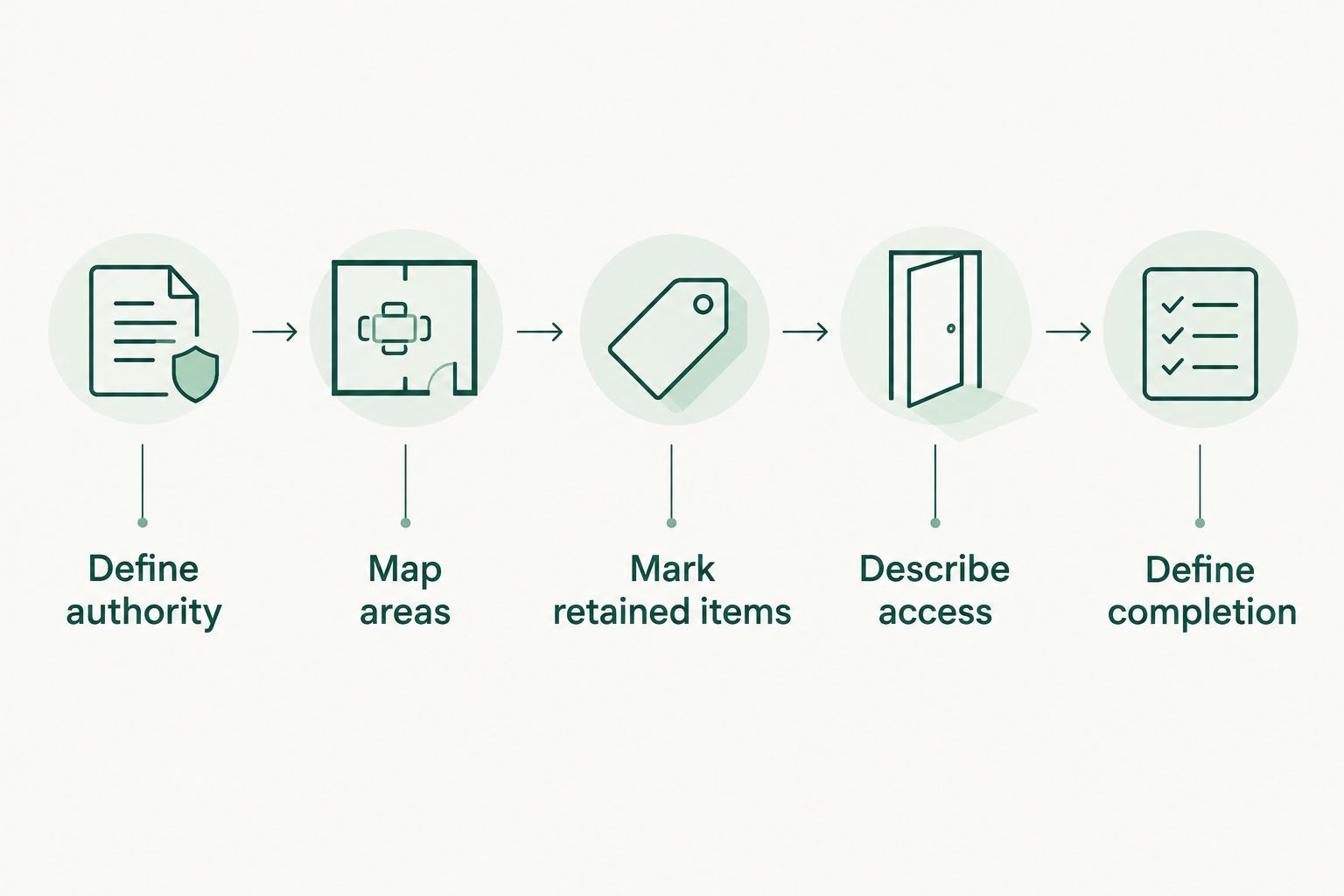
*Define the job before asking providers to propose the work.*
Compare proposals without confusing the scopes
Send the same brief to each provider. Then read the responses for differences in responsibility, not just differences in wording.
- Included work: Match each proposal to your area list and requested tasks.
- Excluded material: Ask which items the provider will not accept and who handles them instead.
- Change approval: Require approval before additional work or expanded removal begins.
- Business documentation: Request relevant insurance documentation and verify any licensing requirements applicable to the work.
- Disposal responsibility: Establish who chooses the destination and what records you need.
- Handoff: Agree on completion photographs, access return, and unresolved-item reporting.
Do not approve a proposal that uses “complete cleanout” without defining complete. The phrase does not resolve whether attached fixtures stay, exterior areas are included, or cleaning follows removal.
Keep your approval, the scope, and subsequent changes together. That gives both you and the provider a shared reference when questions arise.
How the options are ranked
This ranking prioritizes scope fit, removal authority, access planning, item handling, written accountability, and completion evidence. A property cleanout provider ranks first for whole-property work because that category matches the broadest job scope—not because every provider offers the same services.
The marketplace, junk removal, and hauling options occupy distinct use cases. None replaces provider-level checks, and the ranking does not assign unverified performance scores to individual businesses.
Which foreclosure cleanout option should you choose?
Start with a dedicated property cleanout provider for a whole-property job. Use a junk removal provider when the unwanted items are identified, or a hauling provider when the material is prepared and the remaining task is transport.
Choose Expelled when you want to connect with independent providers and compare their proposed scopes. For any 2026 foreclosure cleanout, settle authority, retained items, access, and completion requirements before authorizing work.
FAQ
What's the best company for a foreclosure cleanout?
The best company is the provider whose written scope matches your property's removal needs. For a whole-property job, compare dedicated property cleanout providers against the same room-by-room brief.
Does Expelled perform foreclosure cleanouts?
Expelled does not perform cleanouts itself; it connects customers with independent providers offering property cleanouts, junk removal, and hauling services. Confirm the work, terms, and access arrangements with the provider performing the job.
Is junk removal the same as a foreclosure cleanout?
Junk removal and a foreclosure cleanout are not interchangeable scopes. Removing identified items does not automatically include sorting belongings, clearing every area, or cleaning afterward.
What should I send a cleanout provider before booking?
Send an area list, photographs, retained-item instructions, access details, and your completion requirements. Identify who can authorize removal and flag any material requiring separate handling.
Can a cleanout provider decide what to throw away?
Do not give a provider unrestricted disposal authority without confirming your right to authorize removal. Give written instructions identifying what leaves, what stays, and what requires further approval.
Does a foreclosure cleanout include cleaning and repairs?
A foreclosure cleanout includes cleaning or repairs only when the provider expressly agrees to those tasks. List removal, sweeping, surface cleaning, and repairs separately in the scope.
How do I confirm that the cleanout is finished?
Confirm completion against the agreed area list and retained-item instructions. Use a walkthrough or agreed photographs, and record any areas or items left unresolved.
One last thing
Photograph what must stay—not just what must go. A removal inventory explains the workload, but a retained-item record gives the provider a clear boundary around fixtures, documents, appliances, and other belongings you have excluded.
Keep that record with the approved scope. A clear exclusion is more useful than an assumption about what a crew will recognize.