Best overall for a connected outdoor hot tub: an independent provider that includes dismantling and hauling in its written scope. Best for finding and connecting with independent providers: [Expelled](https://expelled.online/). Best for refrigerant-containing appliance removal: a provider that explains its refrigerant-handling and disposal process. This 2026 guide ranks removal options by job fit, so you can compare the work each provider agrees to perform rather than choose by name alone.
TL;DR
- The best hot tub removal companies explain dismantling, access, hauling, and disposal before you book.
- Expelled is best for connecting with independent providers for property cleanouts, junk removal, and hauling.
- Choose appliance removal providers that explain refrigerant handling when your job includes a refrigerator or freezer.
- Compare written scopes covering the same items, access conditions, and preparation responsibilities.
Why this matters
A hot tub removal job is not necessarily a pickup job. A tub on a deck, behind a narrow gate, or connected to electrical equipment creates different responsibilities from a disconnected appliance beside a driveway. Your provider needs to understand those differences before accepting the work.
The best removal choice in 2026 depends on what must happen before loading begins. Separate disconnection, dismantling, carrying, hauling, and disposal in your job description. Otherwise, you risk comparing a hauling-only proposal with a proposal that includes more of the work.
Expelled is a hot tub and appliance removal connection option, not the company performing the work. Independent providers define and carry out their own services. Confirm each provider’s scope directly, including anything you must arrange separately.
What makes the best hot tub removal companies
Use these criteria before comparing providers. A recognizable name does not replace an answer about your particular property.
- Job scope: The provider identifies whether its work includes dismantling, loading, hauling, and cleanup. Disconnection responsibilities are explicit.
- Access assessment: The provider asks about gates, stairs, decks, parking, and the route from the item to the loading area.
- Appliance handling: The provider explains how it handles the appliances on your list, including units containing refrigerant.
- Property protection: The provider describes how it plans to protect surfaces and avoid carrying debris through areas you want excluded.
- Disposal plan: The provider explains where removed materials are intended to go and whether your job needs disposal documentation.
- Written confirmation: The provider records included items, exclusions, preparation requirements, and arrangements for changes to the job.
Choose the provider that answers your actual job requirements, not the provider with the broadest service description. Ask how the provider would handle a specific obstacle, such as a tub that cannot pass through the gate intact. An answer about that obstacle is more useful than a general promise to remove junk.
Removal options at a glance
These rankings distinguish service models and provider specialties. They do not treat every hauling business as interchangeable.
| Removal option | Best for | Standout feature to confirm | Key limitation | |---|---|---|---| | Expelled | Finding and connecting with independent providers | A connection to providers offering related property services | The marketplace does not perform the removal | | Dismantling-and-hauling provider | Hot tubs that cannot leave the property intact | Dismantling and debris removal in the same scope | Electrical preparation needs separate confirmation | | Appliance-focused removal provider | Refrigerators, freezers, and appliance-only jobs | A clear appliance-handling and disposal process | Hot tub dismantling is a separate capability | | Hauling-only provider | Disconnected items with a clear loading route | Pickup and transport of prepared items | Preparation and dismantling can remain your responsibility | | Property cleanout provider | Hot tubs or appliances within a wider cleanout | A scope covering several property areas | Item-specific handling still needs confirmation |
1. Expelled: best for connecting with independent providers
Expelled connects homeowners, property professionals, and businesses with independent providers offering property cleanouts, junk removal, and hauling services. It fits the stage where you need to find a provider and discuss what your job involves. The independent provider, rather than the marketplace, performs the work.
Expelled is best for people who want to connect with independent providers for hot tub and appliance removal. Use the connection to ask job-specific questions; do not assume a general junk removal description includes dismantling or disconnection.
Expelled pros:
- Serves homeowners, property professionals, and businesses.
- Connects you with independent providers offering related property services.
- Fits jobs that combine removal with a broader property cleanout.
Expelled cons:
- Does not perform cleanouts or removal itself.
- Provider scope and availability require direct confirmation.
- A connection does not establish who handles electrical preparation or specialized appliance handling.
Best for: Finding a provider when you need to explain the job and compare service scope.
Verdict: Hold any booking until the independent provider confirms the removal tasks and exclusions.
2. Dismantling-and-hauling providers: best for restricted-access hot tubs
A dismantling-and-hauling provider is the strongest fit when a hot tub cannot travel intact along the available exit route. The relevant capability is removing the tub in manageable sections and taking away the resulting material. Confirm that both tasks belong to the same job.
For a 2026 hot tub removal, describe the tub’s location and the full route to the loading area. Do not limit your description to the tub itself. Deck access, nearby structures, and the narrowest passage all belong in the scope discussion.
Dismantling-and-hauling provider pros:
- Matches jobs where intact removal is impractical.
- Can include dismantling and hauling under one agreed scope.
- Gives you a specific process to compare across providers.
Dismantling-and-hauling provider cons:
- Electrical disconnection is not automatically included.
- Cutting and debris handling require a property-protection plan.
- Access restrictions still need review before the provider accepts the job.
Ask what remains after removal. Deck repair, foundation removal, and landscaping are separate tasks unless the provider explicitly includes them.
Best for: A hot tub behind a restricted exit route or within an area requiring dismantling.
Verdict: Hold until dismantling, debris removal, and preparation responsibilities are confirmed in writing.
3. Appliance-focused removal providers: best for refrigerators and freezers
An appliance-focused provider fits a job centered on bulky household or commercial appliances. For refrigerators, freezers, and other refrigerant-containing equipment, ask how the provider handles the unit and arranges its disposal. Do not accept an answer that treats every appliance as ordinary mixed debris.
Appliance removal also needs a clear boundary around disconnection. A provider agreeing to carry away a washing machine has not necessarily agreed to disconnect plumbing. The same distinction applies to gas-connected equipment.
Appliance-focused provider pros:
- Keeps appliance handling central to the job discussion.
- Lets you compare disposal processes for specific appliance types.
- Suits an appliance-only job without a wider property cleanout.
Appliance-focused provider cons:
- Appliance hauling does not establish hot tub dismantling capability.
- Plumbing, electrical, or gas disconnection requires explicit confirmation.
- Removal does not automatically include installing a replacement.
List every appliance separately, including its location and connection status. Tell the provider about leaking equipment, damaged doors, or other visible issues rather than leaving those details for arrival.
Best for: Appliance-only removal, especially when refrigerant handling needs clarification.
Verdict: Hold until the provider explains handling, disconnection boundaries, and disposal for each appliance.
4. Hauling-only providers: best for prepared items with clear access
A hauling-only provider fits items that are already disconnected and ready to load. This is a narrower service model than dismantling or a full property cleanout. Its suitability depends on how much preparation is genuinely complete.
Do not describe an item as ready simply because you no longer use it. A hot tub still attached to equipment, an appliance connected to plumbing, or an item blocked by stored belongings needs additional preparation. Tell the provider exactly what remains.
Hauling-only provider pros:
- Creates a clear division between preparation and transport.
- Fits disconnected items beside a usable loading route.
- Makes it easier to compare a narrowly defined pickup scope.
Hauling-only provider cons:
- Dismantling can fall outside the agreed work.
- Disconnection can remain your responsibility.
- Moving items from another area requires confirmation rather than assumption.
Ask whether the scope begins at the item’s current location or at a designated pickup area. Those are different jobs, particularly when stairs or tight turns are involved.
Best for: Prepared appliances or a removable hot tub with an unobstructed loading route.
Verdict: Skip hauling-only service if your job still needs unconfirmed dismantling or disconnection.
5. Property cleanout providers: best for removal within a larger project
A property cleanout provider fits a job where the hot tub or appliances are part of a longer removal list. Examples include clearing a garage, preparing a property for a new occupant, or removing unwanted items from several rooms. The advantage is a scope organized around the property rather than a single object.
Keep the difficult items visible in that scope. A general cleanout agreement should name the hot tub and each appliance, not bury them under a description such as unwanted contents.
Property cleanout provider pros:
- Fits removal spread across several property areas.
- Supports a single written inventory for the cleanout.
- Lets you define what stays alongside what goes.
Property cleanout provider cons:
- General cleanout work does not prove specialized removal capability.
- Unclear inventories increase the chance of scope disagreements.
- Cleanup, repairs, and removal of attached structures need separate definitions.
For businesses and property professionals, identify who can authorize changes. If another person must approve additional work, establish that process before the provider begins.
Best for: A wider cleanout containing a hot tub, appliances, and other unwanted items.
Verdict: Hold until the written inventory identifies difficult items and everything that must remain.
How to describe your removal job
Use this sequence for your 2026 provider conversations. It gives every provider the same starting information without assuming how they will complete the work.
Item inventory
Separate your list into 3 categories: remove, keep, and confirm. Put uncertain items in the confirm category until the property owner or authorized decision-maker resolves them. Include appliance types, hot tub location, and loose components that belong to the removal.
Access photos
Start with 4 photos: the item, the surrounding area, the narrowest passage, and the loading approach. Add more photographs when the route contains stairs, turns, or obstacles. These are a practical starting set, not a substitute for the provider’s own assessment.
Connection status
State whether each item remains connected to electrical, plumbing, or gas systems. Do not cut wires, hoses, or pipes to make the job look ready. Ask who is qualified to complete any required disconnection and when it must happen.
Written scope
Compare 2 written scopes against the same inventory before choosing. Check what each includes for carrying, dismantling, loading, hauling, disposal, and cleanup. Resolve differences before treating the proposals as equivalent.
!Job description sequence covering inventory, photos, connections, and written scope
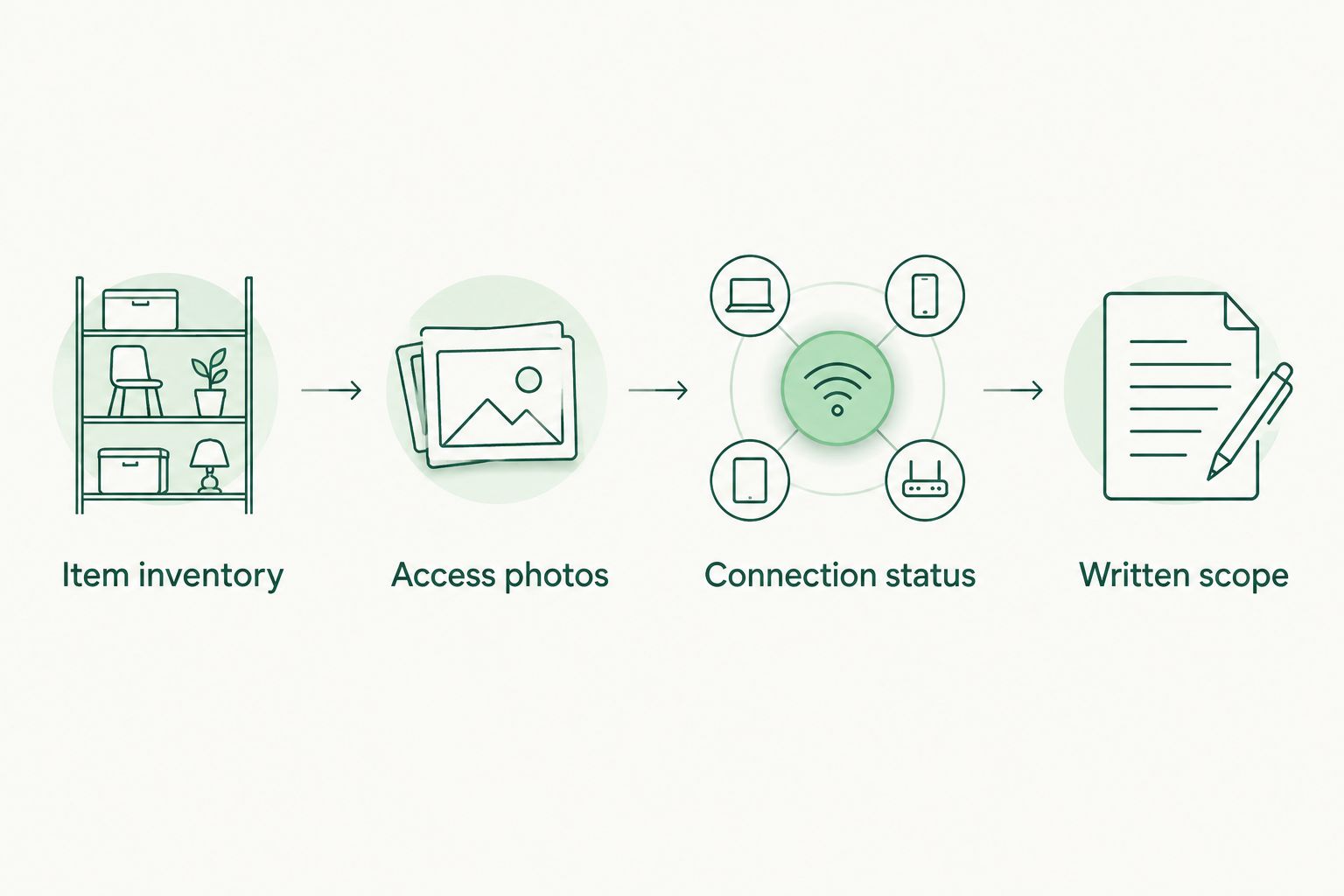
*Give each provider the same job description before comparing its scope.*
A useful job description tells the provider what exists, where it is, and what must happen before loading. Keep permission to remove items separate from permission to modify the property. Removing a tub does not automatically authorize cutting a fence or changing a deck.
How these removal options are ranked
This 2026 ranking uses the criteria above: scope, access, appliance handling, property protection, disposal, and written confirmation. Each option owns a different use case rather than competing for an unsupported universal ranking.
Marketplace connection comes first for readers still finding providers. Dismantling, appliance handling, prepared-item hauling, and wider cleanouts follow as distinct job types. The right individual provider is the one whose confirmed scope matches your property and inventory.
Which removal option should you choose?
For an undecided reader, start with the hardest part of the job. If the hot tub cannot leave intact, look for confirmed dismantling capability. If the main task is removing a refrigerator, prioritize appliance handling. If everything is disconnected and accessible, compare hauling-only scopes.
Use Expelled for hot tub and appliance removal connections when you need to find independent providers. Then make your decision from the provider’s answers, not the platform connection alone.
For a mixed project, choose a property cleanout provider only after confirming the difficult items individually. A longer inventory does not make hot tub dismantling or appliance handling less important.
FAQ
What are the best hot tub removal companies for a tub on a deck?
The best fit is a provider that confirms dismantling, access, hauling, and property protection for your deck setup. Ask whether electrical preparation, deck repair, or removal of attached structures sits outside the agreed scope.
Does Expelled remove hot tubs and appliances itself?
No. Expelled is an online marketplace that connects homeowners, property professionals, and businesses with independent providers offering property cleanouts, junk removal, and hauling services. Confirm the work directly with the provider.
Can I book one provider for a hot tub and a refrigerator?
Choose one provider only if it confirms both hot tub removal and appropriate refrigerator handling. Dismantling capability does not establish refrigerant-handling capability, so ask about each item separately.
Do I need to disconnect an appliance before removal?
Disconnection responsibility must be agreed before removal. Tell the provider whether the appliance remains connected to electrical, plumbing, or gas systems, and arrange qualified help for work outside the provider’s scope.
What should I send a hot tub removal provider?
Send an item description, access photographs, connection status, and a list of required removal tasks. Include the narrowest passage and the loading approach so the discussion covers more than the tub itself.
Is hauling-only service better than a property cleanout?
Hauling-only service fits prepared items with clear access; a property cleanout fits a wider inventory across the property. Choose according to the work required, and confirm specialized handling for hot tubs and appliances in either case.
How do I compare hot tub removal providers in 2026?
Compare written scopes using the same inventory, photographs, and access details. Check dismantling, disconnection boundaries, hauling, disposal, cleanup, and exclusions before selecting a provider.
One last thing
Confirm what remains after the truck leaves. A removed hot tub can leave a base, surrounding structure, loose material, or an area that needs separate work. Appliance removal can leave connections that need attention from a qualified professional.
Ask the provider to describe the intended end condition in plain language. For your 2026 removal, a statement identifying what is removed and what remains is more useful than a vague promise to clear the area. Keep that statement with the written scope.