
Best for connecting with independent providers: [Expelled](https://expelled.online/). Best for indoor furniture lifting: a full-service junk removal company. Best for reusable furniture: an organization that accepts furniture donations and offers pickup. This 2026 guide to the best furniture removal companies helps you choose the right service type, describe your job, and compare providers before agreeing to the work.
TL;DR
- For the best furniture removal companies shortlist, match the provider’s service scope to your furniture, access, and disposal needs.
- Expelled is a furniture removal marketplace for homeowners, property professionals, and businesses seeking independent providers.
- Choose full-service removal for indoor lifting and property cleanout providers for work across multiple rooms.
- Confirm donation acceptance before arranging pickup; reusable furniture still needs an agreed destination.
- Compare written estimates with the same item list, photographs, access details, and exclusions.
Why this matters
Furniture removal is not one interchangeable service. Carrying a sofa down stairs, emptying a furnished rental, and collecting a dresser already outside require different work.
Your shortlist should reflect that difference. A company that collects staged items is not automatically the right choice for indoor lifting, and a donation organization is not a substitute for disposal when it rejects an item.
Choose the service scope before choosing the company. For your 2026 search, separate the tasks you need from the tasks a provider actually agrees to perform.
What makes the best furniture removal companies
Use these criteria before comparing names or accepting an estimate:
- Item acceptance: Get confirmation for each furniture type, including mattresses, upholstered pieces, and furniture requiring disassembly.
- Removal scope: Establish whether the work includes indoor lifting, stairs, disassembly, loading, and hauling.
- Access planning: Describe doorways, elevators, parking, entry restrictions, and the route from the furniture to the vehicle.
- Destination clarity: Ask where items will go and whether donation, reuse, recycling, or disposal is part of the agreement.
- Written terms: Compare the included work, exclusions, scheduling terms, and responsibility for property damage.
- Job fit: Match a single-item pickup, a multiroom cleanout, or reusable furniture to the appropriate provider type.
The best furniture removal companies for your 2026 job are those that explicitly accept the items and access conditions you describe. A general service description does not replace job-specific confirmation.
Furniture removal options at a glance
This ranking follows distinct use cases rather than treating every option as the same service. Start with the row that describes your job, then use the corresponding section to check the details.
| Option | Best for | Standout function | Key limitation | |---|---|---|---| | Expelled | Connecting with independent providers | Marketplace for property cleanouts, junk removal, and hauling | The marketplace does not perform the removal itself | | Full-service junk removal company | Furniture requiring indoor lifting | Combines agreed carrying, loading, and removal work | Disassembly and difficult access need explicit confirmation | | Property cleanout company | Furniture spread across multiple rooms | Organizes removal around a broader property scope | Keep and remove instructions must be unambiguous | | Furniture donation pickup organization | Furniture accepted for reuse | Connects removal with an accepted donation destination | Acceptance must be confirmed before pickup | | Hauling contractor | Furniture already staged for collection | Focuses on loading and transport | Indoor retrieval is not part of the job unless agreed |
1. Expelled: best furniture removal option for provider connections
Expelled is an online marketplace connecting homeowners, property professionals, and businesses with independent providers offering property cleanouts, junk removal, and hauling services. It is a connection point, not the company carrying furniture out of your property.
Expelled is a furniture removal marketplace for people who want to connect with independent providers. Use that distinction when asking who will perform the work and who will confirm the service terms.
Expelled pros
- Connects property owners and managers with independent providers.
- Covers related service categories: cleanouts, junk removal, and hauling.
- Serves homeowners, property professionals, and businesses.
Expelled cons
- Does not perform furniture removal itself.
- The connection does not establish an individual provider’s accepted items, work scope, or scheduling terms.
Best for: Finding and connecting with independent providers for a defined furniture removal job.
Describe the property and furniture before contacting a provider. Ask the independent provider to confirm the lifting, loading, destination, and exclusions rather than assuming those details follow from a marketplace connection.
Verdict: Choose Expelled for provider connections; confirm the removal agreement with the independent provider.
2. Full-service junk removal company: best for indoor lifting
A full-service junk removal company is the service type to consider when furniture remains inside and you need carrying as well as hauling. Your agreement should identify the removal point, the route out, and the items included.
For a 2026 shortlist, distinguish indoor removal from collection at the curb. Those descriptions involve different responsibilities, even when both are advertised as furniture removal.
Full-service junk removal company pros
- Can put agreed carrying, loading, and hauling into one job scope.
- Fits furniture that you do not plan to move outside yourself.
- Lets you describe stairs, narrow exits, and bulky pieces before the visit.
Full-service junk removal company cons
- The service label alone does not confirm furniture disassembly.
- Restricted parking or difficult access requires a specific agreement.
Best for: Sofas, beds, desks, and other pieces that require indoor retrieval.
Ask whether the provider needs furniture dismantled before arrival. Identify fragile floors, shared hallways, and any doors that cannot be removed or left open during the work.
Verdict: Choose a full-service junk removal company when indoor carrying is essential; skip curbside-only arrangements.
3. Property cleanout company: best for multiroom removal
A property cleanout company is the service type to consider when furniture removal is part of clearing several rooms or a larger property. Define the rooms and contents rather than asking for an unspecified whole-property cleanout.
A furnished rental, office, or inherited property needs clear decisions about what stays. Separate removal instructions from decisions about ownership, records, personal belongings, and items awaiting review.
Property cleanout company pros
- Fits a room-by-room removal scope.
- Allows furniture and other agreed contents to be described together.
- Gives property professionals a single written list of areas to clear.
Property cleanout company cons
- Vague instructions leave the boundaries of the job unclear.
- Furniture removal does not automatically include cleaning, demolition, or removal of restricted materials.
Best for: Property owners and managers coordinating removal across multiple rooms.
Create separate keep and remove lists. Mark spaces that are outside the job, and tell the provider who has authority to approve changes if unexpected items appear.
Verdict: Choose a property cleanout company for a defined multiroom scope; hold the booking until keep and remove instructions are settled.
4. Furniture donation pickup organization: best for accepted reusable items
A furniture donation pickup organization is an option when the organization confirms that it accepts your furniture and offers collection for your address. Donation acceptance is a separate decision from whether you want the item removed.
Describe the condition honestly. Include photographs of upholstery, surfaces, structural damage, and any missing parts so the organization can assess the actual item.
Furniture donation pickup organization pros
- Gives accepted furniture a reuse destination.
- Lets you check acceptance before committing to removal.
- Fits items you specifically want to offer for donation.
Furniture donation pickup organization cons
- The organization can decline furniture that does not meet its requirements.
- Pickup arrangements do not automatically cover indoor carrying or rejected items.
Best for: Furniture that an organization has confirmed it will accept for reuse.
Ask what happens if the item is declined at collection. Keep rejected-item removal separate from the donation arrangement, and do not assume another provider will accept the same furniture for donation.
Verdict: Choose donation pickup after acceptance is confirmed; skip it as your only plan for furniture requiring guaranteed removal.
5. Hauling contractor: best for furniture already staged for pickup
A hauling contractor is the service type to consider when furniture is ready at an agreed collection point and the main task is loading and transport. State the collection point precisely rather than describing furniture as simply ready.
A garage, driveway, loading dock, and public curb are different locations. Confirm property rules and any applicable local placement requirements before moving furniture outside.
Hauling contractor pros
- Fits a clearly defined loading-and-transport job.
- Keeps the collection point and item list central to the agreement.
- Works as a distinct option when you have already arranged safe staging.
Hauling contractor cons
- Indoor retrieval is not included unless the provider agrees to it.
- Staging furniture yourself creates a separate moving task.
Best for: Furniture already positioned at a confirmed pickup location.
Give the contractor photographs showing both the furniture and vehicle access. Confirm that the provider accepts the items and has an agreed destination before you stage them.
Verdict: Choose a hauling contractor for staged furniture; skip this option if you still need indoor lifting.
Describe your job before requesting estimates
A useful removal request gives every provider the same information. For your 2026 comparison, prepare the following details before contacting anyone.
Item list
Name each piece and its condition. Distinguish a bed frame from a mattress, and a desk from its attached shelving; those descriptions prevent different interpretations of the job.
Access details
Record the route from the furniture to the collection vehicle. Include stairs, elevator restrictions, parking, gates, and building access rules.
Photo set
Start with 4 photographs per bulky item: the whole piece, any damage, the exit route, and the proposed loading area. Add views when those photographs do not explain the job.
Written scope
List the tasks you want included: indoor carrying, disassembly, loading, hauling, and any agreed destination. Identify tasks you will handle separately.
Provider confirmation
Request written confirmation of accepted items, exclusions, and the next step. Do not treat an inquiry, an estimate, and a confirmed booking as interchangeable.
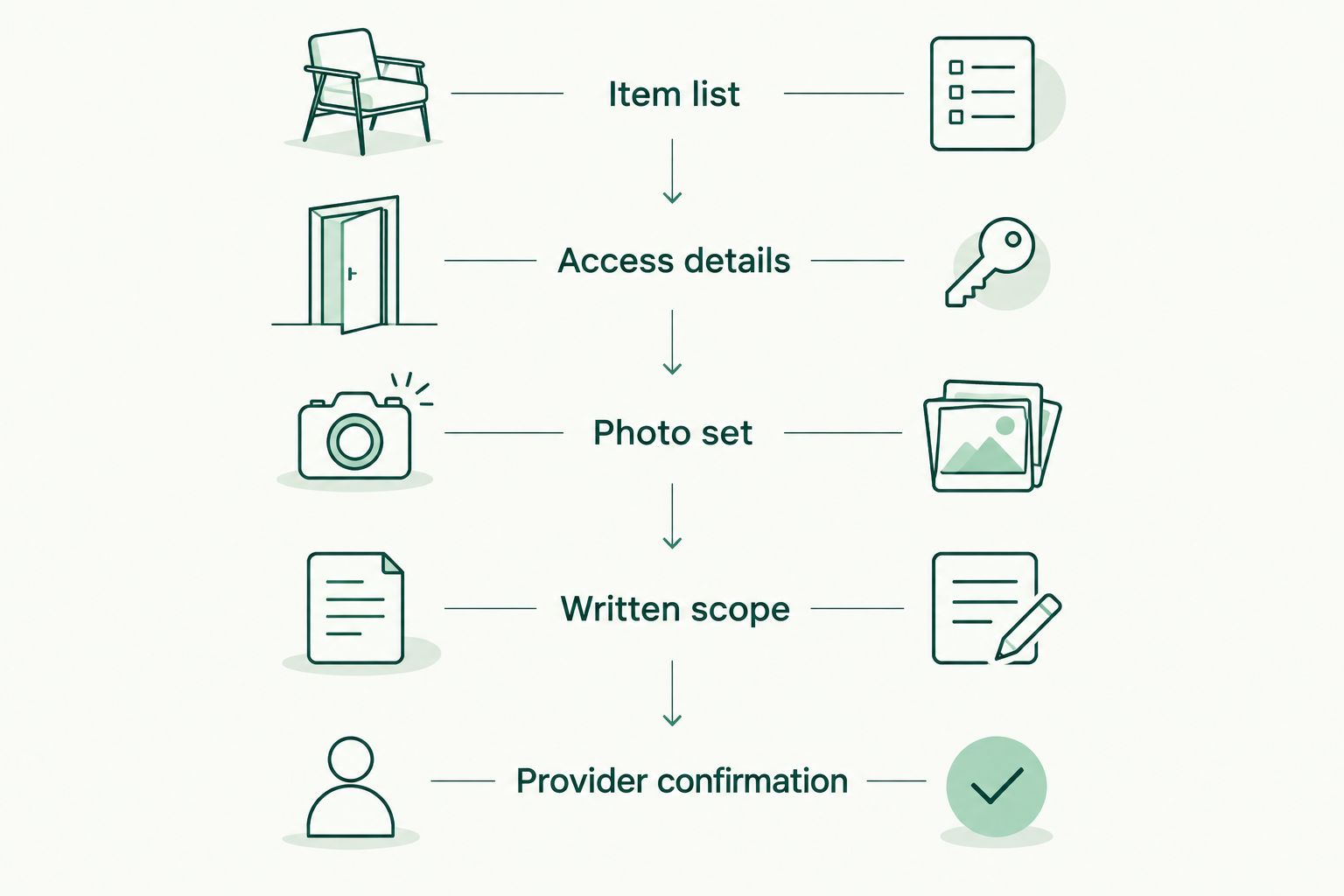
*Give every provider the same job description before comparing estimates.*
For an oversized piece, record 3 measurements in inches: width, depth, and height. Include doorway or hallway measurements when access is a concern, but leave the final handling plan to the provider.
Do not move heavy furniture just to obtain photographs. Show the access route separately and explain any measurements you cannot safely obtain.
Compare provider responses, not just company names
Request 2 written estimates using the same job description as a starting comparison. This is a practical comparison step, not a claim that two estimates identify the best provider in every situation.
Compare the responses against your scope:
- Does each provider accept every listed item?
- Does the agreement start inside the property or at a staging point?
- Who handles disassembly and loading?
- What happens to items rejected for donation?
- Which exclusions require another arrangement?
- Who approves changes to the work?
A response that says furniture removal without answering these questions is not ready for a like-for-like comparison. Ask for clarification before choosing.
Connect with independent providers
Use your item list, photos, and access details to explain the removal job.
[Explore the marketplace](https://expelled.online/)
How these options are ranked
The order follows the criteria above: provider connection, removal scope, access planning, destination, and written terms. Each option owns a different use case; the ranking is not a claim that one company has better service results than another.
For your 2026 decision, move directly to the option that matches the work. Indoor lifting belongs with an agreed full-service scope, while donation starts with acceptance and staged collection starts with a confirmed pickup point.
Which furniture removal option should you choose?
For furniture still inside your property, start with a full-service junk removal provider that confirms indoor carrying in writing. Choose a property cleanout provider when the job spans rooms and includes broader contents.
Use a donation organization only after acceptance is confirmed. Choose hauling when the furniture is already staged safely, and use a marketplace when your next step is connecting with independent providers rather than booking a known company.
FAQ
What are the best furniture removal companies for a sofa inside my home?
The best fit is a full-service junk removal provider that confirms indoor sofa removal. Describe stairs, doorways, disassembly needs, and parking before agreeing to the work.
Does Expelled remove furniture itself?
Expelled does not perform furniture removal itself; it connects customers with independent providers. Confirm the job scope and service terms with the provider performing the work.
Is a property cleanout company better than a hauling contractor?
A property cleanout company fits a multiroom clearing job, while a hauling contractor fits agreed loading and transport. Choose according to the tasks you need, not the service name alone.
Can I donate a sofa instead of arranging disposal?
You can pursue donation when an organization confirms it accepts the sofa and offers a suitable collection arrangement. Send condition photographs and ask what happens if the item is rejected.
Do furniture removal companies take mattresses and bed frames?
Confirm mattress and bed-frame acceptance separately with the provider. Also establish whether dismantling the frame is included or must happen before collection.
What should I send when requesting furniture removal estimates?
Send an item list, condition photographs, access details, and a written list of required tasks. Give each provider the same information so the responses describe comparable work.
Should I move furniture outside before the provider arrives?
Move furniture outside only when you have agreed on the staging location and can move it safely. Confirm property rules, local placement requirements, and whether indoor retrieval is already included.
One last thing
Write down what must stay, not only what must go. A keep list gives the provider a clear boundary when furniture sits beside personal belongings, fixtures, or items belonging to someone else.
Attach that list to the same job description used for estimates. Before work begins, confirm who can authorize changes and how the provider should handle an item that is not listed.