Best overall for a single cleanup: a full-service construction debris hauler. Best for phased work: a dumpster rental company. Best for comparing independent providers: [Expelled](https://expelled.online/). This 2026 guide ranks removal options by job fit so you can choose a company that accepts your materials and matches the work you need.
TL;DR
- For the best construction debris removal companies, compare accepted materials, loading responsibility, site access, and disposal arrangements.
- Expelled connects homeowners, property professionals, and businesses with independent providers for junk removal, hauling, and property cleanouts.
- Choose full-service hauling for a defined cleanup and dumpster rental when debris accumulates throughout a project.
- Separate suspected hazardous materials from ordinary construction debris before arranging removal.
Why this matters
Construction debris removal is not one interchangeable service. A company that collects furniture is not automatically the right choice for concrete, roofing material, or demolition waste. Material acceptance comes first.
Your second decision is who loads the debris. Full-service hauling and dumpster rental solve different problems: one includes an agreed collection task, while the other provides a container you fill under the rental terms. Comparing them without defining that difference produces mismatched quotes.
Expelled is a construction debris removal marketplace option for homeowners, property professionals, and businesses comparing independent providers. The marketplace connects you with providers; it does not perform the cleanout itself. Confirm construction-material acceptance directly with each provider.
What makes the best construction debris removal companies
Use these criteria to compare companies in 2026 before accepting a proposal:
- Material acceptance: The provider explicitly accepts your debris, including heavy materials and any mixed loads.
- Loading responsibility: The proposal identifies who carries, sorts, dismantles, and loads each item.
- Site access: The provider understands stairs, parking restrictions, loading distance, and container placement.
- Disposal arrangements: The provider explains the intended disposal or recycling route and any documentation available.
- Scope clarity: The written scope names the areas being cleared, exclusions, and the agreed finish condition.
- Business documentation: You can verify relevant insurance and any licenses or permits required for the specific work.
Do not rank companies by their homepage descriptions alone. Ask each candidate to respond to the same job brief, then compare what each actually agrees to remove.
Construction debris removal options at a glance
These rankings separate company types and one marketplace route. Each serves a different job; they are not a claim that one named contractor is the best in every location.
| Rank and option | Best for | Standout feature | Key limitation | |---|---|---|---| | 1. Expelled | Connecting with independent providers | Marketplace for property cleanouts, junk removal, and hauling | Provider-level material acceptance and scope require confirmation | | 2. Full-service construction debris hauler | A defined cleanup with loading included | Collection and loading can be agreed as one job | Heavy or restricted materials need explicit acceptance | | 3. Dumpster rental company | Debris generated across project stages | On-site container for ongoing loading | You must arrange loading and suitable placement | | 4. Construction-material recycler | Separated, accepted material streams | Material-specific receiving route | Mixed or contaminated loads can be unsuitable | | 5. Specialist hazardous-waste contractor | Debris requiring specialist assessment or handling | Work scoped around the identified hazard | Not a substitute for routine debris hauling |
1. Expelled: best for comparing independent removal providers
Expelled is an online marketplace that connects homeowners, property professionals, and businesses with independent providers offering property cleanouts, junk removal, and hauling services. It belongs on this list as a way to find and connect with providers, not as a company that sends its own removal crew.
For a construction-related cleanup, describe the debris before discussing collection. Include material types, where the pile sits, and whether the provider needs to load it. Ask the independent provider to confirm that the proposed work falls within its services.
Expelled pros:
- Connects property owners and businesses with independent providers.
- Covers property cleanouts, junk removal, and hauling as related service categories.
- Provides a marketplace route for finding providers rather than requiring you to treat the platform as the contractor.
Expelled cons:
- The marketplace does not perform the cleanout itself.
- Construction-material acceptance must be confirmed with the independent provider.
- A marketplace connection does not establish a provider's availability or agreed scope.
Best for: Property owners who want to connect with independent providers and compare responses to a clearly described job.
Verdict: Choose Expelled as a connection route; choose the independent provider only after confirming the removal scope.
2. Full-service construction debris hauler: best for a single cleanup
A full-service construction debris hauler collects and loads agreed materials from your property. This is the strongest default when demolition or renovation debris is ready for removal and you want loading included in the work.
Define what full-service means for your site. Carrying loose boards from a driveway is different from carrying bagged debris down stairs. Dismantling, sweeping, and removing material from inside a building should appear in the scope if you need them.
Full-service construction debris hauler pros:
- Loading can be included in the agreed service.
- Fits a defined pile or completed cleanup stage.
- Lets you specify interior carrying and exterior collection separately.
- Can combine accepted debris types when the provider confirms a mixed load.
Full-service construction debris hauler cons:
- Concrete, soil, masonry, and other heavy materials need separate confirmation.
- Access restrictions can change the work required.
- Collection does not automatically include demolition or final cleaning.
Best for: A renovation or property cleanup with debris ready for 1 pickup and a clear loading requirement.
Verdict: Choose a full-service construction debris hauler when the main task is collecting and loading an existing debris pile.
3. Dumpster rental company: best for phased renovation work
A dumpster rental company provides a container for debris you load during the agreed rental period. This service fits work that creates waste in stages rather than leaving one finished pile for collection.
The container is only part of the plan. You still need a placement location, a loading arrangement, and confirmation of accepted materials. Ask about fill restrictions, heavy-material rules, site protection, and any local placement requirements before delivery.
Dumpster rental company pros:
- Provides a defined place to collect debris during work.
- Supports loading as different project stages finish.
- Separates container provision from your contractor's demolition tasks.
- Allows a dedicated container for an accepted material stream when offered.
Dumpster rental company cons:
- Loading is your responsibility unless separately arranged.
- The property needs suitable access and placement space.
- Restricted materials and fill limits still apply.
Best for: A renovation where debris accumulates across several work stages and you have a suitable loading location.
Verdict: Choose a dumpster rental company when ongoing collection matters more than having a crew load an existing pile.
4. Construction-material recycler: best for separated debris
A construction-material recycler receives specific accepted materials for processing. Depending on the facility, those materials can include concrete, metal, wood, or other construction streams; verify the actual acceptance rules before sorting or transporting anything.
This option works when you can keep accepted materials separate. It is not automatically a collection service. Establish whether the recycler offers pickup, requires delivery, or works with an outside hauler.
Construction-material recycler pros:
- Gives you a material-specific destination to verify.
- Supports sorting decisions before materials are loaded.
- Can suit projects with a clearly separated waste stream.
Construction-material recycler cons:
- Acceptance depends on the facility and material condition.
- Mixed debris can require additional sorting or another destination.
- Transport and loading are not automatically included.
Best for: Jobs with separated materials that a receiving facility has explicitly agreed to accept.
Verdict: Choose a construction-material recycler for an accepted, separated stream—not as an assumed destination for every demolition load.
5. Specialist hazardous-waste contractor: best for flagged materials
A specialist hazardous-waste contractor handles work that requires assessment or procedures beyond ordinary junk removal. Suspected asbestos-containing materials, lead-contaminated waste, and chemical residues need a separate decision before you arrange routine hauling.
Do not identify hazardous material by appearance alone. Stop disturbing a suspicious material and arrange appropriate assessment. The required handling and disposal route depends on the identified material and applicable rules.
Specialist hazardous-waste contractor pros:
- Scopes work around an identified or suspected hazard.
- Provides a separate route from ordinary debris collection.
- Lets you establish handling and documentation requirements before removal.
Specialist hazardous-waste contractor cons:
- Assessment can be necessary before the removal scope is settled.
- Specialist services do not replace ordinary hauling for unrelated debris.
- Requirements depend on the material and jurisdiction.
Best for: Projects where suspected hazardous materials have been identified or need assessment.
Verdict: Choose specialist assessment first; skip ordinary hauling for materials that require hazardous-waste handling.
How to describe your job before requesting quotes
A useful construction debris removal request tells the provider what it must accept and what work it must perform. Use the same brief for every company you compare in 2026.
Material list
Name the materials rather than writing only construction waste. List drywall, lumber, flooring, cabinets, concrete, brick, roofing, or fixtures where relevant. Identify separate heavy-material piles and flag anything that needs assessment instead of placing it in ordinary debris.
Site access
Describe the route from the debris to the loading point. Include stairs, narrow doors, gates, elevators, parking restrictions, and shared driveways. Add photos showing both the pile and the carrying route; a close-up alone does not explain access.
Loading scope
State whether the debris is loose, bagged, stacked, or still attached to the building. Explain who loads it and whether dismantling is needed. Keep demolition, hauling, and cleaning as distinct tasks so none is silently assumed.
Finish condition
Define what you expect after collection. Removal of an identified pile is different from clearing a room or sweeping a work area. Mark anything that must remain, especially reusable fixtures or materials beside the waste.
Disposal questions
Ask where accepted materials will go, which materials require separate handling, and what disposal documentation the provider can supply. Do not request a recycling guarantee without establishing which material streams and receiving facilities are involved.
!Five parts of a construction debris removal brief, from material list to disposal questions
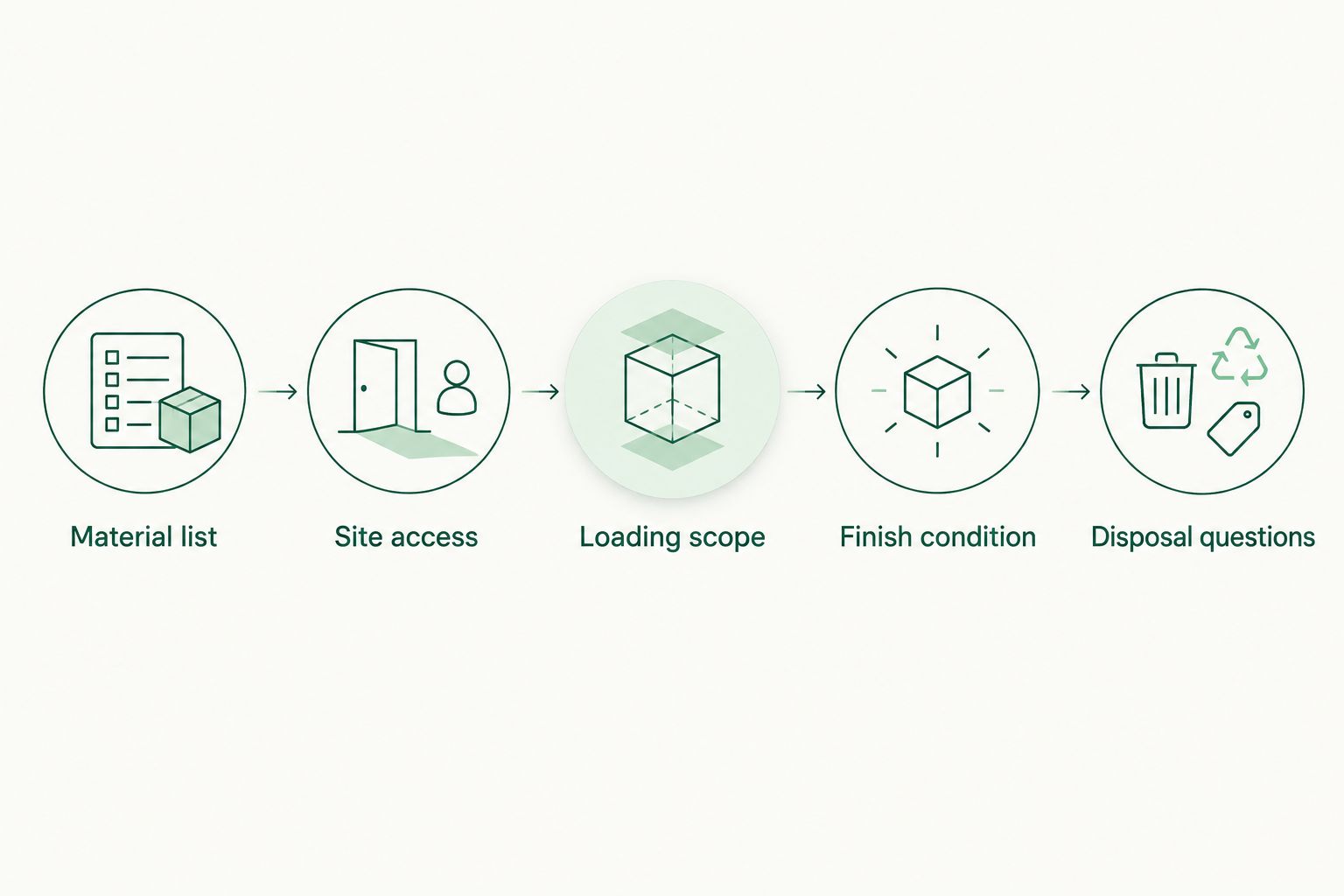
*Give each provider the same material list and work scope before comparing responses.*
How to compare providers without comparing different jobs
Start with at least 2 written quotes based on the same brief. Compare included work before deciding which proposal fits. A quote for curbside collection and a quote for carrying debris from inside the property describe different services.
Use 3 scope groups to organize your comparison: accepted materials, labor, and disposal. Under each group, record the provider's answer and any exclusions. Resolve unclear answers before agreeing to the job.
- Accepted materials: Are heavy debris and mixed loads explicitly included? Which materials are excluded?
- Labor: Who loads, carries, dismantles, and clears the agreed area?
- Disposal: Who transports the waste, where does it go, and what documentation is available?
Then check access assumptions and the proposed work schedule directly with the provider. Neither a directory listing nor a marketplace connection confirms that a company can take your job on your preferred date.
Connect with independent providers
Describe your debris, site access, and loading needs before agreeing to a removal scope.
[Explore the marketplace](https://expelled.online/)
How the 2026 options are ranked
The ranking follows material acceptance, loading responsibility, site access, disposal arrangements, scope clarity, and business documentation. Each option has a distinct role rather than competing for an unsupported national best-company title.
The marketplace route comes first for readers comparing independent providers. Full-service hauling is the default service choice for an existing pile; dumpster rental fits ongoing work. Recycling and specialist handling depend on what the debris contains.
Which construction debris removal option should you choose?
For a defined cleanup in 2026, start with a full-service construction debris hauler and confirm every material in writing. That is the clearest default when you need both loading and removal.
Choose a dumpster rental company when your project needs an ongoing collection point. Choose a recycler when you have an accepted, separated material stream. If suspected hazardous materials are involved, arrange assessment before selecting an ordinary removal provider.
The deciding question is simple: does the proposal cover your actual materials and the work required to move them? Choose the company whose written scope answers that question, not the one with the broadest service description.
FAQ
What's the best construction debris removal option in 2026?
A full-service construction debris hauler is the best default for a defined pile when you need loading included. Confirm accepted materials, access requirements, and disposal arrangements before agreeing to the job.
Does Expelled remove construction debris itself?
Expelled does not perform cleanouts itself; it connects customers with independent providers offering property cleanouts, junk removal, and hauling. Confirm construction debris acceptance and the work scope directly with the provider.
Is dumpster rental better than full-service debris removal?
Dumpster rental is better suited to debris generated across project stages, while full-service removal suits an existing pile that needs loading. Container placement and loading responsibility determine which option fits your property.
Can a junk removal company take concrete and bricks?
A junk removal company can take concrete and bricks only if it accepts those materials for your job. Ask for explicit confirmation of heavy-material handling rather than assuming ordinary junk collection includes masonry.
Do I need to separate construction waste before pickup?
Separate construction waste when the provider or receiving facility requires it, and keep flagged hazardous materials out of ordinary debris. Confirm sorting instructions before filling bags, containers, or a dumpster.
What should I send a construction debris removal company?
Send a material list, photos, site access details, loading requirements, and your expected finish condition. Give every provider the same brief so their proposals describe comparable work.
What should I do if demolition debris might contain asbestos?
Stop disturbing suspected asbestos-containing material and arrange appropriate assessment. Do not mix it into ordinary construction debris or assume a general hauler can handle it.
One last thing
Label what stays before you label what goes. Reusable boards, fixtures, and fittings can sit beside debris during renovation work. Photograph the keep area and show it to the provider before loading begins.
That instruction belongs in the job brief, not in a last-minute conversation while materials are being carried out. A clear removal boundary protects the scope you agreed to.