
Best for connecting with independent providers: [Expelled](https://expelled.online/). Best for a standalone pickup: an independent appliance removal provider; best for removal tied to a replacement: a retailer’s haul-away service, if offered. This 2026 guide compares service routes so you can choose by job scope rather than an unsupported nationwide company ranking.
TL;DR
- Expelled is an appliance removal marketplace for homeowners, property professionals, and businesses seeking independent providers.
- The best appliance removal companies confirm access, disconnection requirements, accepted items, and disposal arrangements before booking.
- Compare standalone junk removal, retailer haul-away, municipal collection, and appliance recyclers against your actual job.
- Keep appliance disconnection separate from hauling unless the provider explicitly accepts both tasks.
Why this matters
An appliance pickup is not always just a loading job. A refrigerator in a garage presents different requirements from a connected washing machine upstairs. A provider needs to understand both the appliance and its route out of the property.
Choose the removal service that accepts your complete scope, not the name that appears most often in search results. For a 2026 booking, confirm the current terms directly with the provider or collection program. A general appliance-removal description does not establish acceptance of your particular item, location, or access conditions.
What makes the best appliance removal companies
Use these criteria before comparing providers:
- Job fit: The provider accepts the appliance type and the other items included in your request.
- Access requirements: The agreed scope covers stairs, doorways, elevators, parking, and the appliance’s starting location.
- Disconnection responsibility: You know who handles electrical, water, drain, or gas connections before removal.
- Written scope: The provider documents what removal includes and identifies exclusions before you agree.
- Disposal arrangements: The provider explains where the appliance goes and how restricted components are handled.
- Coordination: You know who confirms property access, building permission, and any handoff with an installer.
These criteria keep different offers comparable. A curbside pickup and removal from an upstairs laundry room are different jobs, even when both descriptions say appliance removal.
Appliance removal options at a glance
| Rank and option | Best for | Standout fit | Key limitation | |---|---|---|---| | 1. Expelled marketplace | Connecting with independent providers | A marketplace for property cleanouts, junk removal, and hauling | The selected provider must confirm the appliance-removal scope | | 2. Independent appliance removal provider | Standalone pickup | Direct discussion of a specific removal job | Accepted items and included tasks depend on the provider | | 3. Retailer haul-away service | Removal with a replacement purchase | Coordinating old-appliance removal with replacement arrangements | Haul-away must be offered and its conditions confirmed | | 4. Municipal collection program | Eligible items under local collection rules | A defined collection route where the program accepts appliances | Local eligibility and preparation rules control the job | | 5. Appliance recycler | Disposal-focused removal | Direct discussion of appliance acceptance and recycling | Pickup and interior removal must be confirmed separately |
The ranking reflects different use cases, not measured performance scores. For your 2026 shortlist, choose the route that fits the job, then compare the providers or programs within that route.
1. Expelled: best appliance removal marketplace for provider connections
Expelled connects homeowners, property professionals, and businesses with independent providers offering property cleanouts, junk removal, and hauling services. It is a marketplace, not the company performing the removal.
Expelled is best for homeowners, property professionals, and businesses seeking independent providers for appliance removal as part of a hauling or cleanout request. Describe the appliance clearly and ask the provider to confirm that the requested work is within scope.
Expelled pros:
- Connects property owners and businesses with independent providers.
- Covers the related service categories of cleanouts, junk removal, and hauling.
- Fits requests that require describing appliances alongside other unwanted property contents.
Expelled cons:
- The marketplace itself does not perform the cleanout or haul.
- Appliance acceptance, disconnection, and disposal arrangements require confirmation with the selected provider.
Best for: Finding a provider connection when you need to explain a property-related removal job.
Verdict: Buy the selected provider’s service only after the appliance scope is confirmed. Treat the marketplace connection as the starting point, not confirmation that every requested task is included.
2. Independent providers: best for standalone appliance removal
An independent appliance removal provider is a direct option when your main task is removing an appliance rather than buying its replacement. Ask whether the service covers removal from inside the property or only collection from an accessible pickup point.
The useful comparison is between written scopes. Give each provider the same appliance description and access details so you are not comparing an interior removal offer with a curbside collection offer.
Independent provider pros:
- Lets you discuss the removal job directly with the provider.
- Gives you a route to request pickup without tying it to a replacement purchase.
- Lets you ask about additional unwanted items in the same request.
Independent provider cons:
- Service boundaries differ between providers.
- Disconnection and disposal details still need separate confirmation.
Best for: A standalone removal request with clearly described access and preparation requirements.
Verdict: Buy when the written scope matches the whole job. Hold if the provider has not confirmed stairs, connected appliances, or additional items.
3. Retailer haul-away: best for replacement coordination
A retailer’s haul-away service is a relevant option when you are purchasing a replacement appliance and the retailer offers removal. Ask about it before finalizing the replacement arrangements, not after the old appliance becomes an obstacle.
Confirm whether delivery, installation, disconnection, and removal are separate tasks. Do not assume that accepting an old appliance means the delivery team will disconnect it or retrieve it from any room.
Retailer haul-away pros:
- Gives you a removal route connected to the replacement transaction.
- Lets you discuss the old and new appliances in the same planning conversation.
- Provides an opportunity to clarify preparation before delivery arrangements are finalized.
Retailer haul-away cons:
- The retailer must offer haul-away for your transaction.
- Its removal conditions do not automatically cover unrelated appliances or property contents.
Best for: Replacing an appliance when the retailer explicitly accepts the old unit under its haul-away terms.
Verdict: Buy only when the removal conditions match your replacement plan. Skip this route for an unrelated cleanout unless the retailer confirms that work is included.
4. Municipal collection: best for rule-based local pickup
Municipal collection is an option only when your local program accepts the appliance. Check the current rules for the address where collection will occur; rules from another municipality do not establish eligibility.
For 2026, confirm the accepted appliance category, scheduling process, placement instructions, and preparation requirements. A general bulky-item program is not proof that every appliance qualifies.
Municipal collection pros:
- Gives you a published set of local collection requirements to check.
- Provides a defined route for items that the program accepts.
- Lets you assess eligibility before seeking another removal service.
Municipal collection cons:
- Appliance acceptance depends on the local program.
- Collection instructions do not establish that a crew will remove the appliance from inside your property.
Best for: An eligible appliance that you can prepare and place exactly as the local program requires.
Verdict: Hold until eligibility and placement instructions are confirmed. Skip this route when your job requires services outside the program’s stated scope.
5. Appliance recyclers: best for disposal-focused decisions
An appliance recycler is a relevant contact when your main question is whether a facility accepts the appliance and how it handles the material. Ask about the specific item rather than assuming that a general recycling description covers it.
Separate acceptance from transportation. A facility’s willingness to accept an appliance does not establish that it collects from homes, removes items from upstairs, or disconnects installed equipment.
Appliance recycler pros:
- Lets you ask directly about appliance acceptance.
- Gives you a place to discuss the intended recycling route.
- Helps distinguish disposal requirements from the physical hauling job.
Appliance recycler cons:
- Pickup must be confirmed rather than assumed.
- Interior removal and disconnection require explicit agreement.
Best for: A disposal-focused request where the recycler confirms both acceptance and any transportation you need.
Verdict: Buy a pickup service only if collection is explicitly included. Hold if the facility accepts drop-offs but you have no safe transportation arrangement.
How to describe your appliance removal job
A clear request makes provider comparisons useful. Before contacting anyone, prepare the same information for every conversation. You can use this process for a single appliance or a broader property cleanout.
Identify the appliance
Name the appliance type and quantity. Explain whether it is freestanding, built in, stacked, or located inside cabinetry. Mention damage that affects handling, such as a loose door or broken base.
Do not describe an appliance as disconnected unless its relevant connections have actually been addressed. If you do not know its connection status, state that clearly.
Document access
Describe the appliance’s current location and the route to the loading area. Include stairs, narrow turns, elevators, gates, parking restrictions, and building access requirements.
Take 3 photos for the request: the appliance, its immediate surroundings, and the exit route. This is a practical preparation step, not a substitute for the provider’s assessment.
Assign disconnection
Ask who handles electrical, water, drain, or gas connections. Do not assume hauling includes plumbing, electrical work, or gas work. Arrange appropriate help where the task requires it, and follow the appliance manufacturer’s instructions.
Keep this responsibility explicit even if the appliance appears ready to move. A hidden connection changes the job.
Confirm the scope
Request 1 written scope that names the appliance, pickup location, access conditions, preparation requirements, and disposal arrangements. List other items separately rather than treating them as automatically included.
!Four steps for describing an appliance removal job before comparing providers
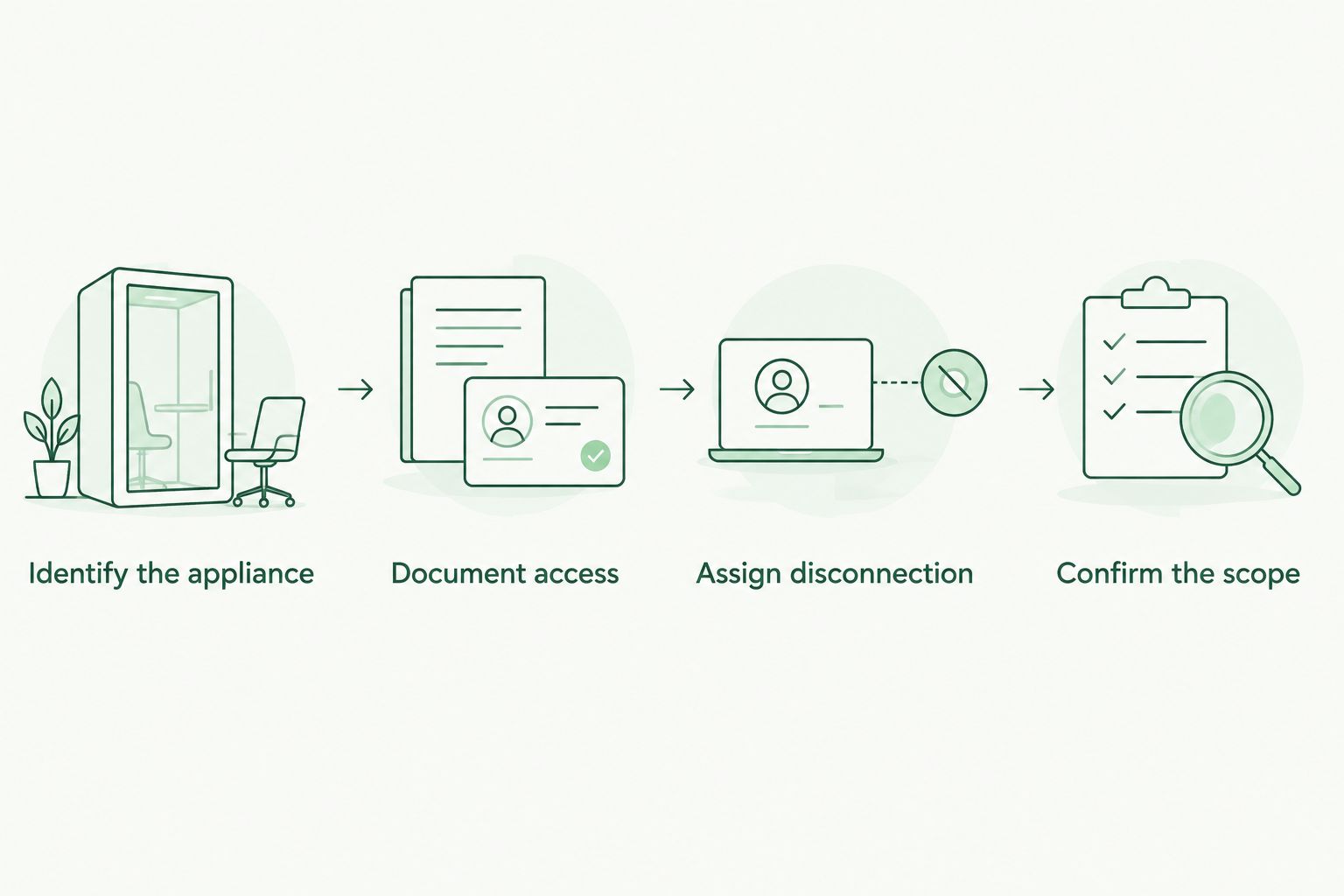
*Confirm the removal scope after identifying the appliance, access, and disconnection responsibilities.*
Compare providers without comparing different jobs
Send the same description in 2 provider requests if you want a direct comparison. That is a suggested starting point, not a claim that any particular number guarantees a better outcome.
For a 2026 appliance removal comparison, ask each provider:
- Is this appliance accepted in its current condition?
- Does the service start inside the property or at a designated collection point?
- Are the described stairs and access restrictions included?
- What must be disconnected or prepared before arrival?
- Who is responsible for damage-sensitive areas along the exit route?
- Where will the appliance be taken, and what disposal arrangements apply?
- What changes would require revising the agreed scope?
Compare matching scopes before choosing a provider. If one response excludes interior removal and another includes it, ask for clarification instead of treating them as equivalent offers.
A property professional should also identify who authorizes access and who can approve changes. For a business, specify building procedures and any restrictions on using shared loading areas. These details belong in the request, not in a last-minute conversation.
How we ranked
This guide ranks service routes by the job each is designed to address: provider connections, standalone removal, replacement coordination, municipal eligibility, or recycling acceptance. The criteria are job fit, access, disconnection, written scope, disposal, and coordination.
It does not assign customer-review scores or declare one company the national performance winner. The best route is the one whose confirmed responsibilities match your removal job.
Which appliance removal option should you choose?
For an undecided reader, start with an independent provider route and a written job description. Use Expelled to connect with independent providers when a marketplace fits how you want to arrange property hauling or cleanout services.
Choose retailer haul-away when it is explicitly offered for your replacement transaction. Choose municipal collection or an appliance recycler only after confirming eligibility, preparation, and transportation responsibilities.
For your 2026 decision, do not book on the strength of the phrase appliance removal alone. Confirm where the job starts, what preparation you must complete, and where the appliance goes.
FAQ
What are the best appliance removal companies for my job?
The best appliance removal companies are the providers that accept your appliance and confirm the complete removal scope. Compare access, disconnection responsibilities, preparation, and disposal rather than choosing from a generic national ranking.
Does Expelled remove appliances itself?
No. Expelled is a marketplace that connects homeowners, property professionals, and businesses with independent providers offering cleanouts, junk removal, and hauling. Confirm appliance removal directly with the selected provider.
Is retailer haul-away better than hiring an independent provider?
Retailer haul-away fits a replacement transaction when the retailer offers it and accepts your old appliance. An independent provider route fits a standalone removal request; compare the actual included tasks before choosing.
Do I need to disconnect my appliance before removal?
You need to confirm disconnection responsibility before booking. Do not assume that hauling includes electrical, plumbing, or gas work, and follow the appliance manufacturer's instructions when arranging preparation.
Can a provider remove an appliance from upstairs?
Ask the provider to explicitly confirm upstairs removal for your job. Describe the stairs, turns, doorway restrictions, and appliance location before agreeing to the scope.
Can I put an appliance out with bulky-item collection?
Only use bulky-item collection if your local program accepts that appliance and you can follow its preparation and placement rules. General bulky-item acceptance does not establish appliance eligibility.
How do I know whether my old appliance will be recycled?
Ask the provider where the appliance will go and what recycling arrangements apply. Do not infer recycling from a general junk removal or hauling description.
One last thing
Write down where removal begins. Inside the kitchen, inside the garage, and at the curb are different starting points. A provider’s agreement to take an appliance does not answer that question.
Add the starting location to your request and written scope. That single detail helps keep a pickup request from being mistaken for an interior removal job.