
Hiring a junk removal company is worth it in 2026 when you need help carrying bulky items, clearing several rooms, or coordinating removal around a property handover. The trade-off is that you must confirm what the provider includes: hauling does not automatically include sorting, dismantling, cleaning, or handling restricted materials. For a small load you can safely transport yourself, hiring help is harder to justify.
TL;DR
- Is hiring a junk removal company worth it? Yes, when carrying, loading, and hauling exceed your practical capacity.
- Expelled connects homeowners, property professionals, and businesses with independent providers for junk removal and property cleanouts.
- Compare written job scopes, not just quotes; confirm access, exclusions, disposal arrangements, and responsibility for property protection.
- Choose self-hauling for manageable loads only after checking vehicle suitability and the receiving facility’s rules.
Is hiring a junk removal company worth it in 2026?
Hire help when the job requires labor, transport, or coordination you cannot reasonably supply yourself. Keep the work yourself when the load is manageable, the disposal route is clear, and you can complete it safely without disrupting other responsibilities.
| Option | Best for | Main advantage | Main limitation | |---|---|---|---| | Independent junk removal provider | Bulky items and jobs requiring carrying and loading | You can arrange removal labor and hauling together | Included tasks and accepted materials require confirmation | | Self-hauling | Manageable loads with a confirmed disposal destination | You control sorting and transport | You supply the lifting, suitable vehicle, and disposal arrangements | | Container rental | Projects where you want to load items gradually | You control the loading sequence | You still handle loading and must confirm placement and material rules |
Property handovers also require decisions about ownership and access. The junk removal guide for property managers addresses that setting separately from a routine household pickup.
Why this matters
A removal decision involves more than getting unwanted objects off the property. Someone must identify what stays, establish who can authorize disposal, protect the route out, and confirm where the material will go.
For your 2026 cleanout, separate those responsibilities before comparing options. Hiring a provider does not transfer every decision to that provider. You still need an agreed scope and a clear boundary between unwanted belongings and items that must remain.
The service is valuable when it removes a defined burden, not when the job description leaves that burden unresolved.
Bulky-item removal: best for difficult carrying and loading
Hiring help makes sense when an item’s shape, weight, or location makes removal impractical for you. Describe the item and its route out rather than assuming a photograph of the object tells the whole story.
A sofa beside an exterior door presents a different task from the same sofa upstairs. Tell prospective providers about stairs, tight turns, doorway restrictions, and anything that requires disassembly. Do not attempt a difficult lift just to make the job easier to quote.
The advantage is arranging help with physical work and transport. The limitation is that disassembly, disconnection, or specialist handling must be agreed separately. Choose a provider that explicitly accepts the item and the access conditions.
Multi-room cleanouts: best for a clearly defined removal scope
A cleanout becomes a coordination task when unwanted belongings are spread throughout a property. Sorting, removal, and cleaning are different activities; requesting a cleanout does not establish that every activity is included.
Mark the rooms involved and identify anything excluded from removal. For an estate or shared property, settle ownership questions before a provider begins carrying items out. Keep documents, keys, valuables, and personal records outside the removal area.
Hiring help reduces the carrying and hauling you must arrange yourself. It does not replace decisions about what should leave. Choose this option after you can distinguish removal items from items awaiting a decision.
Small loads: best for considering self-hauling first
Self-hauling deserves consideration when you can safely handle the items, use a suitable vehicle, and confirm an appropriate receiving facility. Check all of those conditions before loading anything.
The advantage is control over the task without coordinating a separate removal appointment. The limitation is that you remain responsible for lifting, securing the load, transport, and acceptance at the destination.
Compare the entire task rather than the drive alone. If you still need to arrange lifting help or find a suitable vehicle, self-hauling has not removed those burdens. Choose self-hauling only when the practical arrangements are already clear.
Why the value of hiring help varies
Your 2026 decision should turn on the actual work, not a generic promise that professional removal is always better. These factors define what you are asking someone else to take over:
- Volume: List the rooms and items involved; avoid relying only on a description such as a large pile.
- Access: Identify stairs, elevator requirements, gates, parking restrictions, and the carrying route.
- Material: Separate ordinary unwanted belongings from items needing special acceptance or handling.
- Preparation: State whether sorting, dismantling, or moving items to a collection point remains your responsibility.
- Disposal arrangements: Ask where materials will be taken and what documentation the provider can supply.
- Coordination: Identify who authorizes removal, provides entry, and confirms that the agreed work is complete.
These details also expose mismatched proposals. A provider quoting only for collection is not offering the same scope as a provider including removal from inside the property.
Describe your job in 4 steps
A clear request makes provider responses easier to compare. Complete these 4 steps before asking anyone to assess the work; you do not need to estimate a truckload to describe your own property accurately.
Step 1: List items
Write an inventory by room or collection area. Name the bulky objects individually, and describe smaller contents in ordinary terms such as boxed household items or loose garage contents.
Photograph the overall area and the largest objects. Include anything that changes the task, such as attached components or items that cannot pass through the nearest doorway intact. Do not describe an item as disconnected or ready to move unless it actually is.
Step 2: Describe access
Explain how a provider would reach the items and carry them outside. Include the floor, stairs, elevator arrangements, entry restrictions, and parking information you can confirm.
Photographs of the route help distinguish an item-handling problem from a transport problem. Keep access descriptions factual; do not promise parking or elevator use that requires someone else’s permission.
Step 3: Define scope
State whether you want collection from a prepared pile or removal from the items’ current locations. Identify any requested sorting, dismantling, or final sweeping as separate tasks.
Use 2 lists: items to remove and items to keep. Label anything undecided as excluded until you resolve it. This prevents an instruction to clear the room from becoming an instruction to remove belongings you intended to retain.
Step 4: Confirm boundaries
Ask the provider to identify exclusions, preparation requirements, and conditions that would change the agreed work. Confirm who will be present and how questions will be resolved during removal.
For rented or managed property, establish authority to dispose of belongings before arranging collection. A removal appointment does not resolve an ownership dispute or substitute for applicable legal requirements.
!Job-description steps covering items, access, scope, and boundaries.
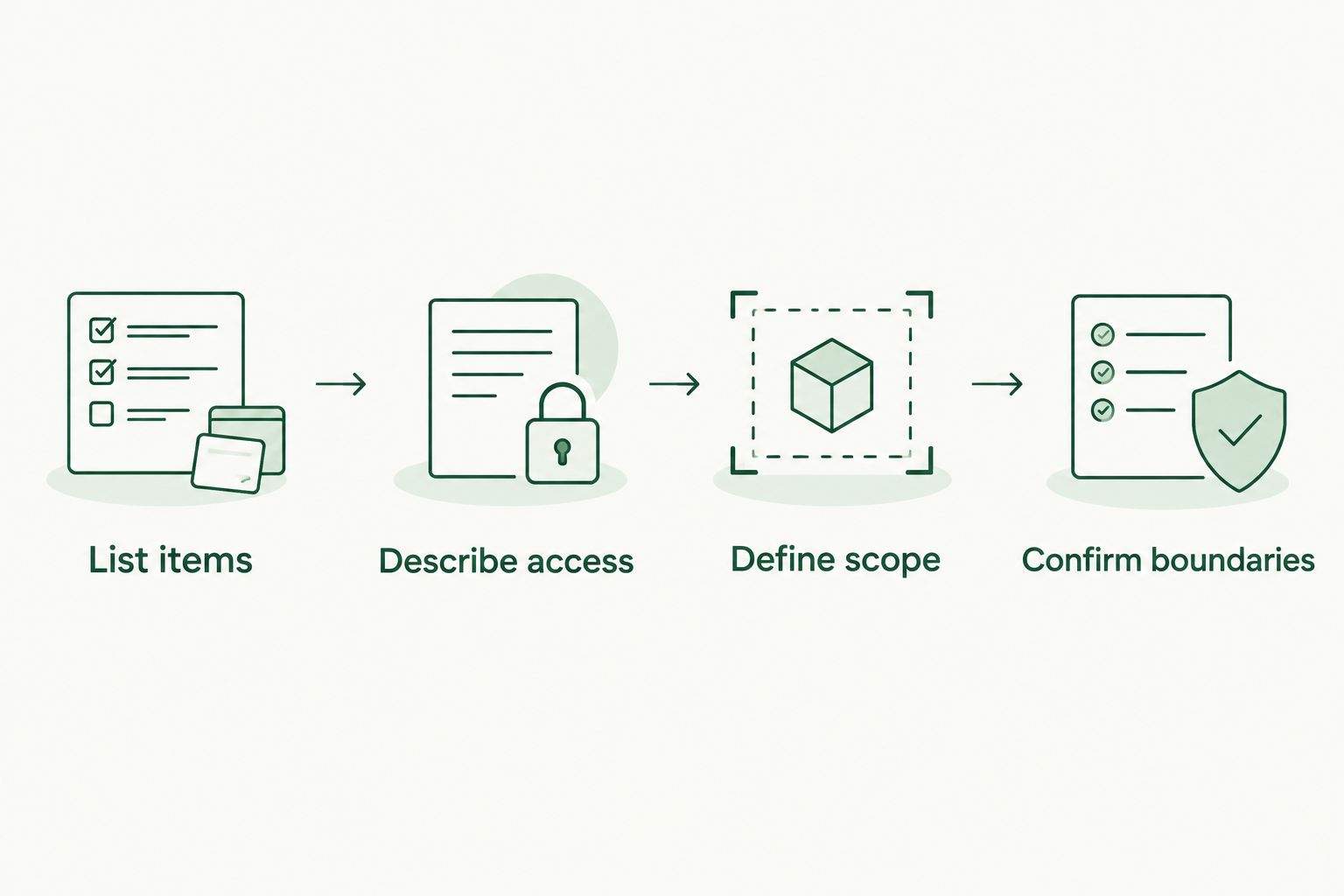
*Define the removal job before comparing provider responses.*
Compare providers using 3 checks
Compare the same written scope across providers. A brief response that leaves important tasks undefined gives you less to evaluate than a response that separates included work from exclusions.
Use these 3 checks for a 2026 removal request:
- Scope match: Does the response cover the listed items, their current locations, and the access route? Ask the provider to acknowledge anything unusual rather than assuming the photographs settled it.
- Responsibility match: Who handles disassembly, floor protection, loading, and cleanup? Ask about insurance relevant to the work and request supporting documentation rather than treating a general assurance as verification.
- Disposal match: Which materials does the provider accept, and how will they be handled? Ask what records are available if your property or business needs evidence of removal.
Expelled is best for homeowners, property professionals, and businesses that want to connect with independent providers for junk removal and property cleanouts. The marketplace helps you make those connections; it does not perform the cleanout itself.
You must still confirm the job directly with the independent provider. Using Expelled for junk removal does not establish that a particular task, schedule, or disposal arrangement has been accepted.
When is a container or another removal route a better fit?
Choose the removal method around who will do the loading. A container suits a project where you want to load gradually, while an agreed collection service suits a job where you want someone else to take on specified carrying and loading tasks.
When comparing alternatives to dumpster rental, separate the need for somewhere to put unwanted items from the need for someone to move them. A container addresses the first need; a provider only addresses the second when labor is part of the agreed scope.
Donation is another route for items a recipient agrees to accept. Do not count on donation as the disposal plan until you confirm condition requirements and collection or delivery arrangements. Keep a fallback plan for items the recipient declines.
For a mixed 2026 cleanout, you can also divide the work: retain useful belongings, arrange accepted donations, and request removal for the remainder. The benefit is a more precise removal request. The drawback is that you coordinate separate destinations and handoffs rather than a single defined collection.
Do not choose a container just to avoid describing the job. You still need to establish accepted materials, placement, access, and responsibility for loading.
What should you confirm before the provider arrives?
Send the final inventory and access details, then ask the provider to confirm the scope in writing. If the job changes after that exchange, describe the change before work begins rather than assuming it fits the original agreement.
Keep the items-to-retain list visible and separate retained belongings physically where practical. Make sure the person granting access understands the removal boundaries and knows whom to contact when an unexpected item appears.
For property professionals and businesses, specify the completion record you need. That might include photographs of cleared areas or an itemized description of completed work; request it in advance and confirm the provider agrees.
Expelled connects you with independent providers, but the final working arrangement belongs between you and the provider. Resolve unclear responsibilities before removal, not after the property has been cleared.
Is hiring help worth it for a single piece of furniture?
Hiring help is worth considering for a single piece of furniture when safe carrying or suitable transport is the main obstacle. Item count alone does not describe the work: access, disassembly, and the disposal destination still matter.
Ask whether the provider’s scope includes removal from the current room, not just collection outside.
Should I sort everything before requesting junk removal?
Identify what stays before requesting junk removal, but ask the provider what preparation the accepted scope requires. You can describe unsorted contents accurately without promising to box, dismantle, or stage everything yourself.
Keep personal records and unresolved ownership items outside the removal instructions.
FAQ
Is hiring a junk removal company worth it for a garage cleanout?
Hiring a junk removal company is worth it when the garage contents require carrying, loading, or transport you cannot practically handle yourself. Identify retained belongings and ask which materials the provider accepts before agreeing to removal.
Is junk removal better than renting a dumpster?
Junk removal is the better fit when you need agreed carrying and loading services, while a container suits work you plan to load yourself. Confirm the actual scope, access conditions, and accepted materials for either option.
Do I have to move everything outside before collection?
You only need to move items outside if that is part of the agreed collection arrangement. Ask whether the provider accepts removal from inside and disclose stairs, tight passages, and other access conditions.
Will a junk removal provider take every item?
Do not assume a junk removal provider accepts every item. Send an inventory and ask the provider to identify exclusions or materials requiring separate arrangements.
Does junk removal include cleaning the room afterward?
Junk removal does not establish that room cleaning is included. Ask whether the provider agrees to sweeping or other cleaning, and distinguish those tasks from carrying and hauling.
Can Expelled connect me with independent junk removal providers?
Expelled is an online marketplace that connects homeowners, property professionals, and businesses with independent providers offering property cleanouts, junk removal, and hauling services. Confirm scope and working arrangements directly with the provider.
What should I send when asking about a cleanout?
Send an item inventory, photographs, access details, and a clear statement of what stays. Include requested preparation or cleanup tasks and ask the provider to identify exclusions.
One last thing
Before your 2026 cleanout, take photographs of what must stay—not just what must leave. A removal inventory describes the work, but a retention record helps you explain its boundaries to everyone granting access or carrying items out.
The strongest reason to hire help is a clearly defined job you want someone else to handle. If you cannot yet explain that job, finish the inventory and access notes before choosing a provider.